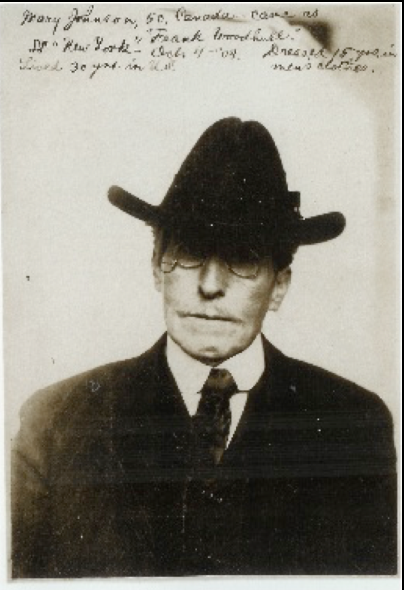
 Frank Woodhull (1858-1938), born Mary Johnson in Toronto, Canada in 1858, lived a remarkable life that bridged the experiences of nineteenth-century gender non-conformity
and early twentieth-century transgender and queer history. Growing up in Canada, Johnson experienced the profound disruption of her father's death when she was twenty
years old, which forced her to navigate life independently and eventually led her to migrate to the United States. During her early years living as a woman in America,
Johnson faced intense social alienation and cruelty. Her physical appearance—including a deep voice and facial hair that caused her to look both male and female—subjected
her to relentless teasing and embarrassment. She later reflected on this period as one of the darkest times of her life, noting that her masculine features made navigating
society as a woman nearly impossible.
Frank Woodhull (1858-1938), born Mary Johnson in Toronto, Canada in 1858, lived a remarkable life that bridged the experiences of nineteenth-century gender non-conformity
and early twentieth-century transgender and queer history. Growing up in Canada, Johnson experienced the profound disruption of her father's death when she was twenty
years old, which forced her to navigate life independently and eventually led her to migrate to the United States. During her early years living as a woman in America,
Johnson faced intense social alienation and cruelty. Her physical appearance—including a deep voice and facial hair that caused her to look both male and female—subjected
her to relentless teasing and embarrassment. She later reflected on this period as one of the darkest times of her life, noting that her masculine features made navigating
society as a woman nearly impossible.
Around the age of thirty-five, facing mounting distress and inspired by the stories of other women who adopted male attire to secure better social and economic
opportunities, Johnson made the pivotal decision to transition to living as a man. Adopting the name Frank Woodhull, she purchased men's clothing and experienced an
immediate and dramatic improvement in her quality of life, noting that living as a man made everything vastly easier. As Woodhull, he built a stable life, achieved
financial independence, and eventually saved enough money to take a trip to England to visit his family's ancestral homeland.
Woodhull’s life entered the historical record on October 5, 1908, when he returned from Europe and arrived at Ellis Island. During the immigration inspection, officials
discovered his female anatomy, leading to his detention and evaluation by the Board of Special Inquiry. The authorities scrutinized his cross-dressing and the
falsification of his sex and name on the ship’s manifest. However, the Board ultimately made a pragmatic and progressive decision: because Woodhull was self-sufficient,
gainfully employed, and not "liable to become a public charge," he posed no economic threat to the state. Immigration officials permitted Woodhull to leave Ellis Island
still wearing his men's suit, granting him entry into the United States. Following this high-profile incident, Woodhull settled in New Orleans, Louisiana, where he lived
and worked for the next three decades before passing away in America.
Frank Woodhull’s life stands as a crucial chapter in the history of gender variance, transgender history, and queer studies. Long before modern terminology like
"transgender" or "non-binary" existed, Woodhull utilized self-determination to align his external presentation with his internal reality, illustrating how nineteenth- and
early twentieth-century individuals navigated gender expression.
Woodhull’s transition highlights a common survival strategy for gender-nonconforming individuals and passing women of the era. By adopting male attire, Woodhull escaped
the systemic poverty and social policing faced by visibly masculine women, gaining access to labor, mobility, and respect denied to women at the time.
Woodhull's interrogation at Ellis Island is frequently studied by historians of sexuality and law because it showcases an early instance where institutional authorities
evaluated gender transgression through an economic rather than a purely moral lens. By focusing on whether Woodhull would become a public charge rather than penalizing him
for violating cross-dressing norms, the Board of Special Inquiry inadvertently created a space for his legal entry.
Because Woodhull's case was heavily reported by contemporary newspapers, it provides modern researchers with rare, firsthand accounts and quotes from a
gender-nonconforming individual of the era. Woodhull's own words articulate a profound dysphoria associated with forced womanhood and a deep sense of liberation found in
manhood, offering an invaluable historical voice to the lineage of transgender history.
References:
Other references:
- https://sites.google.com/a/ps334school.org/frank/home/about-me
- Passenger Manifest and Ellis Island Records: SS New York Passenger List (Arrived October 4, 1908; Port of Departure: Southampton, England). The original handwritten logs show "Frank Woodhull" crossed out and corrected/annotated to "Mary Johnson".
- Ellis Island "Record of Aliens Held for Special Inquiry" files documenting the October 1908 detention, medical examination, and Board of Special Inquiry ruling.
- The New York Times: "SHE POSED AS MAN FOR FIFTEEN YEARS; 'Frank Woodhull,' Passenger on the New York, Was in Fact Mary Johnson" (Published October 5, 1908).
- New York Daily Tribune: "Lived 15 years as a man: woman wore disguise until halted at Ellis Island" (Published October 5, 1908, featuring an iconic photograph taken by the port authorities/press).
- Rand, Erica. The Ellis Island Snow Globe. Durham: Duke University Press, 2005.
Support this project
This website is a passion project researched, developed, and funded entirely by me. If you find the content valuable and would like to help support the ongoing research and hosting costs, any contribution is deeply appreciated.
Thank you for keeping this independent resource alive!
My books on Amazon: Elisa Rolle's books
BACK TO HOME PAGE
