Queer Places:
Kilkea House, Kilkea Upper, Castledermot, Co. Kildare R14 XY81, Ireland
Dulwich College, Dulwich Common, London SE21 7LD, United Kingdom
St Faiths House, 2 St Richard's Walk, Chichester PO19 1QB, United Kingdom
Portfield Cemetery, Church Rd, Chichester PO19 7HN, United Kingdom
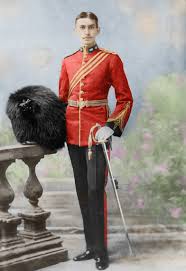 Francis Richard Shackleton, known as Frank (September 19, 1876 - June 24, 1941), was born on September 19, 1876, at Kilkea House in County Kildare,
Ireland, as the second son of Henry Shackleton and Henrietta Gavan, and the younger brother of the famed Antarctic explorer Sir
Ernest Shackleton. Following his family’s move to England, he attended Dulwich College from 1891 to 1893. He subsequently entered military service,
volunteering during the Second Boer War, where he was commissioned as a lieutenant in the Royal Irish Fusiliers before being invalided home in 1901.
Francis Richard Shackleton, known as Frank (September 19, 1876 - June 24, 1941), was born on September 19, 1876, at Kilkea House in County Kildare,
Ireland, as the second son of Henry Shackleton and Henrietta Gavan, and the younger brother of the famed Antarctic explorer Sir
Ernest Shackleton. Following his family’s move to England, he attended Dulwich College from 1891 to 1893. He subsequently entered military service,
volunteering during the Second Boer War, where he was commissioned as a lieutenant in the Royal Irish Fusiliers before being invalided home in 1901.
In 1899, Shackleton was appointed assistant secretary at the Office of Arms in Dublin Castle. Dapper, charismatic, and ambitious, he moved smoothly
within aristocratic social circles, establishing friendships with figures such as the Duke of Argyll and Lord
Ronald Sutherland-Gower. Through these connections, he was appointed Dublin Herald of Arms in September 1905 by
Sir Arthur Vicars, the Ulster King of Arms. The two men shared a residence at Clonskeagh, and Shackleton
became deeply embedded in the social and operational life of Dublin Castle.
Shackleton was a prominent figure within the discreet homosexual social networks operating in late Victorian and Edwardian society. In an era when
homosexual acts were strictly criminalized under British law, Dublin Castle hosted a covert gay subculture involving several high-profile officials and
aristocrats. Shackleton’s connections stretched from local castle heralds to elite figures in London, acting as a social conduit within these private
circles.
In July 1907, the insignia of the Order of St. Patrick, popularly known as the Irish Crown Jewels, were discovered missing from a safe in the Bedford
Tower of Dublin Castle. Because there was no sign of forced entry, suspicion centered on an inside job, and Shackleton’s heavy debts to moneylenders made
him a primary suspect. Sir Arthur Vicars publicly accused Shackleton of stealing the keys to make impressions. However, official inquiries were abruptly
stymied, and no formal charges were ever brought. Historians and commentators have suggested that the investigation was deliberately suppressed by the
Crown to prevent a public trial from exposing the broader homosexual subculture and potential scandals involving prominent figures tied to the Royal
Household. Vicars was removed from his position as a scapegoat, while Shackleton resigned his position as Dublin Herald in November 1907.
Following the scandal, Shackleton engaged in speculative business schemes that eventually crumbled. He was declared bankrupt in 1910 with enormous
debts and fled to Portuguese West Africa. In 1912, he was arrested for fraud regarding the conversion of funds from a wealthy acquaintance, Miss Mary
Browne, as well as financial mistreatment of Lord Ronald Sutherland-Gower. Extradited to London, Shackleton was tried at the Old Bailey in October 1913,
convicted of fraudulent conversion, and sentenced to fifteen months of hard labor.
Upon his release from prison, Shackleton adopted the pseudonym "Frank Mellor" to escape public notoriety. His brother Ernest helped him secure quiet
employment in a London office. By the 1930s, he had settled in Chichester, Sussex, where he operated an antique shop and worked as a genealogist
alongside his unmarried sister, Amy Vibert Shackleton. Frank Shackleton died at St. Richard's Hospital in Chichester on June 24, 1941, and was buried in
Chichester Cemetery under the name Mellor.
References:
- Cafferky, John, and Kevin Hannafin. Scandal & Betrayal: Shackleton and the Irish Crown Jewels. Cork: The Collins Press, 2002.
- Dungan, Myles. The Stealing of the Irish Crown Jewels: An Unsolved Crime. Dublin: Town House, 2003.
- Bankes, Viola, and Francis Bamford. Vicious Circle: The Case of the Missing Irish Crown Jewels. London: Max Parrish and Co., 1965.
- Jordaan, Peter. A Secret Between Gentlemen (Vol. 1 & 2). Sydney: Alchemie Books, 2023.
- Galloway, Peter. The Most Illustrious Order: The Order of Saint Patrick and its Knights. London: Unicorn Press, 1999.
- Hood, Susan. Royal Roots, Republican Inheritance: The Survival of the Office of Arms. Dublin: Woodfield Press, 2002.
- Viceregal Commission (1908). Report and Appendix of the Commission to Investigate the Circumstances of the Loss of the Regalia of the Order of Saint Patrick. Command Papers Cd. 3906 & Cd. 3936. HMSO.
- Central Criminal Court Records (Old Bailey, 1913). Trial transcripts regarding the prosecution and conviction of Francis Shackleton for fraudulent conversion.
- O'Riordan, Tomás. "The Theft of the Irish Crown Jewels, 1907." History Ireland, Vol. 9, No. 4 (Winter 2001).
- National Archives of Ireland. The Theft of the Irish 'Crown Jewels' (Exhibition and historical summary).
Support this project
This website is a passion project researched, developed, and funded entirely by me. If you find the content valuable and would like to help support the ongoing research and hosting costs, any contribution is deeply appreciated.
Thank you for keeping this independent resource alive!
My books on Amazon: Elisa Rolle's books
BACK TO HOME PAGE