Queer Places:
Cimitero Evangelico degli Allori, Via Senese, 184, 50124 Firenze FI
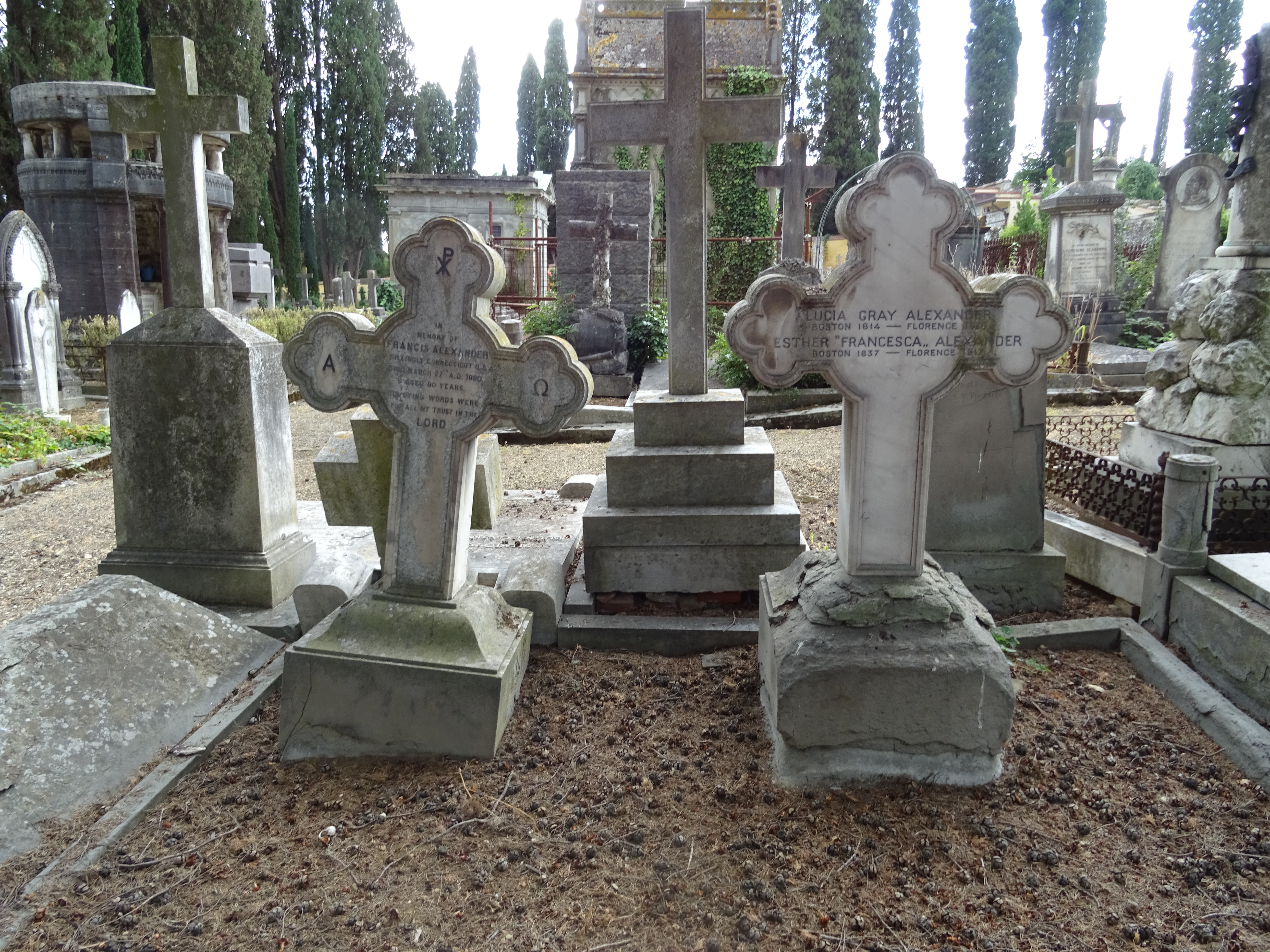 Francesca Alexander (February 27, 1837 - January 21, 1917), originally known as Esther Frances Alexander and often called Fanny or Fany, was born in Boston on February 27,
1837, to Francis Alexander, a famous American portrait painter, and Lucia Gray Swett, a wealthy heiress. Growing up in an elite, progressive Boston circle, she was
encouraged from an early age to pursue art by her father, learning to draw anything and everything in sight—from literary sources and nature to architecture and portraits of
those around her—despite never receiving formal instruction. In 1853, when Esther Frances was sixteen years old, the family moved to Florence, Italy, to experience life in
the city of the Medici, ultimately establishing permanent residence there and never returning to live in the United States.
Francesca Alexander (February 27, 1837 - January 21, 1917), originally known as Esther Frances Alexander and often called Fanny or Fany, was born in Boston on February 27,
1837, to Francis Alexander, a famous American portrait painter, and Lucia Gray Swett, a wealthy heiress. Growing up in an elite, progressive Boston circle, she was
encouraged from an early age to pursue art by her father, learning to draw anything and everything in sight—from literary sources and nature to architecture and portraits of
those around her—despite never receiving formal instruction. In 1853, when Esther Frances was sixteen years old, the family moved to Florence, Italy, to experience life in
the city of the Medici, ultimately establishing permanent residence there and never returning to live in the United States.
The Alexanders lived a life of privilege as prominent members of Florence's vibrant Anglo-American community, residing in locations such as the hilltop enclave of
Bellosguardo and welcoming travelers, intellectuals, and friends like the Gardners, Longfellows, and Lowells to their home for gatherings or to model for Francesca's
artwork. Alongside her portraits of Anglo-American visitors and local figures, Alexander developed a deep affinity for the Tuscan countryside, spending summers in Abetone on
the Pistoian Mountains where she immersed herself in the traditions, stories, and folk songs of peasants, shepherds, and charcoal burners. She formed particularly close
bonds with local women like Beatrice Bugelli of Pian degli Ontani, meticulously recording their songs with
original lyrics and English translations alongside detailed pen-and-ink illustrations of local laborers and regional saints, such as her famous depiction of Santa Zita.
Deeply compassionate and philanthropic, Alexander dedicated much of her time, energy, and the proceeds from her art to operating food kitchens and providing financial
assistance to the sick, poor, and working-class Italians she befriended. Wealthy patrons frequently overpaid for her intricate illustrations and handmade manuscripts as a
way to contribute to her charitable causes. In 1882, her life and career shifted when she met the influential British writer and art critic John Ruskin, who became a
lifelong friend and champion of her work. Ruskin was captivated by her manuscripts, acquiring works like The Story of Ida and Roadside Songs of Tuscany, though his heavy
editorial revisions and initial business handling caused friction before her mother intervened to safeguard her artistic materials. Ruskin successfully published several
volumes in the UK and US, including The Story of Ida (1883), Roadside Songs of Tuscany (1884), and Christ's Folk in the Apennines (1888), which brought Alexander
international acclaim, followed by her independently published works Tuscan Songs (1897) and The Hidden Servants (1900).
Alexander maintained significant social and literary connections within the Anglo-American expatriate network, sharing mutual circles with the pioneering author
Violet Paget, who wrote under the pseudonym Vernon Lee. Lee was well acquainted with Alexander's work, referencing the story of Saint
Zita from Roadside Songs of Tuscany in her 1887 correspondence and drawing direct inspiration from it for her 1905 book Sister Benvenuta. Furthermore, Alexander deeply
praised Lee for her outspoken efforts and civic activism aimed at halting the destructive modernization and urban demolition of historic Florence. After living in Florence
for over six decades, Alexander spent her final years facing failing health and blindness, passing away on January 21, 1917, at the age of eighty. She is buried in the
Cimitero degli Allori in Florence alongside her mother, leaving behind a legacy as a celebrated artist, author, translator, and devoted philanthropist whose works were
largely rediscovered by Italian audiences only in recent years.
References:
- The Story of Ida: Epitaph of an Etruscan Tomb (1883) — Edited and published with an introduction by John Ruskin.
- Roadside Songs of Tuscany (1884) — Translated, illustrated, and compiled by Francesca Alexander, edited by John Ruskin.
- Christ's Folk in the Apennine (1888) — Edited by John Ruskin.
- Tuscan Songs (1897) — Self-published collection of traditional Tuscan folk songs and illustrations.
- The Hidden Servants and Other Very Old Stories Told Over (1900) — Published collection of narrative poetry and traditional folklore.
- Isabella Stewart Gardner Museum (Boston): Holds major artworks by Alexander, including her large-scale painting Decorating a Shrine (1865), alongside first-edition presentation copies of her books and correspondence.
- Wellesley College Special Collections: Houses personal sketches, papers, and family documents related to Francesca and her parents.
- Boston Public Library (Fine Arts Department): Preserves additional unpublished manuscript material and artwork.
- UK Institutions (Ashmolean Museum, Sheffield Museums, and Victoria and Albert Museum): Hold pen-and-ink illustrations, drawings, and manuscript folios related to Roadside Songs of Tuscany.
- Musacchio, Jacqueline Marie. The Art and Life of Francesca Alexander: 1837–1917. Lund Humphries, 2025. (The definitive, exhaustively researched modern monograph detailing her life in Boston and Florence, her art, and her philanthropy).
Support this project
This website is a passion project researched, developed, and funded entirely by me. If you find the content valuable and would like to help support the ongoing research and hosting costs, any contribution is deeply appreciated.
Thank you for keeping this independent resource alive!
My books on Amazon: Elisa Rolle's books
BACK TO HOME PAGE