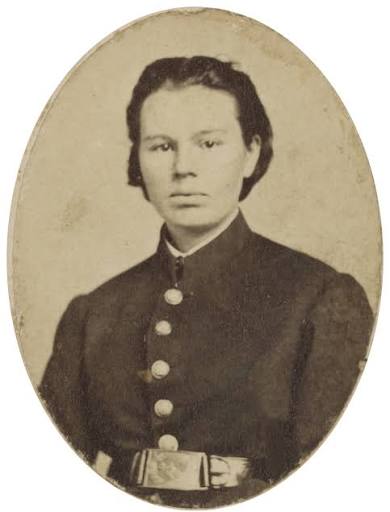
 Frances Hook (1847 – March 17, 1908) was one of an estimated 400 to 1,000 women who covertly cross-dressed and assumed male identities to fight in the American Civil War.
Frances Hook (1847 – March 17, 1908) was one of an estimated 400 to 1,000 women who covertly cross-dressed and assumed male identities to fight in the American Civil War.
Born in Illinois, Hook was orphaned at the age of three and raised by her older brother. When the Civil War broke out in 1861, her brother decided to enlist in Chicago. Unwilling to be left behind without family, the 14-year-old Hook cut her hair, claimed she was 22, and successfully enlisted alongside him in the 11th Illinois Infantry under the alias Private Frank Miller. They served out a 90-day enlistment together without her gender being discovered.
Hook’s military trajectory is defined by a fierce determination to stay in the ranks, requiring her to adapt new male personas whenever her biological sex was discovered:
Re-enlisting for a three-year term, Hook and her brother fought at Fort Henry, Fort Donelson, and Shiloh. Her brother was killed at Shiloh. Devastated, she could no longer bear staying in the same regiment and assumed a second identity—Frank Henderson—joining the 33rd Illinois Infantry.
Wounded in the shoulder at the Battle of Fredericktown, Missouri, a military surgeon discovered her sex during treatment. She was promptly discharged and ordered to go home.
Having no home or family to return to, Hook adopted yet another alias (Frank Martin or Frank Fuller) and joined the 90th Illinois Infantry. With this regiment, she saw extensive combat at the Siege of Vicksburg, Jackson, and Missionary Ridge.
In late 1863, while foraging in Florence, Alabama, Hook was captured by Confederate forces and sent to a military prison in Atlanta. During a daring escape attempt, she was shot in the thigh. While treating her wound, prison doctors realized she was a woman. Because of her unique situation, Confederate authorities placed her on a prisoner exchange list. On February 17, 1864, she was exchanged at Graysville, Georgia, and sent to a Union hospital in Nashville, Tennessee to recover.
After her recovery, she was discharged and returned to civilian life. She eventually married and had a daughter. Frances Hook passed away on March 17, 1908.
While Frances Hook lived in an era before modern terminology like "transgender," "genderqueer," or "lesbian" existed, her narrative is deeply integrated into modern LGBTQ+ historical frameworks and gender studies.
Historians and queer theorists frequently analyze Civil War soldiers like Frances Hook, Albert Cashier (born Jennie Hodgers), and Sarah Emma Edmonds. While many women enlisted purely for economic survival, patriotism, or to stay close to male loved ones, Hook's persistent re-enlistment under entirely new male personas—even after her brother's death and being explicitly ordered to return to domestic womanhood—suggests a comfort in, or necessity for, a masculine social role. Scholars study these accounts to map the long history of cross-dressing, gender transgression, and lived trans-masculine experiences.
During her recovery at the Chattanooga military hospital, Hook's case caught the attention of Dr. Mary Edwards Walker, the contract surgeon for the Union Army and a passionate advocate for women's dress reform. Walker actively alerted the press to Hook’s bravery, using her story to challenge strict Victorian concepts of rigid gender divisions.
When looking at Civil War figures through an LGBTQ+ lens, historians draw a distinction between:
Adapting a male identity as a temporary vessel to achieve specific goals forbidden to women (combat, equal pay, independence).
Individuals like Albert Cashier, who continued to live completely as a man for fifty years after the war ended.
Frances Hook falls into an intriguing space. She returned to a traditional female presentation after the war, yet her stubborn, multi-year refusal to occupy the Victorian female sphere during the war remains a cornerstone study in non-traditional gender expression.
References:
Support this project
This website is a passion project researched, developed, and funded entirely by me. If you find the content valuable and would like to help support the ongoing research and hosting costs, any contribution is deeply appreciated.
Thank you for keeping this independent resource alive!
My books on Amazon: Elisa Rolle's books