Queer Places:
Whittingehame Churchyard, Whittingehame Estate, Haddington EH41 4QA, United Kingdom
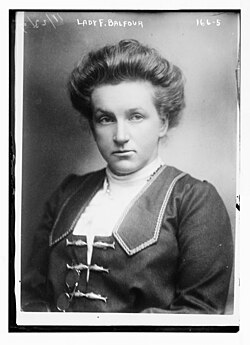 Lady Frances Balfour (born Frances Campbell, February 22, 1858 - February 25, 1931) was a prominent British aristocrat, biographer, writer, and one of the most high-ranking
figures to assume a leadership role in the British constitutional women's suffrage movement.
Born at Argyll Lodge, Frances was the tenth child of George Campbell, the 8th Duke of Argyll, a major Scottish peer and Liberal politician, and Lady Elizabeth
Sutherland-Leveson-Gower. From early childhood, she suffered from a severe hip-joint disease that caused chronic pain and forced her to walk with a permanent limp. Despite
these physical challenges, she grew up in a politically active, deeply religious household dedicated to various social reform movements. As a young girl, she participated in
these causes, such as knitting garments for the children of emancipated slaves.
In May 1879, she married Colonel Eustace James Anthony Balfour, an architect and brother to Arthur Balfour (who would later
serve as Conservative Prime Minister), as well as a nephew of Lord Salisbury. Her marriage bridged two powerful political dynasties, though it created immediate ideological
friction. While her husband's family was staunchly Conservative, Frances remained a fierce, lifelong Liberal and a devoted follower of Prime Minister William Ewart
Gladstone. Because of these sharp political differences and personal strains, the couple gradually drifted apart, spending less time together over the years prior to
Eustace's death in 1911. Together, they had five children: Blanche, Alison, Francis, Joan, and Oswald.
Lady Frances entered the public sphere of the women's rights movement in the late 1880s, quickly establishing herself as a formidable intellectual and political force.
Possessing a razor-sharp wit and an intimidating platform presence, she became known as a "mistress of invective" in the defense of female enfranchisement. In 1887, she
helped establish the Liberal Women's Suffrage Society. By 1889, she was acting as the primary liaison between constitutional suffragists and Parliament.
When the National Union of Women's Suffrage Societies (NUWSS) was officially structured in 1897 under the presidency of
Millicent Garrett Fawcett, Lady Frances became a core member of its executive committee, serving continuously until
1919. She also held the presidency of the London Society for Women's Suffrage from 1896 to 1919. As a committed "constitutionalist," she firmly believed in peaceful
lobbying, legal reform, and public demonstration, fiercely opposing the militant, direct-action tactics deployed later by
Emmeline Pankhurst’s Women's Social and Political Union (WSPU). Among her most notable demonstrations was leading the famous
"Mud March" alongside Fawcett on February 9, 1907.
Beyond the vote, her reform efforts spanned wide-ranging social issues. From 1910 to 1912, she served as one of only two women appointed to the Royal Commission on
Divorce and Matrimonial Causes, advocating for fairer legal grounds for women seeking separation. She was also heavily involved with the Lyceum Club (serving as president
from 1903 to 1915) to assist professional women, edited the equality-focused magazine Women and Progress alongside Nora Vynne, and served as president of the National
Council of Women from 1921 to 1923. A deeply pious Presbyterian, she championed the role of women within the Church of Scotland, serving as president of the Scottish
Churches League for Women's Suffrage. She chronicled much of her life and political philosophy in her 1930 memoir, Ne Obliviscaris (Dinna Forget).
In recognition of her monumental contributions to securing women's rights, Lady Frances Balfour’s name and likeness—alongside those of 58 other prominent women and men
suffrage supporters—were permanently etched onto the bronze plinth of Gillian Wearing’s famous statue of Millicent Fawcett. Unveiled in Parliament Square, London, in 2018,
this landmark monument marked the very first sculpture of a woman—and the first created by a female artist—to occupy Parliament Square.
While Lady Frances Balfour lived a conventional heterosexual life by the standards of her era—marrying a man and raising five children—her historical footprint intersects
with LGBTQ history in a few notable ways. Most directly, her inclusion on the plinth of the Parliament Square Millicent Fawcett monument places her shoulder-to-shoulder with
numerous pioneering figures of the broader first-wave feminist and suffrage movements, several of whom (such as fellow plinth honorees
Eva Gore-Booth, Chrystal Macmillan, and author/activist
Laurence Housman) were openly or actively part of historical queer circles, gender-nonconforming networks, or
same-sex partnerships. Furthermore, modern historical retrospectives regarding "Queer Women of the Suffrage Movement" frequently contextualize figures like Balfour,
examining how elite Victorian and Edwardian women navigated homosocial bonds, professional spaces independent of traditional male domination (such as her leadership in the
professional women's Lyceum Club), and radical revisions of gender roles that ultimately paved the way for modern understandings of gender and sexuality.
References:
- Balfour, Frances. Ne Obliviscaris: Dinna Forget. 2 vols. London: Hodder and Stoughton, 1930. (Her primary two-volume autobiography detailing her life, social circles, and decades of political work).
- Balfour, Frances. Lady Victoria Campbell: A Memoir. London: Hodder and Stoughton, 1911.
- Balfour, Frances. Life and Letters of the Reverend James MacGregor. London: Hodder and Stoughton, 1912.
- Balfour, Frances. Dr. Elsie Inglis. London: Hodder and Stoughton, 1920.
- Balfour, Frances. The Life of George, Fourth Earl of Aberdeen. 2 vols. London: Hodder and Stoughton, 1923.
- Balfour, Frances. A Memoir of Lord Balfour of Burleigh, KT. London: Hodder and Stoughton, 1924.
- Women and Progress. Co-edited by Frances Balfour and Nora Vynne. (An early 20th-century reformist magazine dedicated to equal rights, legal reform, and women's professional advancement).
- National Review periodical. Published regular political commentary and essays authored by Frances Balfour under the pseudonym "Grille".
- The Balfour Papers / Argyll Munitions: Correspondence, personal papers, and family archives housed primarily within the National Archives of Scotland (Edinburgh) and relevant estate collections detailing the Duke of Argyll's family records.
- The Fawcett Library / The Women's Library (held at the London School of Economics - LSE Library): Contains organizational records, executive committee minutes, correspondence, and pamphlets from the National Union of Women's Suffrage Societies (NUWSS) and the London Society for Women's Suffrage documenting her decades-long leadership tenure (1896–1919).
- The Travellers' Aid Society Collection: In Memoriam the Lady Frances Balfour, 1881–1931. A compiled volume of contemporary newspaper cuttings, obituaries, and memorial tributes assembled following her death in 1931.
- Huffman, Joan B. "Balfour, Lady Frances (1858–1931)." Oxford Dictionary of National Biography. Oxford University Press, 2004 (online edition, May 2006).
- Crawford, Elizabeth. The Women's Suffrage Movement: A Reference Guide, 1866–1928. London: UCL Press, 1999. (Contains detailed biographical entries on Balfour and her institutional connections within constitutional suffrage networks).
- Leneman, Leah. A Guid Cause: The Women's Suffrage Movement in Scotland. Aberdeen University Press, 1991.
- Pedersen, Susan. Family, Dependence, and the Origins of the Welfare State: Britain and France, 1914–1945. Cambridge University Press, 1993. (Examines her social policy outlook, royal commission involvement, and establishment viewpoints).
- Oldfield, Sybil. Spinsters of This Parish: The Life and Times of F.M. Mayor and Mary Sheepshanks. London: Virago, 1984.
Support this project
This website is a passion project researched, developed, and funded entirely by me. If you find the content valuable and would like to help support the ongoing research and hosting costs, any contribution is deeply appreciated.
Thank you for keeping this independent resource alive!
My books on Amazon: Elisa Rolle's books
BACK TO HOME PAGE