Queer Places:
Cimetière de Grèzes par Carcassonne, 4 Allée Des Pins, 11000 Carcassonne, France
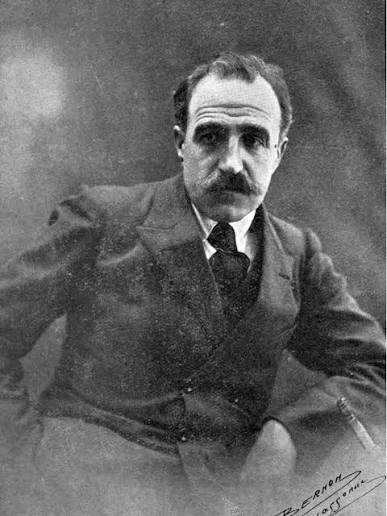 François-Paul Alibert (March 16, 1873 - June 23, 1953) was born in Carcassonne on March 16, 1873, and spent his entire life in his native city, where he
worked as an office clerk at the town hall while cultivating deep ties with Parisian literary circles. Associated with the neoclassical poetry revival at
the dawn of the twentieth century, he aligned himself with the Roman School and Jean Moréas. Throughout his life, he contributed to Jean Rivain and
Eugène Marsan’s Revue critique des idées et des livres and published around forty poetry collections characterized by a classical style that bridged the
traditions of Jean Moréas and Paul Valéry. His poetic works earned praise from figures like Jean Paulhan and Henri Clouard, the latter of whom noted that
Alibert’s verse celebrated eternal themes of love and death through a pagan lens that refused to mutilate the unity of soul and body. Beyond poetry,
Alibert engaged in notable travels, including a 1907 automobile journey through the Gers and Landes with
André Gide and Eugène Rouart, and a 1913 trip to Italy with Gide and
Henri Ghéon, the latter of which he chronicled in a published journal. In 1928, alongside friends Joë Bousquet,
Ferdinand Alquié, Claude-Louis Estève, and René Nelli, he co-founded the review Chantiers, and he also served as director of the Théâtre antique de
Carcassonne, where he staged adaptations of Euripides and his own play Nausicaa. He passed away in Carcassonne on June 23, 1953, and was buried in the
city's Grèzes-Herminis cemetery, which subsequently named a street in his honor.
François-Paul Alibert (March 16, 1873 - June 23, 1953) was born in Carcassonne on March 16, 1873, and spent his entire life in his native city, where he
worked as an office clerk at the town hall while cultivating deep ties with Parisian literary circles. Associated with the neoclassical poetry revival at
the dawn of the twentieth century, he aligned himself with the Roman School and Jean Moréas. Throughout his life, he contributed to Jean Rivain and
Eugène Marsan’s Revue critique des idées et des livres and published around forty poetry collections characterized by a classical style that bridged the
traditions of Jean Moréas and Paul Valéry. His poetic works earned praise from figures like Jean Paulhan and Henri Clouard, the latter of whom noted that
Alibert’s verse celebrated eternal themes of love and death through a pagan lens that refused to mutilate the unity of soul and body. Beyond poetry,
Alibert engaged in notable travels, including a 1907 automobile journey through the Gers and Landes with
André Gide and Eugène Rouart, and a 1913 trip to Italy with Gide and
Henri Ghéon, the latter of which he chronicled in a published journal. In 1928, alongside friends Joë Bousquet,
Ferdinand Alquié, Claude-Louis Estève, and René Nelli, he co-founded the review Chantiers, and he also served as director of the Théâtre antique de
Carcassonne, where he staged adaptations of Euripides and his own play Nausicaa. He passed away in Carcassonne on June 23, 1953, and was buried in the
city's Grèzes-Herminis cemetery, which subsequently named a street in his honor.
A close friend and correspondent of André Gide, Alibert moved within elite literary networks that navigated same-sex desire during an era of strict
social conservatism. His most explicit contributions to queer literature are his anonymous, clandestinely published erotic novels focusing on male
homosexuality. His first novel, Le Supplice d'une queue, was published secretly in 1931 by the erotic publisher René Bonnel after being transmitted
through Roland Saucier at the instigation of André Gide, and it featured a frontispice by Catalan artist Pere Créixams. Reissued in 1991 with a preface
by Hugo Marsan—who highlighted the novel's bold assertion that happiness through sexual ecstasy is possible between two men—the work portrays the
passionate and fulfilling relationship between two characters named Albert and Armand. Literary critics such as Annie Le Brun have celebrated the book as
a major novel of desire and "courtly love" embodying an uncompromising expression of passionate longing, while noting its additional theme of paternal
initiation. Alibert's other queer literary works include a second clandestine homosexual novel, Le Fils de Loth, published in 2002 with a preface by
Didier Eribon, and a third text titled Une Couronne de pines, whose initial print run was destroyed by the police shortly after its 1931 creation,
leaving only a single surviving set of proofs.
References:
Other references:
- André Gide & François-Paul Alibert, Correspondance : 1907-1950, published in 1982.
- François-Paul Alibert, En Italie avec André Gide : impressions d'Italie, 1913, documenting the 1913 voyage through Italy with André Gide, Henri Ghéon, and Eugène Rouart, published in 1983.
- François-Paul Alibert, Le Supplice d'une queue (published anonymously and clandestinely by René Bonnel in 1931; reissued with a preface by Hugo Marsan, Paris: Ramsay / Jean-Jacques Pauvert, 1991).
- François-Paul Alibert, Le Fils de Loth (published in 2002 with a preface by Didier Eribon).
- François-Paul Alibert, Une Couronne de pines (printed clandestinely shortly after 1931).
- Didier Eribon, Preface to Le Fils de Loth (2002).
- Annie Le Brun, "De la noblesse d'amour" in La Quinzaine littéraire no. 824 (2002), collected in Ailleurs et autrement (Paris: Gallimard, coll. "Arcades", 2011).
- Hugo Marsan, "Le Jeu de l'amour et de la nécessité", Preface to Le Supplice d'une queue (Paris: Ramsay / Jean-Jacques Pauvert, 1991).
- Jean-Jacques Pauvert, Notice on Le Supplice d'une queue in Anthologie historique des lectures érotiques, t. III (Paris: Stock / Spengler, 1995).
- Pascal Pia, Les Livres de l'Enfer. Du XVIe siècle à nos jours (Paris: Fayard, 1998).
- Emmanuel Pierrat, Le Bonheur de vivre en enfer (Paris: Maren Sell Éditeurs, 2004).
- Martial Andrieu, "François-Paul Alibert (1873-1953), poète et auteur dramatique" on Musique et patrimoine de Carcassonne (2013).
- Claude Marquié, "François-Paul Alibert : ce poète méconnu" and articles on the Théâtre antique de Carcassonne in La Dépêche du Midi (2008–2009).
- Léon Riba, Carcassonne, ses places et ses rues (Carcassonne: Imprimerie Bonnafous et fils, 1953).
Support this project
This website is a passion project researched, developed, and funded entirely by me. If you find the content valuable and would like to help support the ongoing research and hosting costs, any contribution is deeply appreciated.
Thank you for keeping this independent resource alive!
My books on Amazon: Elisa Rolle's books
BACK TO HOME PAGE
