Queer Places:
Woodlawn Cemetery, Bronx, Bronx County, New York, USA
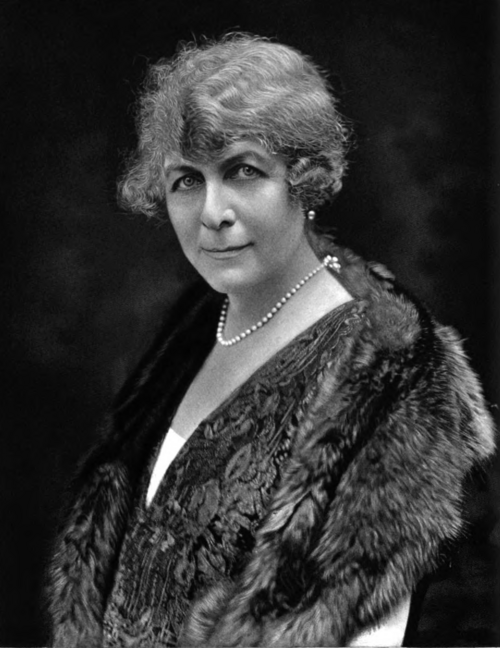 Florence Jaffray "Daisy" Harriman (July 21, 1870 - August 31, 1967), born Florence Jaffray Hurst on July 21, 1870, in New York City, lived a remarkably
long and consequential life as an American socialite, suffragist, social reformer, organizer, and diplomat, passing away on August 31, 1967, at the age
of 97. Orphaned of her mother at a young age, she was raised by her father and maternal grandparents, growing up in an elite environment where she was
exposed to political figures early on. In 1889, she married wealthy New York banker J. Borden Harriman, with whom she had one daughter, Ethel. Though
initially leading the traditional life of a wealthy society matron, Harriman quickly pivoted toward civic engagement, labor reform, and women's rights.
In 1903, she co-founded the Colony Club, New York City's first exclusive social club for women, alongside a prominent circle of progressive, wealthy
women that included Alva Belmont, Elisabeth "Bessy" Marbury,
Elsie de Wolfe, and Anne Morgan—figures whose tight-knit social
networks and professional partnerships reflected the vibrant lesbian and queer women's subculture of the era's elite artistic and reform movements.
Florence Jaffray "Daisy" Harriman (July 21, 1870 - August 31, 1967), born Florence Jaffray Hurst on July 21, 1870, in New York City, lived a remarkably
long and consequential life as an American socialite, suffragist, social reformer, organizer, and diplomat, passing away on August 31, 1967, at the age
of 97. Orphaned of her mother at a young age, she was raised by her father and maternal grandparents, growing up in an elite environment where she was
exposed to political figures early on. In 1889, she married wealthy New York banker J. Borden Harriman, with whom she had one daughter, Ethel. Though
initially leading the traditional life of a wealthy society matron, Harriman quickly pivoted toward civic engagement, labor reform, and women's rights.
In 1903, she co-founded the Colony Club, New York City's first exclusive social club for women, alongside a prominent circle of progressive, wealthy
women that included Alva Belmont, Elisabeth "Bessy" Marbury,
Elsie de Wolfe, and Anne Morgan—figures whose tight-knit social
networks and professional partnerships reflected the vibrant lesbian and queer women's subculture of the era's elite artistic and reform movements.
Harriman's career as a reformer expanded significantly as she championed child labor laws, tenement improvements, and safe milk distribution for the
poor, earning praise from figures like Franklin D. Roosevelt. She became a leading voice in the women's suffrage movement, organizing and leading parades
down Fifth Avenue. Her political influence deepened during the 1912 presidential election when she actively campaigned for Woodrow Wilson, who
subsequently appointed her to the groundbreaking U.S. Commission on Industrial Relations. Following the sudden death of her husband in 1914 and the
depletion of her personal fortune, Harriman sustained her public service through organizing, writing, and leadership. She co-founded the Woman's National
Democratic Club in 1922, served for decades on the Democratic National Committee, and hosted legendary Sunday night salons in Washington, D.C., that
brought together diverse political minds.
Her diplomatic career reached its zenith in 1937 when President Franklin D. Roosevelt appointed her as the U.S. Minister to Norway, making her one of
the nation's early female diplomats. When Nazi Germany invaded Norway in 1940, Harriman displayed immense courage by assisting in the perilous evacuation
of the Norwegian royal family and American citizens, an experience she chronicled in her book Mission to the North and for which she received Norway's
prestigious Grand Cross of the Order of St. Olav. In her later years, she remained a fierce advocate for civic causes, famously protesting D.C. taxation
without representation in a parade at age 84 and finally casting her first presidential vote at age 94 following the passage of the Twenty-third
Amendment. Honored by President John F. Kennedy in 1963 with the inaugural Citation of Merit for
Distinguished Service, Daisy Harriman spent over nine decades at the center of American history, remembered as a fearless pioneer who bridged elite
society and radical social reform.
References:
- Harriman, Florence Jaffray Hurst. Examples of Welfare Work in the Cotton Industry: Conditions and Progress: New England and the South. New York: Woman's Dept., National Civic Federation, 1910.
- Harriman, Mrs. J. Borden. From Pinafores to Politics. New York: H. Holt and Company, 1923. (Her autobiographical account detailing her early life, social networks, and entry into political and women's suffrage activism).
- Harriman, Florence Jaffray. Mission to the North. Philadelphia: J.B. Lippincott, 1941. (Her firsthand memoir detailing her tenure as U.S. Minister to Norway and her harrowing escape during the 1940 Nazi invasion).
- Harriman, Florence Jaffray Hurst. Norway Does Not Yield; The Story of the First Year. New York: American Friends of German Freedom, 1941.
- Zarembina, Natalia, and Florence Jaffray Hurst Harriman (Foreword). Oswiecim, Camp of Death (Underground Report). New York: "Poland fights," Polish Labor Group, 1944. (One of the earliest English-language publications detailing the Auschwitz concentration camp).
- Harriman, Florence Jaffray Hurst. The Reminiscences of Mrs. Florence Jaffray Harriman. Oral History Research Office, Columbia University, 1972.
- Florence Jaffray Hurst Harriman Papers (1857–1982). Manuscript Division, Library of Congress, Washington, D.C. (Contains roughly 10,000 items, including personal and diplomatic correspondence from her time in Oslo, subject files, speeches, and scrapbooks documenting her 1912 campaign work for Woodrow Wilson).
- Franklin D. Roosevelt Presidential Library and Museum, Hyde Park, New York. (Contains official diplomatic correspondence, President's Secretary's File, and communications regarding her reporting on the invasion of Norway and refugee relief).
- Nash, Penny. Breaking Protocol: America's First Female Ambassadors, 1933–1964. Lexington: University Press of Kentucky, 2020. (Features detailed analysis of Harriman's diplomatic career and her post in Norway).
- Leavitt, Judith A. American Women Managers and Administrators: A Selective Biographical Dictionary of Twentieth-Century Leaders in Business, Education, and Government. Westport: Greenwood Press, 1985. (Includes a biographical profile covering her administrative roles on the New York State Reformatory board and federal committees).
- Trager, James. Park Avenue: Street of Dreams. New York: Atheneum, 1990. (Provides context on her elite New York upbringing and socialite background).
- The New York Times. "Mrs. J. Borden Harriman, Ex-Envoy, Dies at 97." September 1, 1967. (Comprehensive obituary detailing her life, career, and public honors).
- Time Magazine. "New Harriman Deal." January 22, 1934; and "To Oslo." May 10, 1937. (Periodical coverage of her Washington D.C. salons and appointment as Minister to Norway).
- The American Presidency Project. Remarks Upon Presenting a Presidential Citation of Merit to Mrs. Florence Harriman. April 19, 1963. (Transcript of President John F. Kennedy honoring Harriman at the White House).
Support this project
This website is a passion project researched, developed, and funded entirely by me. If you find the content valuable and would like to help support the ongoing research and hosting costs, any contribution is deeply appreciated.
Thank you for keeping this independent resource alive!
My books on Amazon: Elisa Rolle's books
BACK TO HOME PAGE