Partner Judith Hastings
Queer Places:
Crowborough Cemetery, Crowborough TN6 1TD, United Kingdom
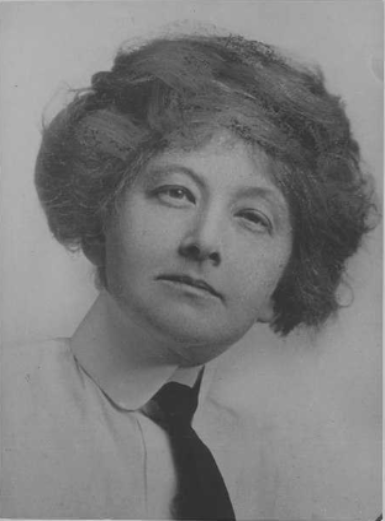 Florence Emily Carlyle (September 24, 1864 – May 2, 1923) was born on September 24, 1864, in Galt, Canada West (now Ontario), to Emily Youmans Carlyle and
William Carlyle. She was the second eldest of seven children and was affectionately known as "Bird" by her family and friends. Her great-uncle was the
Scottish historian and philosopher Thomas Carlyle. In 1871, the family moved to Woodstock, Ontario, where her father worked as the county inspector of
schools for Oxford County. Recognizing her early artistic talent, her mother established an art studio for local children and arranged for Florence to take
private drawing and painting lessons with William Lees Judson starting around 1874.
Florence Emily Carlyle (September 24, 1864 – May 2, 1923) was born on September 24, 1864, in Galt, Canada West (now Ontario), to Emily Youmans Carlyle and
William Carlyle. She was the second eldest of seven children and was affectionately known as "Bird" by her family and friends. Her great-uncle was the
Scottish historian and philosopher Thomas Carlyle. In 1871, the family moved to Woodstock, Ontario, where her father worked as the county inspector of
schools for Oxford County. Recognizing her early artistic talent, her mother established an art studio for local children and arranged for Florence to take
private drawing and painting lessons with William Lees Judson starting around 1874.
Carlyle quickly demonstrated her skill, participating in local art fairs and exhibiting her work at the Toronto Industrial Exhibition by 1883. At this
exhibition, Princess Louise purchased one of her paintings of water lilies, bringing her widespread public recognition. Following this success, she
obtained her Teacher's Certificate from the Ministry of Education in 1885 and traveled across Ontario teaching art. Seeking further artistic development
abroad, Carlyle moved to Paris, France, on November 3, 1890, accompanied by her artistic mentor Paul Peel, his sister Margaret, and their father John Peel.
In Paris, she studied under prominent instructors such as Tony Robert-Fleury, Jules Lefebvre, and Adolphe-William Bouguereau, and spent two summers
painting at Barbizon.
Returning to Canada in May 1896, Carlyle established studios in London and Woodstock, Ontario, and later in New York City. In 1897, she made history by
becoming one of the first women elected as an Associate of the Royal Canadian Academy, an honor she received again in 1912. Working predominantly in an
impressionist style, her art centered on domestic, feminine spaces and the intimate lives of contemporary women, earning her a reputation as a
representative of the late 19th-century "New Woman" feminist movement. She received numerous prestigious accolades, including an Honourable Mention at the
Pan-American Exhibition in Buffalo in 1901, the Ontario Society of Artists' Prize in 1902, and a silver medal for her oil painting The Tiff at the 1904
St. Louis World's Fair.
In 1911, Carlyle met Judith Hastings, who would become her lifelong partner and muse. The two women left Canada in 1913 for Italy, spending time in
Venice where Carlyle painted the canals and captured their relationship in works like The Guest, Venice and her bridal portrait of Hastings, The Threshold.
Eventually, the couple settled at "Sweet Haws," an English cottage in Crowborough, Sussex, England. During World War I, Carlyle contributed to the war
effort by working in hospitals, serving in the Women's Land Army, and selling paintings to benefit the Red Cross. In 1918, she was commissioned by the
Canadian War Memorials Fund to paint a portrait of Lady Julia Drummond.
As her later years progressed, limited art supplies and failing eyesight restricted her painting, leading her to focus on smaller still lifes, flower
paintings, and short stories. Carlyle died in her sleep from stomach cancer on May 2, 1923, at her cottage in Crowborough, and was laid to rest in
Crowborough Cemetery. Her legacy as a trailblazing Canadian figure and portrait painter is preserved through collections in major institutions such as the
National Gallery of Canada, the Art Gallery of Ontario, and the Woodstock Art Gallery, which holds the largest collection of her works.
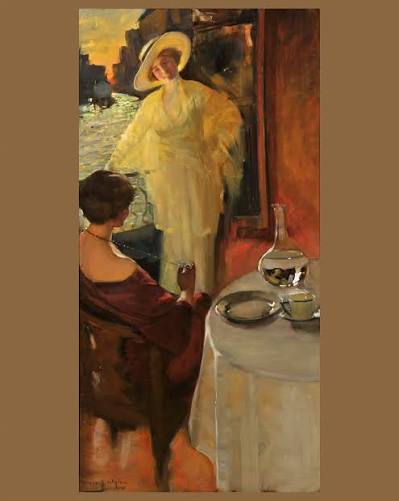
The Guest, Venice
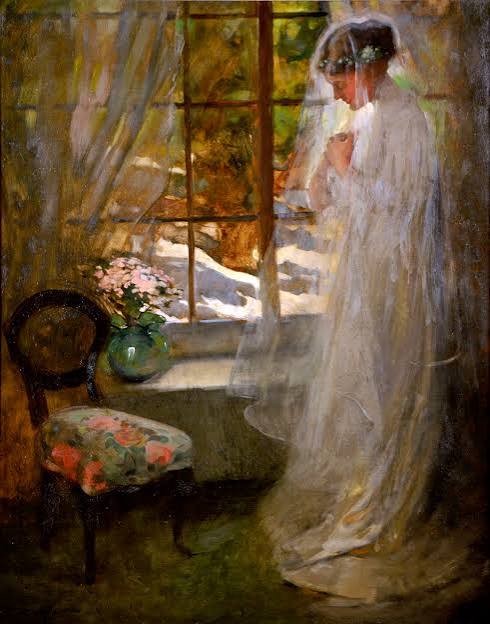
The Threshold
References:
- Butlin, Susan. The Practice of Her Profession: Florence Carlyle, Canadian Painter in the Age of Impressionism. Kingston, ON: McGill-Queen's University Press, 2009.
- Murray, Joan. Florence Carlyle: Against All Odds. London and Woodstock: Museum London and the Woodstock Art Gallery, 2004.
- Boutilier, Alicia, and Tobi Bruce, eds. The Artist Herself: Self-Portraits by Canadian Historical Artists. Kingston and Hamilton: Agnes Etherington Art Centre / Art Gallery of Hamilton, 2015.
- Farr, Dorothy, and Natalie Luckyj. From Women's Eyes: Women Painters in Canada. Kingston: Agnes Etherington Art Centre, 1975.
- Woodstock Art Gallery (Woodstock, Ontario): Holds the largest permanent collection of Carlyle's works (over 50 pieces) alongside personal papers and archival records.
- Oxford County Archives: Maintains research materials, correspondence, and historical blog documentation detailing her life and relationship with Juliet Hastings.
- National Gallery of Canada (Ottawa): Houses key representative paintings by Carlyle in its permanent collection.
- Art Gallery of Ontario (Toronto): Holds major works including The Tiff.
- Carlyle, Florence. "Student Life in Paris." Sentinel-Review (Woodstock), February 10, 1936.
- Contemporary exhibition reviews and notices from The Globe, The Daily Mail, The Montreal Gazette, and the Sentinel-Review.
Support this project
This website is a passion project researched, developed, and funded entirely by me. If you find the content valuable and would like to help support the ongoing research and hosting costs, any contribution is deeply appreciated.
Thank you for keeping this independent resource alive!
My books on Amazon: Elisa Rolle's books
BACK TO HOME PAGE