Queer Places:
Académie Julian, Passage des Panoramas, 75002 Paris
Glendalough House, Drummin, Annamoe, Co. Wicklow, A98 V1D6 Ireland
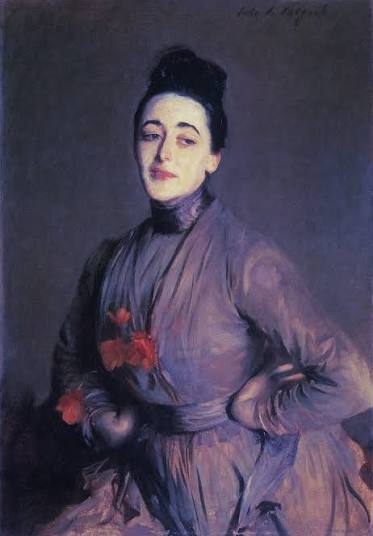 Flora Priestley (January 20, 1859 - 1944) was an Anglo-Italian painter, artist's model, and prominent figure within late-nineteenth and early-twentieth-century artistic
circles, best known as a lifelong friend, muse, and favorite model of the famous expatriate portraitist
John Singer Sargent.
Flora Priestley (January 20, 1859 - 1944) was an Anglo-Italian painter, artist's model, and prominent figure within late-nineteenth and early-twentieth-century artistic
circles, best known as a lifelong friend, muse, and favorite model of the famous expatriate portraitist
John Singer Sargent.
Born in Florence, Italy, on January 20, 1859, to English parents, she was the daughter of Augusta Le Poer Trench and the Reverend William Henry Priestley, who served as
the Chaplain of the English Church in Nice, France. Because of her father's posting, she likely met John Singer Sargent during their shared childhoods on the French Riviera,
though some art historians suggest they alternatively crossed paths as young art students in Paris around 1882.
As a woman in the late 19th century, Priestley was barred from enrolling in the prestigious École des Beaux-Arts in Paris, but she overcame this barrier by training at
the more progressive Académie Julian and maintaining her own studio in the city. She was deeply embedded in the European avant-garde art scene, befriending luminaries such
as Paul Cézanne, who once famously gifted her a small still-life painting during a studio visit. Never marrying, she lived an autonomous life dedicated to art and her chosen
community. Her cosmopolitan lifestyle and striking aesthetic—characterized by a pale complexion, intense dark hair, sharp profile, and a love for dramatic costumes—made her
a favorite sitter and muse for Sargent. He immortalized her likeness in at least four major works, including Miss Priestley (c. 1889), which resides in the permanent
collection at Tate Britain, and Flora Priestley (Lamplight Study) (c. 1889), a masterclass in dramatic, warm lighting effects.
Priestley's deep ties extended to the broader queer and literary networks of the era, anchoring her firmly within an avant-garde bohemian community. She was a close
companion to Sargent's sister, Emily Sargent, and the pioneering author Violet Paget, who wrote under the male pseudonym
Vernon Lee. Lee, a central figure in European aestheticism and queer literary history, held Priestley in high enough esteem to
dedicate her celebrated 1890 supernatural-story collection, Hauntings, to her. Her biographical background paints a clear picture of her cosmopolitan life and artistic legacy.
Following her death in 1944, Priestley left her personal art collection—which included works such as John Singer Sargent's painting River Bank, near Oxford (given to her
directly by the artist)—to the Irish politician Robert Childers Barton of Glendalough House in County Wicklow, Ireland.
References:
- Richard Ormond and Elaine Kilmurray, John Singer Sargent: The Later Portraits (Vol. III), Yale University Press / Paul Mellon Centre for Studies in British Art (detailing biographical context, childhood on the Riviera, and provenance records tracking works through Emily Sargent, Flora Priestley, and Violet Sargent/Mrs. Francis Ormond).
- Tate Britain, Permanent Collection and Exhibition Archives (documentation for Miss Priestley, c. 1889, presented by Miss Emily Sargent in memory of her brother through the Art Fund, 1929).
- Sotheby’s Fine Art Catalogues, American Art auction archives (provenance notes detailing Flora Priestley's ownership, her 1936 collection holdings, and relationship history documented via Ormond family traditions and art historian evaluations by Mount, Ormond, and Kilmurray).
- Vernon Lee (Violet Paget), Hauntings: Fantastic Stories, Heinemann, 1890 (dedication text formally inscribing the collection to Flora Priestley).
- Fondazione Il Palmerino / Cultural Archives, biographical monographs and research notes on Flora Priestley's artistic circle, her studies at the Académie Julian, and her association with Paul Cézanne.
Support this project
This website is a passion project researched, developed, and funded entirely by me. If you find the content valuable and would like to help support the ongoing research and hosting costs, any contribution is deeply appreciated.
Thank you for keeping this independent resource alive!
My books on Amazon: Elisa Rolle's books
BACK TO HOME PAGE