Queer Places:
Cimetière Central Toulon, Pl. du Souvenir Français, 83000 Toulon, France
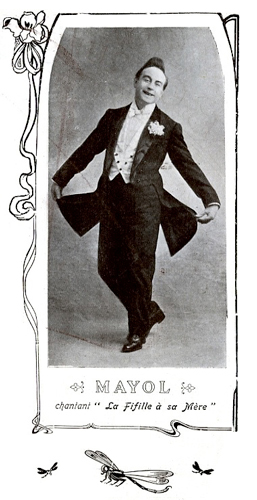 Félix Mayol (November 18, 1872 – October 26, 1941) was born on November 18, 1872, in Toulon, France, into a family steeped in the performing arts. His
father was a singer and actor, and his mother was a dancer, which immersed Mayol in the theater world from a young age. He began his career performing in
regional venues before moving to Paris in the mid-1890s, a crucial step that launched him into stardom during the golden age of the café-concert.
Renowned for his distinct physical presence—highlighted by his trademark shaved head, immaculate dandy style, and a sprig of white lily of the valley
worn in his lapel—he quickly became one of the most celebrated and highest-paid entertainers in France.
Félix Mayol (November 18, 1872 – October 26, 1941) was born on November 18, 1872, in Toulon, France, into a family steeped in the performing arts. His
father was a singer and actor, and his mother was a dancer, which immersed Mayol in the theater world from a young age. He began his career performing in
regional venues before moving to Paris in the mid-1890s, a crucial step that launched him into stardom during the golden age of the café-concert.
Renowned for his distinct physical presence—highlighted by his trademark shaved head, immaculate dandy style, and a sprig of white lily of the valley
worn in his lapel—he quickly became one of the most celebrated and highest-paid entertainers in France.
Mayol was famous for popularizing numerous timeless songs that defined an era, most notably "Viens Poupoule," which became an international sensation.
His stage persona combined sophisticated charm with infectious humor, captivating audiences across France and Belgium. Beyond his entertainment career,
Mayol maintained a deep and lifelong devotion to his hometown of Toulon. In 1920, he famously purchased land and donated it to build a stadium for the
local rugby union club, Sporting Club Toulonnais. To honor his immense generosity and civic pride, the stadium was named Stade Mayol, a title it proudly
retains to this day, ensuring his legacy is permanently etched into the cultural and sporting landscape of Toulon. As his performing days wound down with
the changing entertainment landscape of the 1930s, Mayol retired to the south of France, passing away on October 26, 1941, in Toulon.
Félix Mayol operated within the vibrant, bohemian subcultures of the Parisian fin de siècle entertainment world, an environment that often fostered
greater personal freedom than mainstream bourgeois society. Within historical and biographical compendiums documenting same-sex love and cultural
history—such as works exploring historical figures who lived outside traditional heteronormative structures—Mayol is frequently recognized as part of the
rich tapestry of gay and queer figures who shaped European arts and entertainment. While turn-of-the-century public figures rarely made explicit
contemporary declarations of their private lives due to the legal and social constraints of the era, historical research and queer historiography place
Mayol among the prominent bachelors and cultural icons of the Belle Époque whose personal lives and homosocial environments reflected the nuanced
realities of early gay history.
References:
Other references:
- Félix Mayol, Les Mémoires de Mayol (recorded and collected by Charles Cluny and Louis Querelle, published by Louis Querelle, Paris, 1929).
- Louis Querelle, Une heure de musique avec Mayol (Éditions Cosmopolites, 1930).
- Contemporary cultural analysis and archival mapping on platforms such as Proustonomics ("Félix Mayol ou le rendez-vous manqué" by Jean-Yves Patte, 2024), examining his intersecting social circles, Belle Époque identity, and proximity to figures like Marcel Proust and Reynaldo Hahn.
- Bibliothèque Nationale de France (BnF Data), covering the comprehensive catalog of his recordings, scores, graphic creations, and identity files (Ark ID: `ark:/12148/cb13897260x`).
- The Département du Var civil registries and genealogical records (hosted via Geneastar), documenting his birth on November 18, 1872, and death on October 26, 1941, in Toulon.
- Le Temps des Cerises aux Feuilles Mortes (comprehensive historical discography tracking his 78rpm recordings, cylinders, and collaborative sheet music with publishers such as Georges Ondet, Henri Christiné, and Pathé/Odéon/Gramophone).
- Historical documentation concerning the establishment of the Stade Mayol in Toulon, detailing his 1920 land purchase and donation to the Sporting Club Toulonnais.
Support this project
This website is a passion project researched, developed, and funded entirely by me. If you find the content valuable and would like to help support the ongoing research and hosting costs, any contribution is deeply appreciated.
Thank you for keeping this independent resource alive!
My books on Amazon: Elisa Rolle's books
BACK TO HOME PAGE
