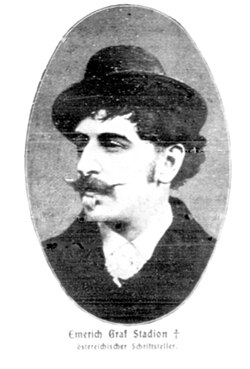
 Emerich von Stadion (born Emerich Simon Damian Joseph Graf von Stadion-Thannhausen; February 17, 1838 – August 3, 1901) was an Austrian writer, military officer, and
artist.
Emerich von Stadion (born Emerich Simon Damian Joseph Graf von Stadion-Thannhausen; February 17, 1838 – August 3, 1901) was an Austrian writer, military officer, and
artist.Partner Franz Keim
Queer Places:
Beltinci Castle, Ravenska cesta 8, 9231 Beltinci, Slovenia
Emerich von Stadion (born Emerich Simon Damian Joseph Graf von Stadion-Thannhausen; February 17, 1838 – August 3, 1901) was an Austrian writer, military officer, and
artist.
Emerich von Stadion was born at Belatincz Castle (in present-day Slovenia) to Damian Friedrich Joseph, a Lieutenant in the Imperial and Royal (k.u.k.) army, and Katharina (née Gyika de Dézsánfalva). He displayed artistic talent at an early age, composing music and writing his first theatrical work, Der Erdgeist, at age 11.
Despite his early artistic inclinations, he pursued a military career in his youth. He entered the infantry regiment IR 47 in 1856, later transferring to the Imperial Rifle Regiment (Kaiserjäger). He served with distinction during the Second Italian War of Independence, seeing action in the battles of Magenta and Solferino (1859), for which he received official commendation. In 1862, he retired from military service and moved to Graz to dedicate himself to literature and music.
Stadion is primarily remembered as a writer of the mid-to-late 19th century. His early work was heavily influenced by the circle surrounding Leopold von Sacher-Masoch. During his time in Graz, he formed a deep, lifelong friendship with the writer and artist Emile Mario Vacano, with whom he frequently collaborated on literary projects.
His first major theatrical success was the salon comedy Eine Ehe auf Pastell (1863), which premiered in Graz. Throughout his career, he maintained friendships with several notable cultural figures of his era, including Friedrich Halm, Marie von Ebner-Eschenbach (his circle included writers like Ada Christen), and Elise Polko.
Stadion’s personal life was marked by his marriage to the Russian countess Marie Madelaine von Gurjew in 1867; the couple separated shortly thereafter. Stadion subsequently moved to St. Pölten to join Vacano. Here he met the writer Franz Keim, from which a relationship developed that is documented in extensive correspondence.
From 1876 on, Stadion lived in Melk, Loosdorf, Znaim (Znojmo), Oberwaltersdorf, Perchtoldsdorf, and Hainfeld, until he finally moved to Vienna in 1900. With the death of his cousin, Karl Friedrich, Imperial Count of Stadion-Thannhausen, in 1898, Stadion came into possession of the entailment (Majorat) and large entailed estates in Bohemia, Bavaria, and Württemberg, but due to illness, he had to transfer the administration to his brother, Philipp, Imperial Count of Stadion-Thannhausen (1847–1908), who became the final holder of the entailment after S.'s death.
Emerich von Stadion passed away in 1901.
Stadion's dramas and his prose were already considered outdated during his lifetime. His strength lay in lyrical work, yet he was not destined for resounding success in that field either. After his death, his work soon fell completely into oblivion.
In modern scholarship, Stadion is often studied alongside Vacano and Sacher-Masoch for his contributions to the literary representation of non-normative relationships and identity in fin-de-siècle Austria. His short story "Leonor" (1868), which explores themes of gender performance and desire, has been republished in modern anthologies examining the history of same-sex love and desire in 19th-century European literature.
References:
Support this project
This website is a passion project researched, developed, and funded entirely by me. If you find the content valuable and would like to help support the ongoing research and hosting costs, any contribution is deeply appreciated.
Thank you for keeping this independent resource alive!
My books on Amazon: Elisa Rolle's books