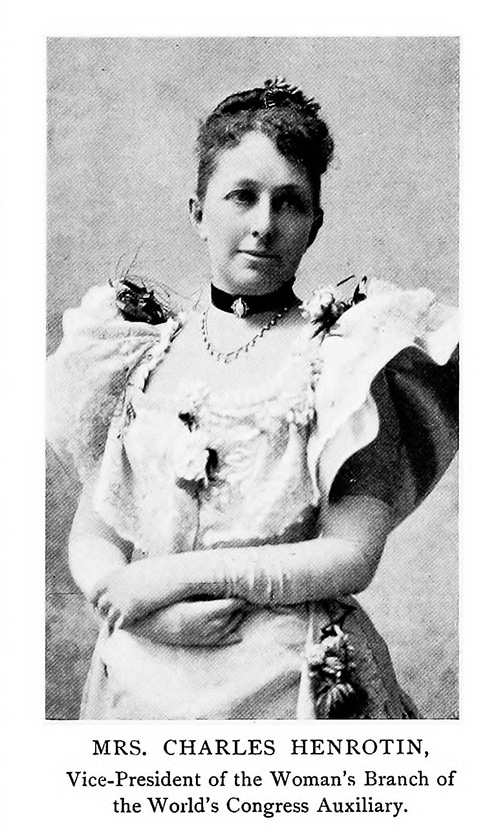
 Ellen Martin Henrotin (July 6, 1847 - June 29, 1922) was a prominent American social reformer, labor activist, and a leading figure in the women’s club movement during the
Progressive Era.
Ellen Martin Henrotin (July 6, 1847 - June 29, 1922) was a prominent American social reformer, labor activist, and a leading figure in the women’s club movement during the
Progressive Era.Queer Places:
Rosehill Cemetery, 5800 N Ravenswood Ave, Chicago, IL 60660
Ellen Martin Henrotin (July 6, 1847 - June 29, 1922) was a prominent American social reformer, labor activist, and a leading figure in the women’s club movement during the
Progressive Era.
Born on July 6, 1847, in Portland, Maine, Ellen was the second of six children born to Edward Byam and Sarah Ellen Martin. Her family was wealthy, which allowed her to live and study extensively abroad in England, France, and Germany between 1860 and 1868.
Upon her return to the United States, she moved to Chicago and married Charles Henrotin on September 2, 1869. Charles was a highly successful banker and one of the principal founders and presidents of the Chicago Stock Exchange. Together, they had three sons: Edward, Charles, and Morris.
As a wealthy society matron, Henrotin chose to channel her social standing and financial privilege into activism. She became an energetic force in several major movements:
Henrotin served as the Vice President of the Women's Branch of the World's Congress Auxiliary at the The World’s Columbian Exposition (1893). While Bertha Palmer managed the physical Woman's Building, Henrotin was the intellectual architect, organizing dozens of women’s congresses. She focused on progressive ideas, bringing in radical speakers like Susan B. Anthony and Fannie Barrier Williams to talk about suffrage and racial equality.
She served as the national president of the General Federation of Women's Clubs (GFWC) from 1894 to 1898. Under her leadership, the movement shifted from being mostly literary study groups into an educational and political powerhouse focused on public action, municipal reform, and labor rights.
Henrotin was deeply committed to the plight of working-class women. She worked closely with Jane Addams and Florence Kelley, fiercely advocating for shorter work hours and better conditions. In 1901, she famously attempted to unionize domestic workers ("servant girls") to improve their working conditions. She also served as an early president of the Illinois branch of the National Women's Trade Union League (WTUL).
She served on the Chicago Vice Commission and authored The Social Evil in Chicago (1911), a massive, highly successful report addressing the systemic issues behind sex work and calling for urban social reform.
For her international contributions to education and sociology, she was decorated by the Sultan of Turkey (1893), the French Republic (1899), and King Leopold II of Belgium (1904). She died in Cherry Plain, New York, on June 29, 1922.
When exploring Ellen Martin Henrotin’s connection to LGBTQ history, it is found primarily in her close proximity to networks of queer women, her mentorship, and the historical context of her activism, rather than explicit or documented self-identification.
Henrotin’s labor and club networks were heavily populated by, and often financially supported by, women living in what were then termed "Boston Marriages" (long-term, cohabitating romantic partnerships between two financially independent women). Organizations she ran or supported, like the Women's Trade Union League (WTUL) and Hull-House, were famous hubs for queer women leaders (such as Jane Addams and Mary Rozet Smith, or Margaret Dreier Robins and Mary Dreier) who formed the backbone of Progressive Era activism. Henrotin was an integral ally, leader, and funding node for these close-knit female networks.
As president of the GFWC and a leader in Chicago reform, Henrotin mentored a younger generation of women who openly or quietly subverted traditional heterosexual family structures to dedicate their lives to social work alongside female partners. Her work alongside public figures in the suffrage and labor movements meant she spent decades operating within a culture where romantic friendships and lifelong female partnerships were the normative structural framework for changing society.
While some modern queer theory and feminist scholarship read the intensely passionate, woman-centric spaces that Henrotin constructed (especially her 1893 World's Congress platform) as foundational to early queer/lesbian organizing and community-building, Henrotin herself remained married to her husband Charles until his death in 1914. Her legacy in LGBTQ history is less about her personal identity and more about how she used her enormous social and financial capital to build safe, powerful institutions where independent, queer, and reform-minded women could flourish and reshape American policy.
References:
Support this project
This website is a passion project researched, developed, and funded entirely by me. If you find the content valuable and would like to help support the ongoing research and hosting costs, any contribution is deeply appreciated.
Thank you for keeping this independent resource alive!
My books on Amazon: Elisa Rolle's books