Partner Mary Fredrika Perry
Queer Places:
University of Michigan, 500 S State St, Ann Arbor, MI 48109, United States
143 LaSalle St (now 211 S LaSalle St, Chicago, IL 60604, USA)
219 W Maple St, Lombard, IL 60148, USA
Lake View Cemetery, Lakeview Avenue, Jamestown, New York 14701 United States
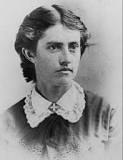 Ellen Annette Martin (January 16, 1847 - March 13, 1916) was a trailblazing American attorney, suffragist, and advocate for civic reform. Best remembered as the first
woman to cast a legal ballot in the state of Illinois, she was also a partner in what is widely considered the first female law firm in American history.
Ellen Annette Martin (January 16, 1847 - March 13, 1916) was a trailblazing American attorney, suffragist, and advocate for civic reform. Best remembered as the first
woman to cast a legal ballot in the state of Illinois, she was also a partner in what is widely considered the first female law firm in American history.
Born on January 16, 1847, in Kiantone, Chautauqua County, New York, Martin was raised by Abram Martin and Mary Eliza Burnham. She demonstrated an early brilliance and
desire for civic engagement, becoming the first female law student in Chautauqua County before enrolling at the University of Michigan Law School.
She graduated with her law degree in 1875. Moving to Illinois, she passed the state bar and was admitted in January 1876.
While in law school at Ann Arbor, Martin met Mary Fredrika Perry, a fellow law student who hailed from Coldwater,
Michigan. After graduation, the two women moved to Illinois and established their law firm—Perry & Martin, Attorneys and Counselors at Law—located on LaSalle Street in
Chicago.
Because women were barred from arguing cases directly in courtrooms as full electors, Perry and Martin focused their practice on office law, chancery, trusts, and
estate work. They frequently took on indigent women as clients pro bono, working to give women legal standing in a system designed to exclude them. The firm was notable
not only as a successful commercial entity, but also as a political hub; in 1880, Perry and Martin hosted delegates for the National Woman Suffrage Association (NWSA)
convention at their law offices.
After Mary Fredrika Perry’s unexpected death in 1883, Martin preserved her partner's memory by keeping the firm name Perry & Martin unchanged for the remainder of her
nearly 40-year career. By 1897, Martin was recognized as the woman who had practiced law the longest in the city of Chicago.
Martin resided in Lombard, Illinois, and commuted daily to her law firm in Chicago. On April 6, 1891, she staged a famous, meticulously calculated challenge to local
voting laws:
Studying the 1869 municipal charter for the Incorporated Town of Lombard, Martin noticed the text stated that "All citizens above the age of 21 years" who met residency
requirements were entitled to vote, without explicitly restricting the franchise to "males".
Armed with a heavy law book under one arm and a gripsack in the other, Martin entered the polling place inside a local general store and demanded a ballot as a
citizen.
The three male election judges were entirely unprepared. Historical accounts colorfully note that election judge Fred Marquardt had a "spasm," Ed Reber leaned stiff
against the wall, and T.H. Vance fell backward into an open flour barrel.
Unable to refute her legal standing under the charter, the judges yielded. Martin cast her vote, immediately followed by 14 prominent Lombard women whom she had
organized.
A county judge subsequently upheld the legitimacy of their ballots, making Ellen Martin the first woman to legally vote in the state of Illinois—nearly three decades
before the passage of the 19th Amendment. Although local male officials quickly closed the charter loophole shortly thereafter, the event galvanized the Illinois suffrage
movement, contributing to the state granting women partial suffrage in 1891 (for school board elections) and broader suffrage in 1913.
Martin remained deeply engaged in civic organizing throughout her life. She was a founding board member of the Chicago Political Equality League (alongside
Susan B. Anthony) and served as a legal expert and leader within the Chicago Woman's Club.
Martin retired from her legal practice in 1915. She died a year later, on March 13, 1916, at the age of 69 in Rochester, New York, and was buried in Jamestown,
New York.
As highlighted by historian Lillian Faderman in To Believe in Women: What Lesbians Have Done For America, the relationship
between Ellen Annette Martin and Mary Fredrika Perry represents a foundational example of 19th-century same-sex domestic partnerships among professional women.
In the late 19th century, financially independent, college-educated women who chose careers over traditional marriage frequently formed long-term, cohabitating domestic
partnerships. These arrangements provided personal support, mutual economic security, and freedom from the legal subordination that marriage imposed on women at the
time.
Perry and Martin shared both their professional life in Chicago and their home in Lombard, Illinois.
After Mary Fredrika Perry died in 1883, Ellen Martin never took on another business partner, nor did she ever marry. She kept the name Perry & Martin on her law firm's
door, stationery, and business cards for more than three decades until her retirement in 1915—a enduring tribute to both their joint legal legacy and their personal
bond.
References:
Other references:
- https://en.wikipedia.org/wiki/Ellen_A._Martin
- https://www.lombardhistory.org/blog/2024/10/26/ztmy6x43ixapyh79gbm1v4mye0wv08
- https://suffrage2020illinois.org/resources/featured-biographies/ellen-annette-martin/
Support this project
This website is a passion project researched, developed, and funded entirely by me. If you find the content valuable and would like to help support the ongoing research and hosting costs, any contribution is deeply appreciated.
Thank you for keeping this independent resource alive!
My books on Amazon: Elisa Rolle's books
BACK TO HOME PAGE
