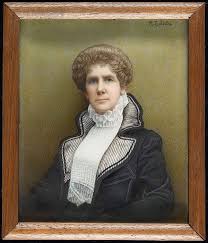
 Elizabeth Woodbridge Pearsall Phelps Resse (1838-1924) was an American philanthropist, composer, and social reformer born in 1838. Her early life and progressive worldview
were deeply shaped by her mother, Elizabeth B. Phelps, who was a prominent figure during the formative days of the American women's club movement. Displaying early
independent and feminist intentions, Elizabeth married her first husband, Robert W. Pearsall, during which period she established the first agricultural school for women in
Long Island. Following her first husband's passing, she relocated to Italy and married Count Pio Resse in 1877, subsequently splitting her time between Rome and Florence
while actively participating in international philanthropic and artistic circles. As a talented composer, she achieved success with musical works such as her composition
cycle Two Songs and maintained personal friendships with legendary figures of the era, including composer Franz Liszt.
Elizabeth Woodbridge Pearsall Phelps Resse (1838-1924) was an American philanthropist, composer, and social reformer born in 1838. Her early life and progressive worldview
were deeply shaped by her mother, Elizabeth B. Phelps, who was a prominent figure during the formative days of the American women's club movement. Displaying early
independent and feminist intentions, Elizabeth married her first husband, Robert W. Pearsall, during which period she established the first agricultural school for women in
Long Island. Following her first husband's passing, she relocated to Italy and married Count Pio Resse in 1877, subsequently splitting her time between Rome and Florence
while actively participating in international philanthropic and artistic circles. As a talented composer, she achieved success with musical works such as her composition
cycle Two Songs and maintained personal friendships with legendary figures of the era, including composer Franz Liszt.
The primary historical and LGBTQ-associated link connecting Elizabeth Phelps Resse to the celebrated queer author and intellectual
Vernon Lee centers around the historic Villa Il Palmerino in Florence. Count Pio Resse and Elizabeth Phelps Resse acquired the
property in the early 1880s and commissioned an extensive architectural restoration directed by the architect Corinto Corinti, celebrating its completion with a grand
inaugural event in February 1884. Although the couple owned multiple estates and did not permanently reside at Il Palmerino, they pivotalized its modern history by leasing
the villa beginning in 1889 to Vernon Lee, her mother, and her half-brother Eugene Lee-Hamilton.
This rental agreement established a vital geographic and cultural anchor for Vernon Lee, who lived openly as a lesbian and maintained long-term romantic relationships
with women within expatriate intellectual circles. Il Palmerino became Lee's permanent sanctuary and intellectual salon in Tuscany—a place where she regularly hosted
legendary literary figures, artists, and fellow members of the turn-of-the-century queer and aesthetic diaspora, such as Henry James,
Edith Wharton, and Oscar Wilde. Though the Resse family eventually parted with the estate
through intermediate owners before Lee formally purchased it in 1906, Elizabeth Phelps Resse's role as landlord facilitated the creation of what became one of the most
important lesbian literary and cultural hubs in modern European history. Elizabeth Phelps Resse passed away in 1924, leaving behind comprehensive personal papers that
document her remarkable transnational life, musical philosophies, and philanthropic legacies.
References:
- Cultural Association "Il Palmerino" Archives and Research
- University of Minnesota Libraries – Elizabeth Woodbridge Phelps Pearsall Resse Papers (1880–1924)
- Smith College Special Collections (Sophia Smith Collection of Women's History)
- Brentwood History Wiki – "The Pearsalls"
Support this project
This website is a passion project researched, developed, and funded entirely by me. If you find the content valuable and would like to help support the ongoing research and hosting costs, any contribution is deeply appreciated.
Thank you for keeping this independent resource alive!
My books on Amazon: Elisa Rolle's books
BACK TO HOME PAGE