Partner Alice Griffith
Queer Places:
Hill Farm, 3125 Sir Francis Drake Blvd, Fairfax, CA 94930
Cypress Lawn Memorial Park, 1701 Hillside Blvd, Colma, CA 94014, United States
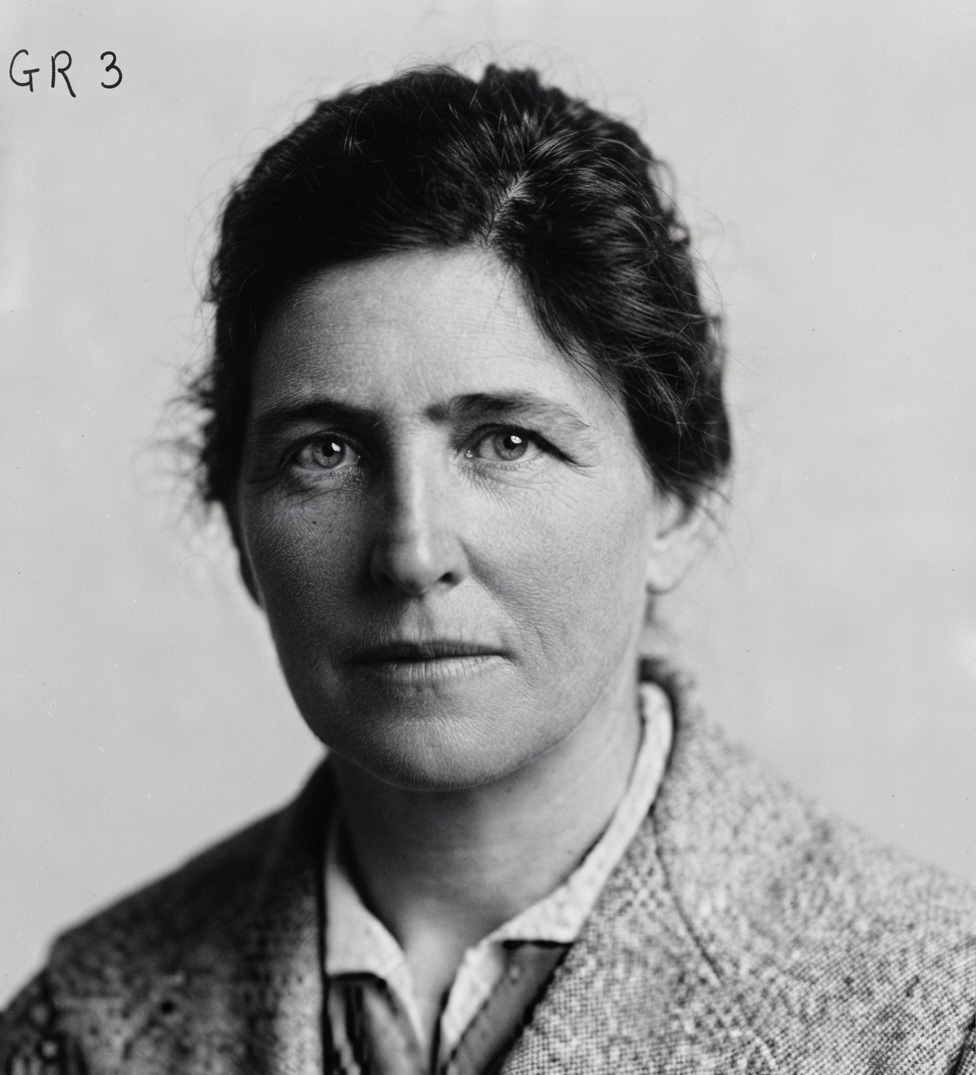 Elizabeth Haywood Ashe (June 16, 1869 – January 25, 1954) was a pioneering American nurse, public health advocate, and community organizer whose
remarkable life of service spanned disaster relief, landmark social welfare institutions, and wartime heroism.
Elizabeth Haywood Ashe (June 16, 1869 – January 25, 1954) was a pioneering American nurse, public health advocate, and community organizer whose
remarkable life of service spanned disaster relief, landmark social welfare institutions, and wartime heroism.
Born in California into a lineage characterized by historic bravery, her grandfather was North Carolina Governor Samuel Ashe—who served as a
lieutenant in the American Revolution and for whom Asheville is named—and her uncle was Civil War Admiral David Farragut, a Southern Unionist who
captured New Orleans in 1862. Her parents, Dr. Richard Porter Ashe (1823–1871) and Caroline Loyall Ashe (1832–1904), were true pioneers who arrived in
San Francisco in 1848 just in time for the gold rush. She grew up alongside her siblings: William Loyal Ashe (1859–1908), Richard Porter Ashe
(1860–1929), Caroline Loyall "Linie" Ashe McLaren (1863–1941), and Camilla Loyall "Millie" Ashe Sewall (1870–1931).
Displaying a natural instinct for civic leadership early on, Elizabeth became a community activist in her teens while teaching Sunday School at what
later became Grace Cathedral, then located at the intersection of California and Stockton. Through her classes, she grew deeply concerned for her
neighbors from Telegraph Hill—mostly Irish, Italian, German, and Latin American immigrants living in overcrowded, unsanitary tenements without heat or
plumbing, particularly noting the vulnerability of unsupervised and working children. Despite outbreaks of diphtheria, tuberculosis, whooping cough, and
typhoid fever, she remained deeply committed to the area. At just 21 years old, alongside her friend
Alice Griffith, she established San Francisco's first settlement house to provide struggling families with
healthcare, daycare, and education, an organization that lives on today as the Telegraph Hill Neighborhood Center.
Elizabeth formalized her commitment to public health by graduating from the School of Nursing at Presbyterian Hospital in New York. Just four years
later, she faced the devastation of the 1906 San Francisco earthquake. Her work helping city residents recover from the fiery aftermath left such a grim
and permanent impression that everything she did afterward seemed manageable by comparison. Expanding her coalition-building efforts, she established the
Hill Farm (later known as the Bothin Convalescent Home for women and children) in 1903, which she expanded in 1910 with the help of steel magnate and
philanthropist Henry E. Bothin. Shortly after in 1911, she and Alice Griffith raised $20,000 from wealthy donors to open the Arequipa Sanitarium for
tuberculosis patients. Designed by Dr. Philip King Brown and the prestigious architectural firm Bakewell and Brown, Arequipa became renowned for its
state-of-the-art facilities and low costs, maintaining a long waiting list for decades. As the need for tuberculosis treatment eventually waned,
Elizabeth repurposed the space, gifting a building to the San Francisco Girl Scouts in 1948 for troop camping—paving the way for the property to become
the Henry E. Bothin Youth Center and Camp Bothin, which continues to operate today.
When World War I erupted, Elizabeth was intensely driven to serve overseas. It took her three years of persistent persuasion to convince the Red
Cross—initially hesitant to dispatch a woman in her mid-40s to such hazardous zones—to send her to France, where she led the nursing staff of the
Children's Bureau of the Red Cross from the summer of 1917 to the summer of 1919, attending to the medical care of French and refugee children. On
August 16, 1917, she found herself in Northern France close to the front lines during an air raid. Describing the moment in a letter three days later,
she wrote, “The Tocsin [siren] sounded and the fearsome took to the cellar... I figured it is as dangerous as crossing Market Street…” In another wartime
letter to Alice Griffith from “Somewhere in France,” she reflected on the grim landscape: “No other women have ever been so near the lines… We visited
several demolished villages en route… Christ on his crucifix in many villages is the only thing erect, where women and little children by thousands must
work in the fields under shell fire wearing gas masks… [It] did not make the dreadful impression on me I anticipated, it is not a circumstance to our
fire.”
True to her knack for finding unexpected beauty amidst destruction, she wrote on July 23, 1917, after an artillery attack rattled their camp: “Just
how much I can tell you of yesterday’s attack, I don’t know, but we tumbled out at 7am, clad hastily… The firing lasted about thirty minutes. The shots
went all over and around us, but except for a few broken windows, no damage was done.” Two sentences later, she added, “The coast is very lovely. With
glasses we can see quaint houses and we smell the new mown hay.” Operating as part of the Children's Bureau unit, Elizabeth tackled France's alarming
infant mortality rate by educating new mothers in Paris tenements and country farms on prenatal hygiene, healthy feeding, and infection prevention, while
also advising orphan asylums and even teaching French children how to play leapfrog. Remarkably, on her days off, she volunteered at Neuilly’s American
Military Hospital, treating wounded servicemen in harrowing conditions where stretchers in the receiving garage were packed so closely together that
stepping between them was impossible.
When her unedited wartime letters were compiled and published as Intimate Letters from France during America's First Year of War in 1918 (with digital
text available through HathiTrust) and later expanded as Intimate Letters from France and Extracts from the Diary of Elizabeth Ashe, 1917-1919 , the San
Francisco Chronicle praised the volume as "not only informative, but essentially human," cementing her image as a brave and deeply empathetic nurse.
Known to her closest friends as Betty, she once shared a proud milestone in a letter from July 1917: “Did I tell you that Miss Maxwell, in introducing me
to a group of nurses, told them that I had humanized her training school, had showed them that all nurses did not have to be made after the same pattern?
I felt that I had not lived in vain.”
Elizabeth passed away at the age of 84 on January 25, 1954, in San Francisco, and was laid to rest at Cypress Lawn Memorial Park in Colma, San Mateo
County, California, leaving behind an institutional and community legacy deeply woven into the fabric of California and beyond.
Historical archives document that Elizabeth Haywood Ashe shared a profound lifelong personal and professional partnership with Alice Griffith. The two
women lived together and collaborated for decades on foundational civic initiatives, including co-founding the Telegraph Hill Neighborhood Center and the
Arequipa Sanitarium. In the study of women's history and early 20th-century social reform, such committed domestic and professional partnerships between
women—often historically recognized as "Boston marriages"—are examined by historians as vital components of early women's networks and queer history,
representing independent lives forged outside conventional marital structures.
References:
- Ashe, Elizabeth Haywood. Intimate Letters from France during America's First Year of War . San Francisco: Press of C.A. Murdock & Co., 1918. (Digitized and available online via the HathiTrust Digital Library).
- Ashe, Elizabeth Haywood. Intimate Letters from France and Extracts from the Diary of Elizabeth Ashe, 1917-1919 . (Compilation of wartime correspondence detailing her service with the American Red Cross Children's Bureau).
- Telegraph Hill Neighborhood Center (TELHIC) Archives: Historical records, photographs, and founding documents detailing Ashe and Alice Griffith's co-founding of San Francisco's first settlement house in 1890.
- Arequipa Sanitarium Records: Historical documentation, architectural blueprints by Bakewell and Brown, and correspondence regarding the 1911 establishment of the tuberculosis sanitarium in Marin County.
- Bothin Convalescent Home / Camp Bothin Collection: Records concerning the establishment of Hill Farm (Bothin Convalescent Home) in 1903 and its later evolution into the Henry E. Bothin Youth Center and Girl Scout camp property.
- Find a Grave: Memorial page for Elizabeth H. Ashe (Birth: June 16, 1869; Death: January 25, 1954, San Francisco, CA; Burial: Cypress Lawn Memorial Park, Colma, CA), containing family lineage details contributed by genealogical researchers (including member contributions via emfoxwell).
- U.S. Federal Census & California Vital Statistics: Documentation of her birth in California, her parents Dr. Richard Porter Ashe (1823–1871) and Caroline Loyall Ashe (1832–1904), and her siblings.
- San Francisco Chronicle : Contemporary reviews, literary notices, and articles regarding her published wartime correspondence, disaster relief efforts following the 1906 San Francisco earthquake, and public health campaigns.
- Local and Queer Women's History Archives: Academic and historical frameworks examining lifelong domestic and professional partnerships between women in turn-of-the-century reform movements (frequently studied as "Boston marriages"), documenting the decades-long personal and professional collaboration between Elizabeth Ashe and Alice Griffith.
Support this project
This website is a passion project researched, developed, and funded entirely by me. If you find the content valuable and would like to help support the ongoing research and hosting costs, any contribution is deeply appreciated.
Thank you for keeping this independent resource alive!
My books on Amazon: Elisa Rolle's books
BACK TO HOME PAGE