BURIED TOGETHER
Partner Jane Walker
Queer Places:
St. Mary the Virgin Churchyard, Colchester CO6 4LX, United Kingdom
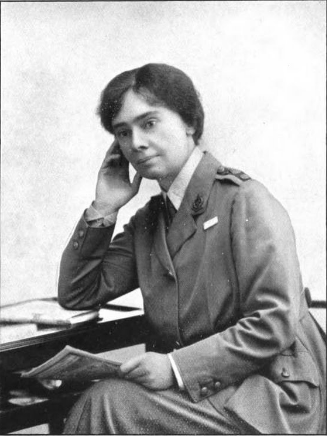 Dr. Eleanor Soltau (1877 - December 30, 1962) was a pioneering English physician, medical administrator, and wartime hospital leader best known for
directing the first Scottish Women's Hospitals unit in Serbia during the First World War and for her decades-long research and work in treating
tuberculosis.
Dr. Eleanor Soltau (1877 - December 30, 1962) was a pioneering English physician, medical administrator, and wartime hospital leader best known for
directing the first Scottish Women's Hospitals unit in Serbia during the First World War and for her decades-long research and work in treating
tuberculosis.
Born in late 1877 in Romford, Essex, Eleanor Soltau was raised in a large, devout, and socially active Nonconformist family. Her father, George Soltau,
served as a Nonconformist minister in Barnstaple, while her mother, Grace Elizabeth Soltau (née Tapson), was a prominent suffragist and the founding
president of the Tasmanian Woman's Christian Temperance Union. Eleanor was one of nine children born to the couple between 1876 and 1890.
In the 1880s, the Soltau family relocated to Launceston, Tasmania, where George Soltau led a mission church. During this time, Grace Soltau established
Hope Cottage in 1887, a pioneering refuge and lying-in facility for unmarried mothers. Eleanor received her early education at Launceston Ladies' College
and successfully passed the matriculation examination for Melbourne University in 1893.
Returning to England for her medical training, Soltau enrolled at the London School of Medicine for Women. After completing her studies and clinical
training at Ilford, she passed her final medical examinations in February 1902. She subsequently gained medical experience working in a hospital in India
and served at the Royal Free Hospital in London prior to the outbreak of the First World War.
The primary focus of Soltau's civilian medical career was centered in Stoke-by-Nayland, Suffolk, at the tuberculosis sanatorium complex founded by Dr.
Jane Walker. Soltau served as the assistant medical superintendent alongside Walker, who was the medical
superintendent. Following Walker’s death in 1938, Soltau succeeded her as medical superintendent.
The Stoke-by-Nayland complex comprised three separate facilities: The East Anglian Sanatorium: Established in 1901 for private patients. The Maltings
Farm Sanatorium: Opened in 1904 for working-class patients, which predominantly cared for ex-servicemen during and after the First World War. The East
Anglian Children's Sanatorium: Founded between 1912 and 1916 for pediatric patients aged 3 to 16.
Soltau specialized in pediatric tuberculosis cases and was an early pioneer in the development and application of artificial pneumothorax—a form of
lung collapse therapy controlled by X-ray imaging. In 1913, Walker and Soltau co-authored research on artificial pneumothorax in the British Medical
Journal (BMJ). Soltau demonstrated the efficacy of this treatment on advanced phthisis cases before the Association of Registered Medical Women in 1914,
and later published a comprehensive report in the BMJ in 1934 analyzing 46 pediatric cases treated at Nayland dating back to 1912. The sanatoriums under
their direction also served as a critical training ground for newly qualified female medical professionals.
With the onset of World War I, Soltau volunteered for service under the Scottish Women's Hospitals for Foreign Service (SWH), an all-female medical
organization formed to support Allied troops. In January 1915, Soltau led the SWH's second official overseas unit to Serbia, arriving at Kragujevac on
January 5, 1915.
Upon arrival, Soltau's unit encountered an overwhelming humanitarian crisis. Retreating Austrian forces had left behind unsanitary, overcrowded
medical facilities, precipitating a devastating typhus epidemic that infected two-thirds of Serbian doctors and killed over a quarter of them. Soltau
organized medical operations by converting a local school and five inns into functional hospitals, eventually taking command of three major facilities: a
surgical hospital, No. 6 Reserve Hospital for typhus patients, and No. 7 Reserve Hospital for general medical cases.
Despite severe shortages of supplies, equipment, and trained personnel, Soltau managed heavy casualties, including soldiers suffering from severe
gangrenous wounds arriving from Valjevo. Her unit operated under extreme strain for months; during the deployment, nine staff members fell ill and three
died, including Scottish nurse Louisa Jordan. In April 1915, Soltau contracted diphtheria and was invalided back to Britain, with Dr.
Elsie Inglis assuming leadership of the Serbian unit.
In recognition of her wartime medical leadership, the King of Serbia conferred upon Soltau the Order of St. Sava (3rd Class) and the Serbian Red Cross
Order. In February 1918, King George V granted her formal permission to wear the decorations in the United Kingdom. On November 17, 1917, Soltau was
appointed medical controller in the Queen Mary's Army Auxiliary Corps (QMAAC).
Throughout her career, Soltau shared a close personal and professional partnership with Dr. Jane Walker (1859–1938), a founder of the Medical Women's
Federation and a pioneer in tuberculosis treatment. For over twenty-five years, the two women lived and worked together in Stoke-by-Nayland, establishing
a collaborative medical practice, co-authoring pioneering scientific papers, and expanding access to healthcare for women, children, and working-class
patients.
Their partnership reflected a broader historical network of early female physicians who built cohabitating life partnerships, professional alliances,
and shared domestic households within the early modern medical movement.
Following her retirement from medical practice, Soltau moved to London, residing at De Vere Gardens in Kensington. She also cared for her mother in
her mother's later years.
Soltau died on December 30, 1962, at Arranmore in Bushey, Hertfordshire, at the age of 85. She was buried beside her lifelong partner, Dr. Jane
Walker, in the churchyard of St. Mary the Virgin in Wissington, Suffolk.
References:
- Walker, Jane, and Soltau, Eleanor. (1913). Research paper on treatment by artificial pneumothorax in pulmonary tuberculosis. British Medical Journal (BMJ).
- Soltau, Eleanor. (February 1914). Presentation on artificial pneumothorax treatment at Maltings Farm Sanatorium before the Association of Registered Medical Women.
- Soltau, Eleanor. Reports on pediatric tuberculosis and artificial pneumothorax treatment. British Journal of Tuberculosis.
- Soltau, Eleanor. (1934). "Treatment of Pulmonary Tuberculosis in Children by Artificial Pneumothorax: A Report on 46 Cases." British Medical Journal (BMJ).
- Scottish Women's Hospitals for Foreign Service (SWH) Archives: Records and official reports regarding the dispatch of the second SWH unit to Kragujevac, Serbia, in January 1915 under Dr. Eleanor Soltau's command.
- Common Cause (May 1916): Official publication of the National Union of Women's Suffrage Societies (NUWSS), documenting Dr. Soltau’s management of No. 6 Reserve Hospital (typhus) and No. 7 Reserve Hospital in Serbia.
- The Edinburgh Evening News / NUWSS Reports (July 1, 1915): Account of Dr. Soltau’s address in Edinburgh on "The Work of the Scottish Women's Hospitals in Serbia" following her return to Britain.
- The London Gazette (February 1918): Official record granting Dr. Eleanor Soltau royal permission from King George V to wear the Order of St. Sava (3rd Class) conferred by the King of Serbia.
- Queen Mary's Army Auxiliary Corps (QMAAC) Records (November 17, 1917): Formal appointment record of Dr. Soltau as Medical Controller in the QMAAC.
- Stoke-by-Nayland & Sanatorium Directories: Advertisements and institutional records published in the Postgraduate Medical Journal (1926) listing Dr. Jane Walker as Medical Superintendent and Dr. Eleanor Soltau as Assistant Medical Superintendent.
- Launceston Ladies' College & Melbourne University Records (1893): Educational matriculation records for Eleanor Soltau in Tasmania.
- London School of Medicine for Women (LSMW) Registers (c. 1897–1902): Qualification and examination rolls for Eleanor Soltau.
- Parish & Burial Registers: St. Mary the Virgin Churchyard, Wissington (Wiston), Suffolk, recording the burial of Dr. Eleanor Soltau alongside Dr. Jane Walker.
Support this project
This website is a passion project researched, developed, and funded entirely by me. If you find the content valuable and would like to help support the ongoing research and hosting costs, any contribution is deeply appreciated.
Thank you for keeping this independent resource alive!
My books on Amazon: Elisa Rolle's books
BACK TO HOME PAGE