Queer Places:
Art Students League of New York, 215 W 57th St, New York, NY 10019
Greenwood Union Cemetery, 215 North St, Rye, NY 10580, United States
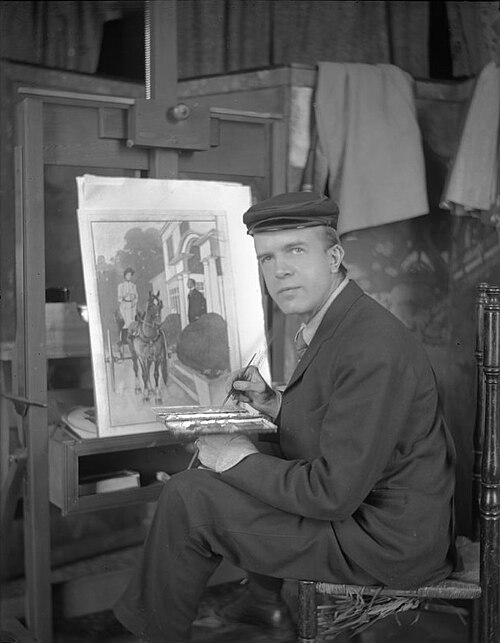 Edward Penfield (June 2, 1866 – February 8, 1925) stands as one of the most celebrated and influential figures of the "Golden Age of American
Illustration," widely recognized as the father of the American poster and a pioneering force in the evolution of graphic design.
Edward Penfield (June 2, 1866 – February 8, 1925) stands as one of the most celebrated and influential figures of the "Golden Age of American
Illustration," widely recognized as the father of the American poster and a pioneering force in the evolution of graphic design.
Born in Brooklyn, New York, he was the third of five children born to merchant Josiah B. Penfield and Ellen Locke Moore, a native of England. Growing
up in Brooklyn, Penfield pursued formal artistic training at New York's Art Students League under the instruction of George de Forest Brush, renowned for
his romanticized scenes of American Indian life. He further honed his craft through extensive studies in Europe, spending formative time in England,
Holland, and Paris.
Penfield's professional career gained significant momentum when he began working as an illustrator for Harper's Weekly in 1891, soon rising to the
position of art director. During his tenure, which lasted until 1901 when he transitioned to a freelance career as an illustrator and painter, Penfield
achieved widespread renown. He developed a distinctive, striking style characterized by simplified figures, bold outlines, and clean settings free of
extraneous detail, famously asserting that a design requiring study is not a true poster. His work drew inspiration from and rivaled the achievements of
European masters like Alphonse Mucha, Théophile Steinlen, and Henri de Toulouse-Lautrec, successfully popularizing bold, high-clarity poster art across
the United States with minimal color palettes suited to primitive reproduction methods of the era. His iconic monthly poster designs for Harper's and
other commercial commissions secured his legacy, and his works remain staples in major literature detailing the history of illustration and graphic
design.
Beyond his commercial success, Penfield was deeply embedded in America's thriving artistic communities. He resided in New Rochelle,
New York—a prominent art colony renowned for its concentration of illustrators, writers, and actors—and served as a founding member of the
New Rochelle Art Association upon its organization in 1912. He also served as the president of the Society of Illustrators from 1921 to 1923 and shared
his European travels through his authored book Holland Sketches, published by Scribner's in 1907.
On April 27, 1897, Penfield married Jennie Judd Walker, the daughter of Civil War veteran and railroad executive Major Charles Ashbel Walker. The
couple initially lived with the Walkers in the Bronx before moving into a large home built by Major Walker in Pelham Manor, New York, where Penfield
maintained a private studio on the upper floor. The couple had two sons: Walker Penfield, born in 1898, and Oliver Penfield, born in 1905, who tragically
died at age five in 1910. Later in life, Penfield suffered severe back injuries from a fall in 1924, ultimately leading to his death on February 8, 1925,
at Dr. Slocum’s Sanitarium in Beacon, New York. He is buried in Greenwood Union Cemetery in Rye, New York.
Among his enduring architectural and artistic legacies are his rare murals located within the original breakfast room of Randolph Hall at Harvard
University's Adams House (formerly part of the historic Hasty Pudding clubhouse ecosystem), which represent some of the only surviving mural works by the
legendary Harper's magazine cover artist.
References:
Other references:
- Dictionary of American Biography (Comprehensive Index, Vol. Supplements), Charles Scribner's Sons.
- Dictionary of Literary Biography, Vol. 188: American Book & Magazine Illustrators to 1920 (featuring the specific entry on Edward Penfield by Margaret A. Irwin), Gale Research.
- Collier's New Encyclopedia (1921 entry on "Penfield, Edward").
- Walt Reed, America's Great Illustrators, Abbeville Press, 1979 (specifically page 114 covering his tenure and transition from Harper's).
- Victor Margolin, American Poster Renaissance: The Great Age of Poster Design, 1890–1900, Castle Books, 1975.
- Charles Matlack Price, Posters: A Critical Study of the Development of Poster Design in Continental Europe, England and America, 1913.
- Edward Penfield, Holland Sketches, Charles Scribner's Sons, 1907.
- Edward Penfield, Spanish Sketches, Charles Scribner's Sons, 1911.
- The Metropolitan Museum of Art (New York): Leonard A. Lauder Collection, housing original lithographic posters created for Harper's Magazine.
- Smithsonian American Art Museum: Biographical files and representative poster collections documenting his role as art director.
- Library of Congress: Catalog containing over 200 historical records, illustrations, and commercial design portfolios.
- Portland Art Museum: Daniel Bergsvik and Donald Hastler Collection of American Publishing Posters.
Support this project
This website is a passion project researched, developed, and funded entirely by me. If you find the content valuable and would like to help support the ongoing research and hosting costs, any contribution is deeply appreciated.
Thank you for keeping this independent resource alive!
My books on Amazon: Elisa Rolle's books
BACK TO HOME PAGE
