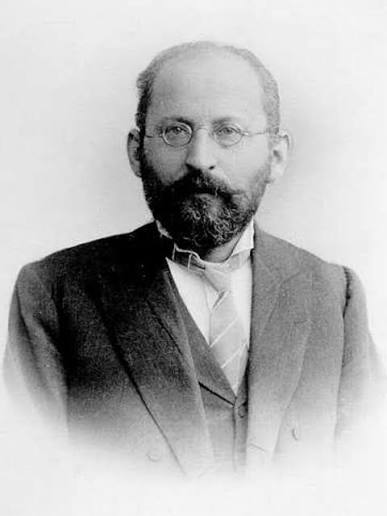
 Eduard Bernstein (January 6, 1850 - December 18, 1932) was a German political theorist, editor, and member of the Reichstag who became one of the most influential figures
in modern democratic socialism.
Eduard Bernstein (January 6, 1850 - December 18, 1932) was a German political theorist, editor, and member of the Reichstag who became one of the most influential figures
in modern democratic socialism.Queer Places:
Friedhof Eisackstrasse, Rubensstraße, 10827 Berlin, Germany
Eduard Bernstein (January 6, 1850 - December 18, 1932) was a German political theorist, editor, and member of the Reichstag who became one of the most influential figures
in modern democratic socialism.
Born in Berlin on January 6, 1850, to a working-class Jewish family, Bernstein began his career as a bank clerk before committing himself to socialist politics. In 1872, he joined the Social Democratic Workers' Party (which later merged into the Social Democratic Party of Germany, or SPD).
Due to Chancellor Otto von Bismarck’s repressive Anti-Socialist Laws, Bernstein was forced into exile in Switzerland and later London. During this time, he served as editor of the party's official underground organ, Der Sozialdemokrat, and became a close friend and intellectual heir to Friedrich Engels.
Following Engels’ death in 1895, Bernstein authored a series of groundbreaking articles and the 1899 book Die Voraussetzungen des Sozialismus (The Preconditions for Socialism or Evolutionary Socialism). In it, he challenged core tenets of orthodox Marxism:
He argued that capitalism was not on the verge of immediate collapse, but was instead adapting through credit and reform.
He advocated for gradual, parliamentary reform rather than a violent proletarian revolution, coining the famous sentiment that "the movement is everything, the final goal nothing."
His theories sparked the famous "Revisionist Controversy" within international socialism. Despite intense pushback from orthodox Marxists like Rosa Luxemburg and Karl Kautsky, Bernstein's reformist principles eventually laid the theoretical groundwork for modern Western European social democracy.
Beyond his contributions to political economy, Bernstein is recognized in queer history as an early proponent of gay rights and decriminalization. His inclusion in historical reference works—such as Robert Aldrich and Garry Wotherspoon’s Who’s Who in Gay and Lesbian History: From Antiquity to World War II—highlights his pioneering role in advocating against legal discrimination.
When Oscar Wilde was prosecuted and imprisoned for "gross indecency" in Britain in 1895, much of the international press engaged in severe moral outrage. Bernstein, writing for the theoretical journal Die Neue Zeit, published two essays directly addressing homosexuality and Paragraph 175 (Germany's anti-sodomy law):
Bernstein argued that same-sex desire was a natural variation of human sexuality rather than a crime or a moral vice.
He asserted that private sexual conduct between consenting adults was not the business of the criminal law, anticipating modern privacy arguments by decades.
Bernstein’s stance was not an isolated anomaly within the left edge of the SPD: August Bebel, co-founder of the SPD, actively partnered with sexologist Magnus Hirschfeld and the Wissenschaftlich-humanitäres Komitee (Scientific-Humanitarian Committee). In 1898, Bebel became the first politician in modern history to present a petition to a national parliament seeking to abolish Paragraph 175.
Bernstein and his contemporaries argued that Victorian legal codes and religious taboos surrounding sex were tools of social control that disproportionately harmed working-class and marginalized individuals.
By framing sexual liberation and emancipation as an integral part of human rights, Bernstein and his SPD colleagues became Europe's earliest political advocates for LGBTQ legal equality.
References:
 Who's Who in Gay and Lesbian History: From Antiquity to World War II 1st Edition by Robert Aldrich and Garry Wotherspoon |
Other references:
Support this project
This website is a passion project researched, developed, and funded entirely by me. If you find the content valuable and would like to help support the ongoing research and hosting costs, any contribution is deeply appreciated.
Thank you for keeping this independent resource alive!
My books on Amazon: Elisa Rolle's books