Queer Places:
53 Bd de Montmorency, 75016 Paris, France
Cimetière de Montmartre, 20 Av. Rachel, 75018 Paris, France
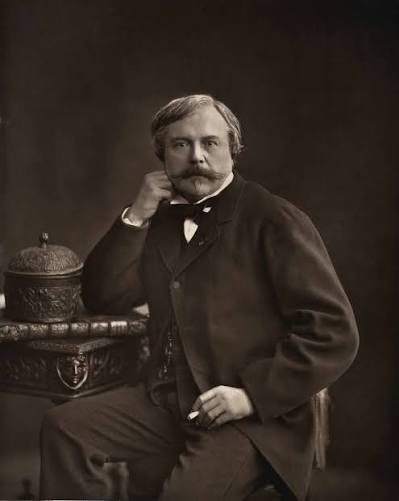 Edmond de Goncourt (May 26, 1822 – July 16, 1896) was a prominent French writer, art critic, and co-author—alongside his younger brother, Jules—of a monumental Journal that
provides an exhaustive, often venomous, and highly detailed chronicle of 19th-century Parisian literary and artistic life.
Edmond de Goncourt (May 26, 1822 – July 16, 1896) was a prominent French writer, art critic, and co-author—alongside his younger brother, Jules—of a monumental Journal that
provides an exhaustive, often venomous, and highly detailed chronicle of 19th-century Parisian literary and artistic life.
Born in Nancy into a minor aristocratic family, Edmond and Jules were left with a comfortable inheritance that allowed them to pursue their artistic interests
independently. They functioned as a symbiotic intellectual unit, often referred to as "Juledmond," writing together so closely that their individual contributions are
nearly impossible to distinguish.
They were key figures in the development of the naturalist novel (e.g., Germinie Lacerteux, 1864) and influential critics who helped revive interest in 18th-century
French art, particularly the Rococo period.
Begun in 1851, the Journal des Goncourt is their most enduring work. It is a vast, candid repository of gossip, cultural observation, and social history. Edmond
continued the diary for 26 years following Jules's death from a syphilis-related illness in 1870.
In 1868, Edmond and his brother Jules moved to a house at 53 Boulevard de Montmorency in the Auteuil neighborhood of Paris. This home was a central pillar of their lives
and served as a meticulously curated showcase for their extensive collections of 18th-century French art and Japanese artifacts. Edmond later detailed the house,
its interiors, and his life there in his 1881 book, La Maison d'un Artiste. The neighborhood and the nearby Bois de Boulogne remained recurring, significant settings
throughout their literary work and personal journals.
Edmond’s most lasting legacy is the Académie Goncourt, which he established through a bequest in his will. Since 1903, the Academy has awarded the Prix Goncourt, which
remains the most prestigious literary prize in France.
Edmond de Goncourt is buried in the Cimetière de Montmartre in Paris. This historic cemetery is the final resting place of numerous prominent writers, artists, and
figures of the 19th century. His tomb serves as a memorial not only to himself but also to his brother, Jules, with whom he shared his lifelong creative partnership.
Some academic and biographical sources—such as the Dictionary of Art Historians and the Dictionnaire historique des homosexuel.le.s célèbres—explicitly categorize him
as a homosexual, often citing his intense, exclusive bond with his brother and his documented lifestyle in the social circles of 19th-century Paris.
The Dictionnaire serves as a reference point for this specific aspect of his biography, situating him among other historical figures known for their same-sex attractions
or relationships.
References:
Other references:
- https://en.wikipedia.org/wiki/Edmond_de_Goncourt
Support this project
This website is a passion project researched, developed, and funded entirely by me. If you find the content valuable and would like to help support the ongoing research and hosting costs, any contribution is deeply appreciated.
Thank you for keeping this independent resource alive!
My books on Amazon: Elisa Rolle's books
BACK TO HOME PAGE
