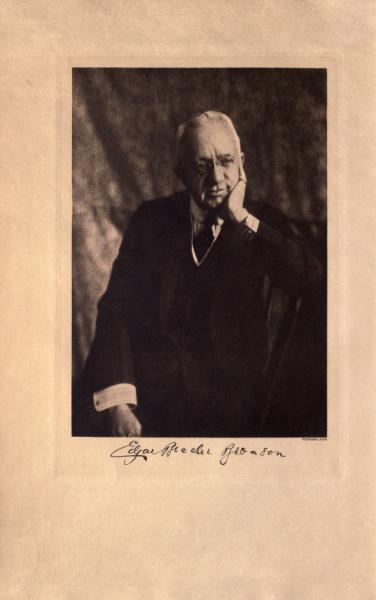
 Edgar Beecher Bronson (September 20, 1856 – February 4, 1917) was an American adventurer, cattleman, photographer, and author best known for his vivid chronicles of the
American frontier.
Edgar Beecher Bronson (September 20, 1856 – February 4, 1917) was an American adventurer, cattleman, photographer, and author best known for his vivid chronicles of the
American frontier.Queer Places:
Woodlawn Cemetery, Bronx, Bronx County, New York, USA
Edgar Beecher Bronson (September 20, 1856 – February 4, 1917) was an American adventurer, cattleman, photographer, and author best known for his vivid chronicles of the
American frontier.
Born in Pennsylvania (or Ithaca, New York), Bronson was a nephew of the famous abolitionist Henry Ward Beecher. He began his career as a youthful reporter for the New York Tribune. Exhibiting the trademark "strenuous" nerve of his generation (later championed by Theodore Roosevelt), he famously crossed the ice-filled East River on foot to deliver his report on the sensational 1875 Henry Ward Beecher adultery trial when ferries were disabled.
In 1877, under the direction of Clarence King (first director of the USGS), Bronson headed west to Wyoming and Nebraska to learn the cattle business. He transitioned from a greenhorn "tenderfoot" Easterner into a seasoned rancher and cattle driver, establishing operations in Sioux County, Nebraska, and managing ranges deep in untamed territory.
After selling his ranch interests in the early 1880s as homesteaders moved in, Bronson later traveled extensively as an African big-game hunter and turned to writing. His premier work, Reminiscences of a Ranchman, was published in 1908, followed by other adventure and frontier books like The Red-Blooded Heroes of the Frontier (1910) and In Closed Territory (1910). He died in Manhattan in 1917.
Bronson’s Reminiscences of a Ranchman (and similar frontier memoirs) provides valuable, albeit complex, primary source material regarding gender presentation and homosocial/queer subtext in the 19th-century American West.
Edgar Beecher Bronson, in his 1908 Reminiscences of a Ranchman, described a tall blonde in drag dancing with another cowboy. Dancing the first set “made ‘Miss De Puyster’ the belle of the day and night.”
In the passage referenced, Bronson describes a frontier celebration or camp dance where a tall, blonde cowboy dressed in full drag—playfully dubbed "Miss De Puyster"—became the belle of the ball, dancing sets with other rough-and-ready cowboys.
Cross-dressing was surprisingly common in the heavily male-dominated settlements, mining camps, and cattle trails of the Old West. Because women were scarce, men frequently dressed in women's clothing for theatricals, holiday celebrations, mock-wedding ceremonies, and dances.
While these instances were often framed by participants as harmless horseplay, frontier humor, or practical necessity to fill the role of a dance partner, modern LGBTQ+ historians point to these accounts as evidence of the fluid, performative nature of gender on the frontier. Cross-dressing episodes offered a temporary space where conventional 19th-century Victorian gender norms could be subverted, allowing men to playfully—and sometimes intimately—interact, dance, and court one another in a homosocial environment.
References:
 A Desired Past: A Short History of Same-Sex Love in America Paperback – May 1, 2002 by Leila J. Rupp |
Other references:
Support this project
This website is a passion project researched, developed, and funded entirely by me. If you find the content valuable and would like to help support the ongoing research and hosting costs, any contribution is deeply appreciated.
Thank you for keeping this independent resource alive!
My books on Amazon: Elisa Rolle's books