Queer Places:
Lycée Condorcet, 8 Rue du Havre, 75009 Paris, France
Cimetière de Montmartre, 20 Av. Rachel, 75018 Paris, France
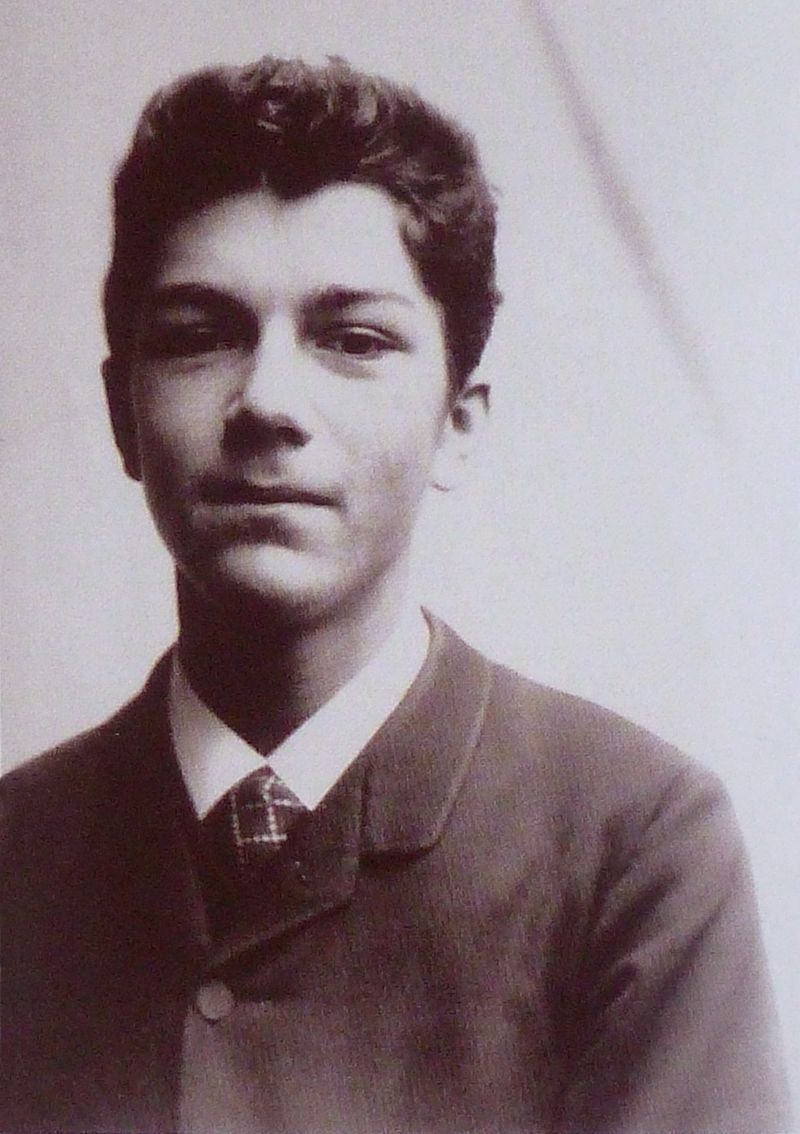 Pol Daniel Halévy (December 12, 1872 - February 4, 1962) was a prominent French historian and essayist whose life spanned nearly a century of profound
political and cultural transformation. He was the son of the French academician Ludovic Halévy, belonging to a distinguished lineage of men of letters of
German Jewish origin, and Louise Breguet, who came from a notable dynasty of Protestant watchmakers. Baptized and raised in the Protestant faith, Halévy
pursued his education at the Lycée Condorcet alongside his older brother, Élie Halévy, forming a lifelong friendship with their classmate
Marcel Proust. He furthered his studies by attending courses at the School of Oriental Languages.
Pol Daniel Halévy (December 12, 1872 - February 4, 1962) was a prominent French historian and essayist whose life spanned nearly a century of profound
political and cultural transformation. He was the son of the French academician Ludovic Halévy, belonging to a distinguished lineage of men of letters of
German Jewish origin, and Louise Breguet, who came from a notable dynasty of Protestant watchmakers. Baptized and raised in the Protestant faith, Halévy
pursued his education at the Lycée Condorcet alongside his older brother, Élie Halévy, forming a lifelong friendship with their classmate
Marcel Proust. He furthered his studies by attending courses at the School of Oriental Languages.
Halévy established himself as an influential voice in early 20th-century intellectual circles, contributing extensively to Charles Péguy's Cahiers de
la Quinzaine between 1903 and 1910—where he published Apologie pour notre passé—and writing for Pages libres from 1901 to 1909 alongside Charles
Guieysse. A key figure in French publishing, he directed the acclaimed Cahiers verts collection at Éditions Grasset from 1921 to 1937 and was later
elected a member of the Academy of Moral and Political Sciences in 1949. His personal and familial network connected him deeply to the French political
and intellectual establishment; he was the stepfather and grandfather of politicians Louis Joxe and Pierre Joxe, as well as the uncle of the libertarian
Marxist and bisexual activist Daniel Guérin.
As an author, Halévy penned major historical and political works, including The End of the Notables (1930), Decadence of Liberty (1931), The Republic
of Dukes (1937), and An Essay on the Acceleration of History (1948), alongside authoritative studies on
Nietzsche, Péguy, Michelet, Proudhon, and Vauban. Deeply integrated into intellectual networks, he was
close to Georges Sorel, whose famous Reflections on Violence (1908) was published in book form largely due to Halévy's persistent encouragement. Later in
life, he occasionally contributed to Courrier français (1948-1950) and collaborated with La Nation française, a magazine founded by Pierre Boutang.
Halévy's political trajectory was complex and marked by a distinct conservative evolution. In his writings, such as Pour l'étude de la Troisième
République, he questioned the Masonic connections of the republican regime, arguing that occult actions bypassed historical analysis. In Apology for Our
Past, he reinterpreted the century between 1789 and 1881, viewing the French Revolution as the progenitor of a republican tradition that frequently
degenerated into disorder, leading him to characterize events like the July Revolution of 1830 and the 1848 revolution as republican restorations.
Disillusioned with liberals and anxious about the fate of European civilization during the interwar period, Halévy moved closer to the Maurrassian
right wing. With the publication of his essay Three Trials: 1814, 1871, 1940 in 1941, he expressed support for the initial reforms of the Vichy
government and contributed articles to the Maurrassian press during the Occupation, affiliations that ultimately resulted in professional and social
disgrace in the post-war era.
Beyond his national political and literary footprint, Halévy maintained significant international intellectual connections, notably with the
Anglo-American author and critic Vernon Lee. Their relationship is highlighted by a published correspondence in
the Revue internationale de Genève in 1921. This exchange, which captured their opposing views on the role of the writer in the post-war period, served
as a vital reflection of the intellectual debates unfolding at Il Palmerino, Lee's historic villa in Florence. Daniel Halévy died on February 4, 1962, in
the 1st arrondissement of Paris and was laid to rest in the Cimetière de Montmartre.
References:
- Revue internationale de Genève (1921 publication of his correspondence with Vernon Lee)
- Cahiers de la Quinzaine (Contributions between 1903 and 1910, including Apologie pour notre passé)
- Pages libres (Contributions from 1901 to 1909 alongside Charles Guieysse)
- Courrier français (Occasional contributions from 1948 to 1950)
- La Nation française (Magazine founded by Pierre Boutang)
- Apologie pour notre passé (1910)
- Pour l'étude de la Troisième République
- The End of the Notables (La Fin des notables, 1930)
- Decadence of Liberty (Décadence de la liberté, 1931)
- The Republic of Dukes (La République des comités / La République des ducs, 1937)
- Three Trials: 1814, 1871, 1940 (Paris: Plon, 1941)
- An Essay on the Acceleration of History (Essai sur l'accélération de l'histoire, 1948)
- Biographical and critical studies on Nietzsche, Charles Péguy, Jules Michelet, Pierre-Joseph Proudhon, and Sébastien Le Prestre de Vauban
- The Academy of Moral and Political Sciences (elected a member in 1949)
- Association to defend the memory of Marshal Pétain
- Steering committee of the Association of the Royaumont Abbey home
Support this project
This website is a passion project researched, developed, and funded entirely by me. If you find the content valuable and would like to help support the ongoing research and hosting costs, any contribution is deeply appreciated.
Thank you for keeping this independent resource alive!
My books on Amazon: Elisa Rolle's books
BACK TO HOME PAGE