Partner Minnie G. Brown
Queer Places:
167 W 136th St, New York, NY 10030, USA
Eastville Ave, Sag Harbor, NY 11963, USA
Oakland Cemetery, 87 Jermain Ave, Sag Harbor, NY 11963, United States
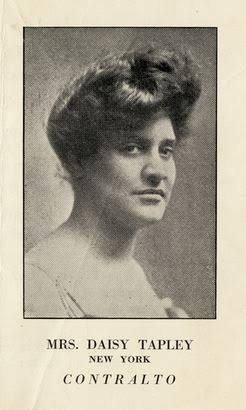 Daisy Robinson Tapley (1882 - February 5, 1925) was a groundbreaking African American contralto, classical pianist, vaudeville performer, and civil
rights activist whose life and career intersected with key movements of the early 20th century, including the Harlem Renaissance, the suffrage movement,
and early LGBTQ history.
Born Daisy Robinson around 1882 in Big Rapids, Michigan, to Henry A. Robinson and Martha Maria Goings, she exhibited remarkable musical talent at an
early age. Raised in Chicago, she studied piano and organ under prominent instructor Emil Liebling, organist Clarence Eddy, and Pedro Tinsley. By age
twelve, she was recognized as a musical prodigy and served as the featured organist at Chicago's Quinn Chapel AME Church. Her time at Quinn Chapel
exposed her to the intersections of faith, racial progress, and women's activism, including hearing prominent speakers like Booker T. Washington. During
her teenage years, inspired by the renowned British contralto Clara Butt, Tapley began focused vocal training to
develop her distinctive contralto voice.
In January 1902, at age nineteen, she married vaudeville musician Green Henri Tapley in Chicago. The couple had no children. Both joined the
celebrated Williams and Walker Company, an all-Black vaudeville troupe led by Bert Williams and George Walker. In 1903, the company traveled to Great
Britain to tour In Dahomey, the groundbreaking musical that became the first full-length show written and performed by Black artists to play on Broadway
and later performed at Buckingham Palace for King Edward VII.
During the British tour of In Dahomey, Tapley's personal and professional life transformed. She met soprano
Minnie G. Brown, who joined the cast in 1904, initiating a relationship that evolved into a devoted,
life-long romantic partnership. While in England, Tapley also performed as a classical pianist and connected with prominent figures, including British
composer Samuel Coleridge-Taylor and her vocal idol, Clara Butt. Butt encouraged Tapley to leave vaudeville to pursue classical music full-time.
Following the tour, Tapley settled in Harlem, New York, where she established a prosperous music studio teaching piano and voice in her home. Although
her legal marriage to Green Henri Tapley was never formally annulled, the two maintained separate residences nearby, and Green identified Daisy as his
next of kin on his World War I draft registration. Meanwhile, Minnie Brown moved in with Tapley shortly after the Williams and Walker Company dissolved
around 1910. The two women shared a home at 167 West 136th Street in Harlem and spent their summers together at their property in Eastville, Sag Harbor,
Long Island. In public census records from 1915 and 1920, they listed their shared household while identifying as sisters or domestic companions to
navigate the societal norms of the era.
Tapley achieved a historic milestone on December 7, 1910, when she became the first African American woman to record commercially, performing the
hymn "I Surrender All" in a duet with baritone Carroll Clark for Columbia Records. Her music career expanded rapidly throughout the 1910s and 1920s as
she directed the YWCA glee clubs in Harlem, staged recitals, and performed at major venues, including Carnegie Hall in 1922 and Jordan Hall in Boston in
1915 alongside tenor Roland Hayes, whom she helped discover and promote.
Alongside their artistic endeavors, Tapley and Brown were deeply committed to social reform, civil rights, and racial equality. As active members of
St. Mark's Methodist Episcopal Church and founding leaders of the National Association of Negro Musicians in 1919, they integrated their art with
activism. Tapley served as treasurer of the New York chapter of the Empire State Federation of Women's Clubs—an affiliate of the National Association of
Colored Women—advocating for women's suffrage and supporting initiatives such as a monument to Harriet Tubman. During the 1917 Silent Protest Parade in
New York City, organized by the NAACP to protest anti-Black violence and lynching, Tapley led the women's division as thousands marched down Fifth Avenue
in quiet protest. During World War I, she also directed the soup kitchen at the Harlem Y "Hut," serving returning Black soldiers of the 15th New York
National Guard.
When the YMCA refused to permit an integrated audience for a music recital Tapley and Brown were organizing in 1918, the couple chose to cancel the
event entirely and published a letter opposing segregation rather than compromise their principles. Following this incident, they launched independent
educational recital series designed to elevate Black musical talent and feature prominent intellectuals like
W.E.B. Du Bois.
In the late summer of 1924, while rehearsing for an opera performance, Tapley was diagnosed with ovarian cancer. She passed away on February 5, 1925,
at about age 42, with Minnie Brown by her side. W.E.B. Du Bois spoke at her memorial services, and she left her entire estate—including their Harlem
residence and the Sag Harbor home—to Brown, leaving only one symbolic dollar to her estranged husband. Tapley was interred at Oakland Cemetery in Sag
Harbor.
Following Tapley's death, Minnie Brown made the funeral arrangements, authored Tapley's obituary, and engaged in public acts of remembrance that
affirmed the depth of their relationship. Brown donated floral arrangements in Tapley's memory at St. Mark's Methodist Episcopal Church and published an
annual "In Memoriam" notice in the New York Age newspaper reading: "In Memory of Daisy Tapley who Died, February 5, 1925 - Minnie Brown." Brown
faithfully renewed this public memorial every year on the anniversary of Tapley's death until her own passing in 1936, leaving a enduring record of their
partnership and shared legacy.
References:
Other references:
- E. Azalia Hackley Collection of African Americans in the Performing Arts, Detroit Public Library, Detroit, Michigan. Includes the Elijah Chorus concert program (Jordan Hall, Boston, April 1915) and photographs of Roland Hayes, Minnie Brown, Daisy Tapley, and Harry Burleigh.
- National Association for the Advancement of Colored People (NAACP) Records, Library of Congress, Washington, D.C. Documentation and organizing records regarding the 1917 Silent Protest Parade in New York City.
- Empire State Federation of Women's Clubs Records / National Association of Colored Women’s Clubs (NACW) Archives. Records regarding convention delegates, suffrage resolutions, leadership rosters, and the 1915 Harriet Tubman monument fund resolution.
- Illinois, Cook County Marriages, 1871–1969: Marriage entry for Breen/Green Henri Tapley and Daisey Robinson (January 29, 1902, Chicago, Illinois).
- New York, New York City Municipal Deaths, 1795–1949: Death record entry for Daisy Tapley (February 5, 1925, Manhattan, New York; parents listed as Harry/Henry Robinson and Martha Goings).
- New York State Census (1915) & United States Federal Census (1920): Household records for 167 West 136th Street, Manhattan, New York, listing Daisy Tapley and Minnie Brown.
- United States World War I Draft Registration Cards, 1917–1918: Registration entry for Green Henri Tapley listing Daisy Tapley as his closest relative.
- Oakland Cemetery Records & Burial Registry, Sag Harbor, Suffolk County, New York (Find a Grave Memorial ID 196137636).
- The New York Age: Public letter published by Daisy Tapley opposing YMCA auditorium segregation (January 19, 1918, p. 6).
- Annual "In Memoriam" notices submitted by Minnie G. Brown on February 5 from 1926 through 1936 ("In Memory of Daisy Tapley who Died, February 5, 1925 — Minnie Brown").
- The Chicago Defender: Historical performance reviews and coverage highlighting Daisy Tapley's classical concerts and leadership in Black musical organizations (including the 1917 tribute calling her "one of the greatest musical artists in the country").
- The New York Amsterdam News: Historical coverage of Harlem society, the Sag Harbor cottage, and retrospectives on Daisy Tapley and Minnie Brown.
- Columbia Records (December 7, 1910): Commercial release of the hymn "I Surrender All" performed as a vocal duet by Daisy Tapley (contralto) and Carroll Clark (baritone).
- Snyder, Jean E. Harry T. Burleigh: From the Spiritual to the Harlem Renaissance. University of Illinois Press, 2016.
- Alexander Street Documents / Black Women Suffragists Collection: Biographical profiles and document lists covering Daisy Robinson Tapley and Minnie G. Brown.
- Wikipedia & Online Biographical Databases: "Daisy Tapley" biographical sketch and WikiTree genealogical profiles.
Support this project
This website is a passion project researched, developed, and funded entirely by me. If you find the content valuable and would like to help support the ongoing research and hosting costs, any contribution is deeply appreciated.
Thank you for keeping this independent resource alive!
My books on Amazon: Elisa Rolle's books
BACK TO HOME PAGE
