Queer Places:
Domaine Château Ermenonville, Rue René de Girardin, 60950 Ermenonville, France
Ermenonville Communal Cemetery, 60950 Ermenonville, France
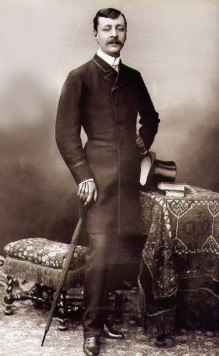 Prince Constantin Vincent Maria Radziwiłł (July 31, 1850 – September 8, 1920) was a prominent Polish-French aristocrat whose high-society standing,
eccentric lifestyle, and open homosexuality made him one of the most intriguing figures of Belle Époque Paris.
Prince Constantin Vincent Maria Radziwiłł (July 31, 1850 – September 8, 1920) was a prominent Polish-French aristocrat whose high-society standing,
eccentric lifestyle, and open homosexuality made him one of the most intriguing figures of Belle Époque Paris.
Born in Poloneczka, Belarus, then part of the Russian Empire, to Prince Constantine Michael Radziwill and Princess Adela Karnicka, Constantin belonged
to the historic Trąby branch of the princely Radziwiłł family. Though his lineage possessed vast aristocratic prestige and royal bloodlines across
Lithuania and Poland, the family's cash fortunes had depleted over time. In 1874, Prince Constantin acquired the grand Château d'Ermenonville,
solidifying his presence in French high society. To restore his personal finances, he married the wealthy French heiress Louise Antoinette Sophie Blanc
in Paris on March 30, 1876. Louise was the daughter of François Blanc, the mastermind founder of the Société des Bains de Mer and developer of the famous
Casino de Monte-Carlo. Together, the couple had two children: Louise, later the Duchess of Doudeauville, and Prince
Léon "Loche" Radziwill.
Constantin Radziwill holds a notable position in LGBTQ+ history due to his remarkably open homosexuality within the rigid social structure of the late
19th and early 20th centuries. Rather than attempting to completely hide his desires, Constantin lived apart from his wife and was uninhibited about his
sexuality, a dynamic fully recognized by Princess Louise. His domestic life at the Château d'Ermenonville was famous for its extravagance; he notably
employed a staff of twelve attractive young houseboys and valets, insisting that each wear a pearl necklace around their neck. Among these valets was
Albert Le Cuziat, a well-known figure in Parisian queer history who later became a prominent bathhouse
proprietor and confidential associate to elite gay men in Paris.
Through his social status, lavish hosting, and obsession with aristocratic etiquette, Constantin became intimately connected to the queer intellectual
network surrounding Marcel Proust, whom he befriended around 1904. Proust was a frequent guest at the Château
d'Ermenonville and drew heavily upon Constantin's life and persona when creating characters for À la recherche du temps perdu. Constantin's strict
adherence to aristocratic decorum and social rank served as one of the key inspirations for the Prince de Guermantes, while his former valet, Albert Le
Cuziat, became a principal model for the character of Jupien. Furthermore, Constantin's son, Léon, became another of Proust’s close friends and romantic
infatuations, inspiring the character of Robert de Saint-Loup.
Despite the financial infusion brought by his marriage to Louise Blanc, Constantin spent vast sums of money throughout his lifetime on his lavish
lifestyle, staff, and personal pursuits, eventually depleting much of his family's capital and placing heavy financial pressure on his children.
Constantin spent his later years navigating the high-society circles of France before passing away in Paris on September 8, 1920, at the age of seventy.
He was laid to rest in the Ermenonville Communal Cemetery in Oise, leaving behind a legacy that directly influenced the literary landscape of French
modernism and preserved an extraordinary chapter of European queer history.
References:
- Painter, George D. Marcel Proust: A Biography. Detailed account of Proust's social network, highlighting Constantin Radziwill's social standing and his influence on the character of the Prince de Guermantes.
- Tadié, Jean-Yves. Marcel Proust: A Life. Comprehensive biography examining Proust’s visits to the Château d'Ermenonville and his relationships with both Constantin and his son, Léon Radziwill.
- Diesbach, Ghislain de. Proust. Historical study detailing the aristocratic circles of the Faubourg Saint-Germain, high-society dynamics, and the Blanc family fortune.
- Proust, Marcel. Correspondance de Marcel Proust (edited by Philip Kolb). Primary correspondence documenting Proust’s interactions with Prince Constantin Radziwill starting around 1904.
- Lucey, Michael. Never Say I: Sexuality and the First Person in Colette, Gide, and Proust. Academic examination of fin-de-siècle queer networks in Paris, including figures like Albert Le Cuziat and his connections to aristocratic households.
- Volbertal, J.-H. (1923). Ermenonville. Historical and municipal account covering the history of the Château d'Ermenonville under Prince Constantin Radziwill's ownership from 1874 onward.
- Archives of the Municipality of Ermenonville (Oise). Civil registry records, cemetery burial indices, and records of the monumental fountain erected in 1911 in memory of Prince and Princess Constantin Radziwill in the Place Jean-Jacques Rousseau.
Support this project
This website is a passion project researched, developed, and funded entirely by me. If you find the content valuable and would like to help support the ongoing research and hosting costs, any contribution is deeply appreciated.
Thank you for keeping this independent resource alive!
My books on Amazon: Elisa Rolle's books
BACK TO HOME PAGE