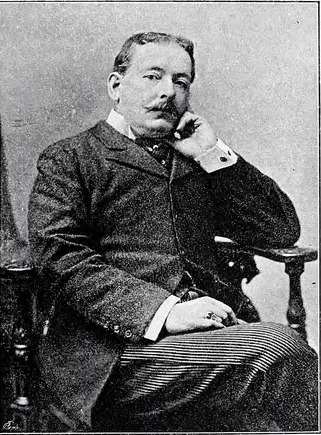
 Sir Claude Phillips (January 29, 1846 - August 9, 1924) was a prominent British art critic, historian, and the first "Keeper" (director) of the Wallace Collection in
London.
Sir Claude Phillips (January 29, 1846 - August 9, 1924) was a prominent British art critic, historian, and the first "Keeper" (director) of the Wallace Collection in
London.Queer Places:
University of London, Senate House, Malet St, London WC1E 7HU, United Kingdom
Wallace Collection, Hertford House, Manchester Square, London W1U 3BN, United Kingdom
40 Ashburn Pl, South Kensington, London SW7 4JR, UK
Kensal Green Cemetery, Harrow Rd, London NW10 5JU
Sir Claude Phillips (January 29, 1846 - August 9, 1924) was a prominent British art critic, historian, and the first "Keeper" (director) of the Wallace Collection in
London.
Born in London to Robert Abraham Phillips and Helen Levy, Phillips was the nephew of Joseph Moses Levy, the founder of the Daily Telegraph. His early life included an education in France and Germany, followed by legal studies at the University of London. Although he was called to the bar in 1883, he eventually transitioned into a career in journalism and art criticism.
In the late 1880s, he began writing for the Daily Telegraph, initially as a music critic before becoming their full-time art critic in 1897. He also contributed to prestigious publications such as the Gazette des Beaux-Arts, the Manchester Guardian, and the Burlington Magazine.
Phillips was appointed the first Keeper of the Wallace Collection in 1897. He spent three years curating the collection and preparing its first catalogue before its public opening at Hertford House in 1900. He held this position until his retirement in 1911, after which he was knighted for his services to the arts.
Phillips was instrumental in the founding of the National Art Collections Fund (now the Art Fund) in 1903. A prolific author, his works included monographs on masters such as Titian, Antoine Watteau, and Sir Joshua Reynolds.
The Dictionary of Art Historians describes Phillips as a "celibate homosexual in the tradition of Oscar Wilde," characterizing him as a "gregarious, perfumed dandy" who was known for his talkative nature when viewing art.
His work often gravitated toward artists whose subjects and styles resonated within the aesthetic movements of his time, which frequently intersected with homoerotic themes.
He wrote on figures such as Gustave Moreau and Pierre Puvis de Chavannes, both of whom are frequently cited for their homoerotic influence on late 19th-century art.
He provided critical analysis of the Post-Impressionist exhibitions organized by Roger Fry, demonstrating his engagement with the shifting, often controversial, artistic landscape of the era.
Phillips remained unmarried throughout his life and spent his later years living in Kensington with his sister, Eugénie. He passed away in 1924, and a collection of his essays, titled Emotion in Art, was published posthumously in 1925.
References:
Support this project
This website is a passion project researched, developed, and funded entirely by me. If you find the content valuable and would like to help support the ongoing research and hosting costs, any contribution is deeply appreciated.
Thank you for keeping this independent resource alive!
My books on Amazon: Elisa Rolle's books