Queer Places:
Cimetière Chrétien de l'Église St. Joseph, El Ménia District, Ghardaïa, Algeria
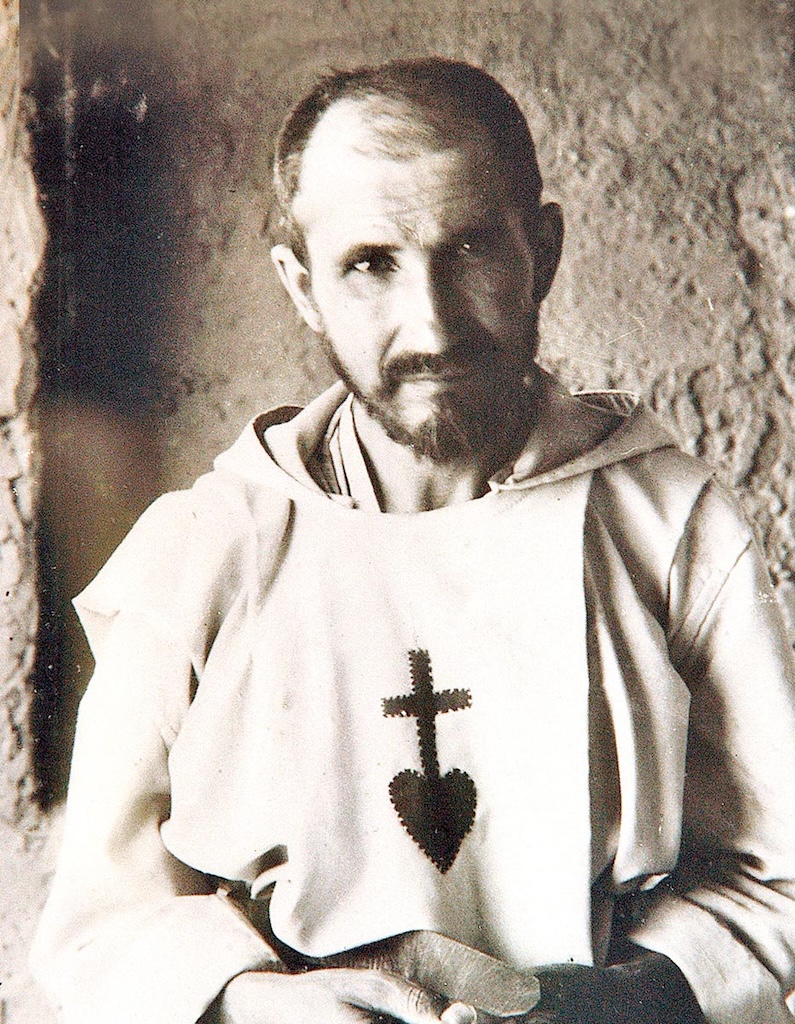 Charles-Eugène de Foucauld (September 15, 1858 – December 1, 1916), also known as Brother Charles of Jesus, was a French military officer, explorer, geographer, Catholic
priest, and hermit who spent his later years living among the Tuareg people in the Algerian Sahara.
Charles-Eugène de Foucauld (September 15, 1858 – December 1, 1916), also known as Brother Charles of Jesus, was a French military officer, explorer, geographer, Catholic
priest, and hermit who spent his later years living among the Tuareg people in the Algerian Sahara.
Born in Strasbourg, France, to an aristocratic family, Foucauld was orphaned at the age of six alongside his sister Marie, after which they were raised by their maternal
grandfather, Colonel Beaudet de Morlet. During his adolescence, following a period of personal loss and a distancing from his childhood upbringing, he lost his religious
faith and became an agnostic.
He pursued a military path, entering the Saint-Cyr Military Academy and later joining the cavalry. Known during his early adulthood for a wealthy, hedonistic lifestyle
and a taste for easy living, he nevertheless displayed determination and discipline in his military duties. Notably, during his school years and early life, he formed deep
bonds, such as with his classmate Gabriel Tourdes, whom he regarded as one of the most significant companions of his youth.
Foucauld left active military service to undertake a risky and acclaimed geographical exploration of Morocco between 1883 and 1884. His observations of the deep religious
devotion and faith exhibited by Muslims during this expedition profoundly impacted him, sparking an internal spiritual crisis and leading him to repeatedly question, "My
God, if you exist, let me come to know you".
Upon returning to France, he was welcomed warmly by his devout family and sought out the guidance of Abbé Henri Huvelin, the parish priest of Saint-Augustine in Paris.
Through Huvelin, Foucauld experienced a powerful religious conversion in October 1886 at the age of 28, deciding thereafter to dedicate his life entirely to God.
Driven by a desire to imitate the hidden, humble life of Jesus of Nazareth, Foucauld joined the strict Trappist order in 1890. He lived in monasteries in France and later
in a remote community in Akbès, Syria, spending seven years as a monk. Seeking an even more austere and humble existence, he left the Trappists in 1897 to live as a servant
and porter near a Poor Clare convent in Nazareth and Jerusalem.
Encouraged by his superiors to pursue formal ordination, he returned briefly to Syria and was ordained a Catholic priest in Viviers, France, in 1901 at the age of 43.
Looking to serve "the furthest removed, the most abandoned," Foucauld moved to the Algerian Sahara. He settled first in Béni Abbès and eventually moved deep into the
Hoggar Mountains at Tamanrasset, living among the Berber-speaking Tuareg people.
Rather than pursuing active conversions, Foucauld sought to preach the Gospel entirely through his presence, charity, and lifestyle—desiring to be a "universal brother".
During these years, he dedicated massive effort to studying the Tuareg culture, authoring a pioneering comprehensive Tuareg-French dictionary and grammar.
On the evening of December 1, 1916, during a period of local political unrest and World War I-related friction, Foucauld was captured and killed outside his desert
hermitage by a band of marauders. He was beatified in 2005 and canonized as a saint by Pope Francis on May 15, 2022.
Directly concerning Charles de Foucauld himself, historical records present no evidence that he identified as LGBTQ. However, his life, legacy, and immediate circle
intersect with queer history and modern theological discussions in a few notable ways:
Biographers note that during his youth and school years, Foucauld formed intense, romanticized platonic bonds with peers such as Gabriel Tourdes, whom he described as an
incomparable life companion, alongside a youthful pursuit of aesthetic and sensory pleasures during his agnostic phase.
The most prominent historical link between Foucauld's circle and LGBTQ history involves his close friend, disciple, and intellectual heir,
Louis Massignon. Foucauld played a major role in guiding Massignon back to the Catholic faith from secularism. Massignon, a
renowned French scholar of Islam, had a complex personal history that included documented same-sex romantic relationships during his youth (notably with Spanish aristocrat
Luis de Cuadra) and deep academic engagements with homoerotic Sufi mystical poetry, such as the works of Rumi. Massignon's
spiritual trajectory—heavily inspired by Foucauld—has frequently been explored by modern queer theologians and writers examining alternative Catholic saints and
figures.
Because of his unconventional life in the desert, his deep emotional attachments to male friendships, and his indirect links to figures like Massignon, Foucauld's life is
periodically discussed within queer Christian spaces and blogs (such as Q Spirit and Queering the Church) that examine the intersections of historical mysticism,
non-traditional male relationships, and modern LGBTQ spirituality.
References:
Other references:
- Reconnaissance au Maroc (1883–1884)
- Dictionnaire Touareg–Français, Dialecte de l'Ahaggar
- Poésies Touarègues. Dialecte de l'Ahaggar
- Notable Collections: Lettres à mes frères de Beni Abbès, Adventurers of God’s Love (his extensive correspondence with Louis Massignon), and his letters to close confidants such as Henry de Castries and his cousin Marie de Bondy.
- Bazin, René (1921), Charles de Foucauld: Explorateur du Maroc, Ermite au Sahara (English translation: Charles de Foucauld – Hermit and Explorer, New York: Benziger Bros, 1923).
- Fremantle, Anne (1950), Desert Calling: The Life of Charles de Foucauld (London: Hollis & Carter).
- Six, Jean-François (2008), Charles de Foucauld autrement (Desclée de Brouwer).
- Antier, Jean-Jacques (2005), Charles de Foucauld (Paris: Editions Perrin).
- Vircondelet, Alain (1997), Charles de Foucauld, comme un agneau parmi des loups (Monaco: Le Rocher).
- Fleming, Fergus (2003), The Sword and the Cross: Two Men and an Empire of Sand (New York: Grove Press).
Support this project
This website is a passion project researched, developed, and funded entirely by me. If you find the content valuable and would like to help support the ongoing research and hosting costs, any contribution is deeply appreciated.
Thank you for keeping this independent resource alive!
My books on Amazon: Elisa Rolle's books
BACK TO HOME PAGE
