Partner Margaret Haley
Queer Places:
Calvary Catholic Cemetery, 301 Chicago Ave, Evanston, IL 60202, United States
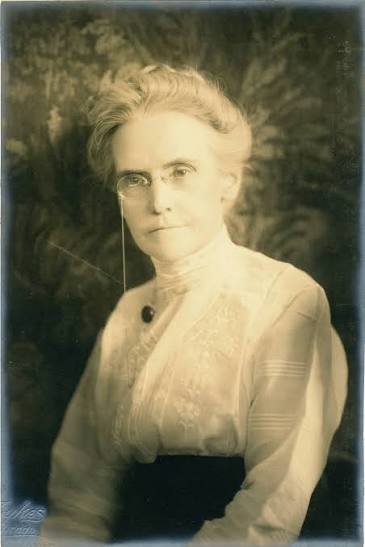 Catharine Goggin (1855 - January 4, 1916) was born to Irish-Catholic immigrant parents in the New York Adirondacks near Lake Champlain. As a child, she moved with her family
to Chicago, where she attended the Franklin School and Central High School. In October 1872, she began her lifelong teaching career in the primary department of the Clarke
School. Throughout her life, she remained single—famously claiming to have received over 300 marriage proposals without accepting any—choosing instead to dedicate her life
to education and labor reform while holding the belief that a woman who teaches learns to govern rather than be governed.
Catharine Goggin (1855 - January 4, 1916) was born to Irish-Catholic immigrant parents in the New York Adirondacks near Lake Champlain. As a child, she moved with her family
to Chicago, where she attended the Franklin School and Central High School. In October 1872, she began her lifelong teaching career in the primary department of the Clarke
School. Throughout her life, she remained single—famously claiming to have received over 300 marriage proposals without accepting any—choosing instead to dedicate her life
to education and labor reform while holding the belief that a woman who teaches learns to govern rather than be governed.
Goggin began her path into public activism by utilizing her connections in Chicago society to convince Governor John Altgeld to support a crucial teachers' pension bill
that successfully passed the Illinois Senate in 1895. She went on to co-found the Chicago Teachers' Federation (CTF), serving as its first president with the help of her
close associate and prominent Chicago suffragist Margaret Haley, and later acting as the CTF's financial officer and Financial
Secretary until her death. Together, Goggin and Haley spearheaded major battles to defend public education, teacher autonomy, and teachers' welfare, fighting passionately
for equal pay for equal work. In 1899, she played a vital pivotal role in successfully leading the fight against and defeating the Harper Bill, which sought to centralize
the administration of Chicago schools, increase male teacher populations and pay at the expense of female educators, impose a college education requirement, and make it
generally more difficult for women to secure teaching positions, alongside granting tax-exempt long-term corporate leases on school property.
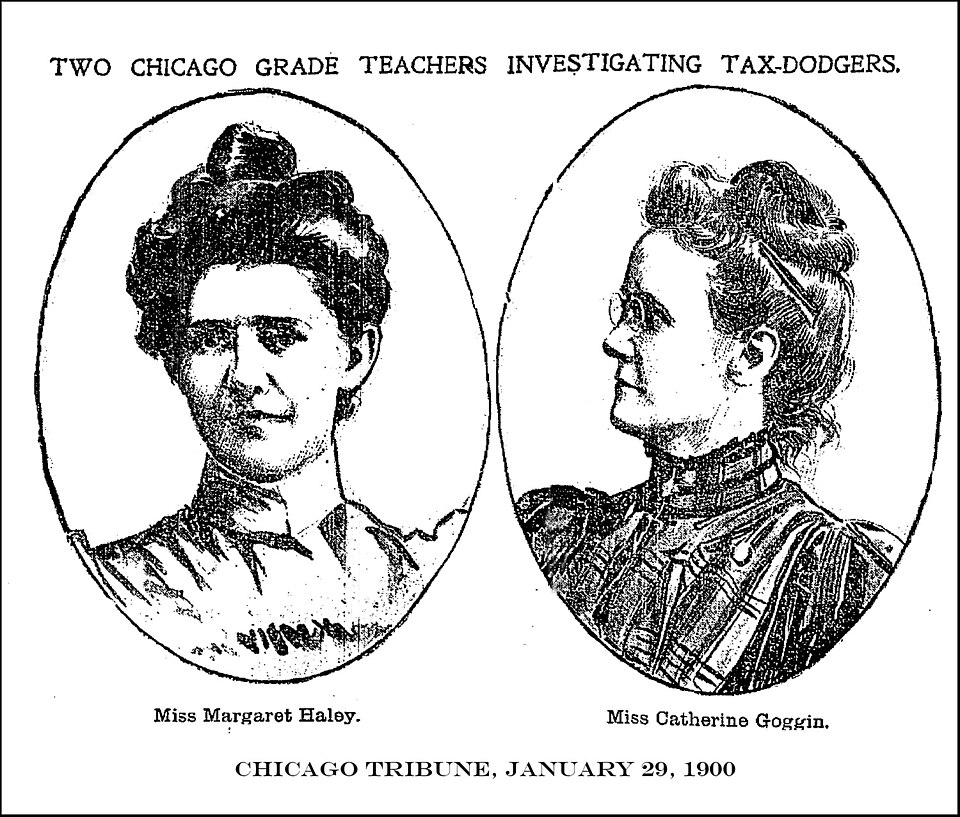
When the state faced financial insolvency and failed to pay teachers, Goggin and Haley launched a historic tax fight against the Illinois Board of Equalization. At the
time, major corporations only paid taxes on tangible assets and avoided paying property taxes. Exposing the illegal under-taxation of twenty-three corporate bodies, Goggin
and Haley argued that the state could fully fund teachers if these corporations paid their fair share of accumulated taxes exceeding one million dollars. They took the legal
battle all the way, and in 1907, the suit ultimately won in the Supreme Court (following key legal victories starting in late 1901), ensuring corporations paid taxes
commensurate with their income and profits, which directly resulted in more money for schoolteacher salaries.
Beyond educational administration and tax equity, Goggin expanded the CTF's platform to support broader progressive movements, including child labor laws and women's
suffrage, such as fighting for women's right to vote. Although Haley was the more publicly active of the pair in the suffrage campaign, Goggin was heavily involved in
various civic and women's groups, including the Catholic Woman's National League, where she served as recording secretary from 1897 to 1900, and the Chicago Federal Union of
Labor. Her commitment to women's rights was further highlighted in 1903 when she spoke at the Annual State Suffrage Convention in Joliet, Illinois, heading a debate
alongside two other women on the question of whether an educational qualification for suffrage should be applied to women. In 1914, she achieved a significant political
milestone for women at the turn of the century by serving as a representative of women on the Chicago City Council's permanent charter commission.
Catharine Goggin’s life was tragically cut short on January 4, 1916, when she was struck and killed by a truck while crossing the street in Chicago. Her sudden death
deepened the local movement for road and pedestrian safety, as the truck lacked a protective fender—a safety feature advocates argued could have saved her life. Following
her passing, her body lay in state in City Hall amid widespread public mourning before her burial on January 8, 1916, at Calvary Cemetery in Evanston, Cook County,
Illinois.
Mainstream historical accounts and biographical records document that Goggin remained single throughout her
life and shared a lifelong domestic and professional partnership with Margaret Haley. However, historical sources available do not explicitly document or frame her life
through modern definitions of LGBTQ identity, as personal records detailing their private romantic lives were largely unrecorded.
References:
- Chicago Teachers’ Federation Records (1864–1968) housed at the Chicago History Museum – Contains core organizational documents, meeting minutes, and records detailing Goggin's co-founding role and financial administration of the CTF.
- The Chicago Teachers' Federation Tax Suit Files and Illinois Supreme Court records detailing the 1901–1907 corporate tax evasion and property tax cases led by Goggin and Margaret Haley.
- Chicago City Council Permanent Charter Commission Records (1914) – Documenting Goggin's appointment as a women's representative.
- The Chicago Day Book (Issues from January 5, January 6, and January 21, 1916) – Contemporary newspaper coverage reporting on her sudden death, her lying in state at City Hall, and the ensuing public safety advocacy regarding delivery truck fenders.
- The Rock Island Argus (October 31, 1900) – Early reporting on the teachers' union and tax battles.
- Catholic Woman's National League Annual Reports (1897–1900) – Recording her tenure as recording secretary.
- Find A Grave Index (Memorial ID 146617934) – Documenting her burial details at Calvary Cemetery in Evanston, Cook County, Illinois.
- Illinois, Archdiocese of Chicago, Cemetery Records (1864–1989) – Official Archdiocese records confirming her burial on January 8, 1916, at Calvary Cemetery.
Support this project
This website is a passion project researched, developed, and funded entirely by me. If you find the content valuable and would like to help support the ongoing research and hosting costs, any contribution is deeply appreciated.
Thank you for keeping this independent resource alive!
My books on Amazon: Elisa Rolle's books
BACK TO HOME PAGE