Partner Mary Watson Whitney
Queer Places:
Vassar College (Seven Sisters), 124 Raymond Ave, Poughkeepsie, NY 12604
Ohio State University, 281 W Lane Ave, Columbus, OH 43210, United States
Columbia University (Ivy League), 116th St and Broadway, New York, NY 10027
Spring Grove Cemetery, 4521 Spring Grove Ave, Cincinnati, OH 45232, United States
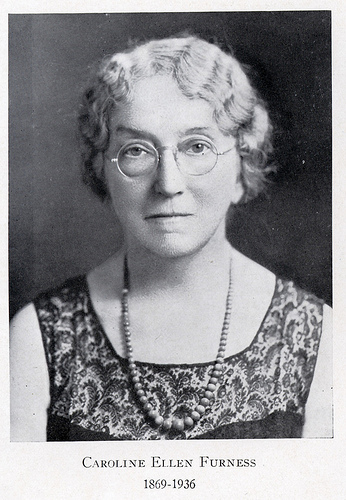 Caroline Ellen Furness (June 24, 1869 - February 9, 1936) was born in Cleveland, Ohio, on June 24, 1869, to Henry Furness, a Civil War veteran and high
school science teacher, and Caroline Sarah Baker Furness, a graduate of the North Granville Ladies’ Seminary. Her father deeply inspired her early
interest in natural history, science, and the archaeological remains of ancient Ohio. Demonstrating exceptional early academic promise, she passed the
Harvard entrance examination for women with honors at the end of high school and earned a four-year scholarship to Vassar College, entering with the
class of 1891.
Caroline Ellen Furness (June 24, 1869 - February 9, 1936) was born in Cleveland, Ohio, on June 24, 1869, to Henry Furness, a Civil War veteran and high
school science teacher, and Caroline Sarah Baker Furness, a graduate of the North Granville Ladies’ Seminary. Her father deeply inspired her early
interest in natural history, science, and the archaeological remains of ancient Ohio. Demonstrating exceptional early academic promise, she passed the
Harvard entrance examination for women with honors at the end of high school and earned a four-year scholarship to Vassar College, entering with the
class of 1891.
At Vassar, Furness excelled academically while remaining active in campus life, acting in college plays and winning the annual tennis tournament in
her senior year. Her extensive correspondence with her family—particularly her sister Mary Baker Furness—offered intimate insights into her student
years, where she formulated her progressive ideas on evolution. Years later, in her essay "Scientists, All Unitarians, Declare Their Religious Faith,"
she articulated her belief that there was no conflict between science and religion, arguing that evolution extended far beyond biology. Following her
graduation in 1891, Furness taught mathematics for a year at West Winsted High School in Connecticut and subsequently spent two years teaching in
Columbus, Ohio, while continuing her mathematical studies at Ohio State University.
In 1894, Furness returned to Vassar as a research assistant to Professor Mary Watson Whitney, marking
the beginning of a profound, lifelong personal and professional partnership. Under Whitney's mentorship, she participated in a nearly decade-long program
of comet and planet observations and was appointed an instructor in mathematics in 1895. Seeking advanced credentials, Furness began graduate studies at
Columbia University in 1896 under Harold Jacoby, supported by funding from Catherine Wolfe Bruce and Frederic Thompson. Her admission broke historic
barriers of prejudice, as the Faculty of Pure Science—which encompassed astronomy—remained officially closed to women. Furness successfully completed her
studies and earned her Doctor of Philosophy degree in 1900 with her dissertation, "Catalogue of stars within one degree of the North pole and optical
distortion of the Helsingfors astro-photographic telescope deduced from photographic measures."
Furness returned to Vassar as an instructor in astronomy in 1903 and was promoted to associate professor in 1911. From 1901 to 1912, she served as
co-editor of Observations of Variable Stars Made at Vassar College alongside Whitney, with whom she closely collaborated on variable star research from
1909 to 1911. When Whitney took a medical leave of absence in 1910, Furness stepped in to manage the department and direct the Vassar College
Observatory, officially succeeding her as director upon Whitney's retirement in 1915. She also served as chair of the astronomy department from 1910 to
1926 and again from 1927 to 1934, holding her profession to the highest standards and viewing education as a tool to foster equality and civic
responsibility rather than elitism. Vassar president Henry Nobel MacCracken later identified her specialized course on variable stars as the absolute
first of its kind offered in any American college.
In 1915, Furness published her seminal, authoritative textbook, Introduction to the Study of Variable Stars , which grew directly out of her
observational research with Whitney. The volume became a standard in the field and was nationally recognized as "among the best one hundred books written
by American women during the last century" at the 1933 Century of Progress world's fair in Chicago. Her extensive publishing record formed the
foundational numbers of the Vassar Observatory series, including her 1905 catalog funded by the Carnegie Foundation enlisting student computers, and her
1934 monograph on the observatory's longitude, which resolved historical calculations left by Maria Mitchell. Appointed the Alumna Maria Mitchell
Professor of Astronomy in 1916, Furness became a fellow of the Royal Astronomical Society in 1922 and maintained active memberships in the American
Astronomical Society, the British Astronomical Association, the American Association of Variable Star Observers, and the Astronomische Gesellschaft.
Beyond her research and teaching, Furness maintained a lifelong devotion to nature as a member of the National Audubon Society and engaged heavily in
international outreach and women's education. During the summer of 1917, she volunteered as a traveling agent for the American Red Cross. The following
year, she traveled to Japan as a representative of the Women’s Committee of the Council of National Defense, the National Organization of Public Health,
and the National Council of Women, carrying messages of friendship to foster ties between American and Japanese women. During her travels, she met Tsuda
Umeko, founder of the English Institute for Women's Studies, and subsequently published influential articles in the New York Medical Journal and the
Vassar Quarterly regarding medical and educational opportunities for Japanese women. She later embarked on a global tour from 1926 to 1927 to visit
scientific institutions, presenting a paper on the "Solar Constant of Radiation" at the Third Pan-Pacific Science Congress in Tokyo, and spent her
1934–1935 sabbatical observing the infrared solar spectrum at Mount Wilson Observatory.
Mirroring the domestic and professional traditions of pioneering academic women of her era, Furness shared a deeply committed lifelong partnership
with Mary Watson Whitney. Having first entered Whitney's orbit as an undergraduate student and resident at the observatory, Furness lived and worked
side-by-side with her mentor, co-authoring approximately 30 joint scientific papers. When Whitney's health began to fail, Furness lovingly managed the
observatory, stepped into leadership roles, and spent her later years preserving Whitney's legacy through biographical tributes.
Caroline Ellen Furness died on February 9, 1936, at Memorial Hospital in New York City at the age of 66, prompting widespread tributes from the
international scientific community. She was laid to rest at Spring Grove Cemetery in Cincinnati, Ohio, leaving behind a towering legacy in astronomical
research, institutional leadership, and the advancement of women in science.
References:
- Caroline Furness Papers (1887–1938) – Hosted at the Archives and Special Collections Library, Vassar College Libraries . This collection contains correspondence (including extensive letters exchanged with Mary Watson Whitney and her father Henry Furness), travel diaries, astronomy notebooks, photographs, and professional papers.
- Vassar College Biographical Files – Department of Archives and Special Collections, Vassar College.
- Vassar Encyclopedia – Caroline E. Furness ’1891 , detailing her academic career, student life, scientific publications, and international travels.
- Monthly Notices of the Royal Astronomical Society – Caroline Ellen Furness , Vol. 97, Issue 4 (February 1937), pages 272–273.
- British Astronomical Association – Memoir and biographical overview by M. W. Makemson.
- Furness, Caroline E. Catalogue of Stars within One Degree of the North Pole (1900)
- Furness, Caroline E. Catalog of Stars within Two Degrees of the North Pole (1905)
- Whitney, Mary W., and Furness, Caroline E. (co-editors). Observations of Variable Stars Made at Vassar College (1913)
- Furness, Caroline E. Introduction to the Study of Variable Stars (Boston: Houghton Mifflin, 1915)
- Furness, Caroline E. The Longitude of the Vassar College Observatory (1934)
- Furness, Caroline E. "Mary W. Whitney." Popular Astronomy 30 (1922): 597–608; 31 (1923): 25–36.
Support this project
This website is a passion project researched, developed, and funded entirely by me. If you find the content valuable and would like to help support the ongoing research and hosting costs, any contribution is deeply appreciated.
Thank you for keeping this independent resource alive!
My books on Amazon: Elisa Rolle's books
BACK TO HOME PAGE