Partner Anna Pfrunder
Queer Places:
University of Zurich, Rämistrasse 71, 8006 Zürich, Switzerland
Villa Ehrenberg, now Lyceum Club Zürich, Rämistrasse 26, 8001 Zürich, Switzerland
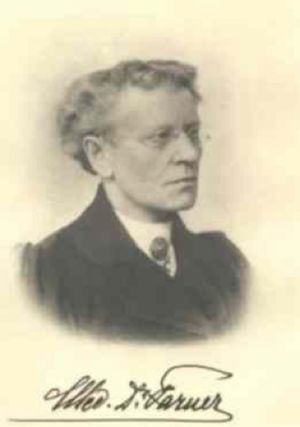 Caroline Farner (June 10, 1842 - April 8, 1913) was a pioneering Swiss physician, feminist, and social activist. She holds a significant place in history as the second woman
in Switzerland to qualify as a medical doctor, following Marie Heim-Vögtlin.
Caroline Farner (June 10, 1842 - April 8, 1913) was a pioneering Swiss physician, feminist, and social activist. She holds a significant place in history as the second woman
in Switzerland to qualify as a medical doctor, following Marie Heim-Vögtlin.
Born on June 10, 1842, in Guntershausen bei Aadorf, Farner was the youngest of seven children in a farming family. Her mother provided informal healthcare to the local
community, which influenced Farner’s eventual career path. After her mother’s death when Farner was 15, she was raised by her older sister. Before pursuing medicine, she
spent several years working as a governess in Scotland, England, and France, an experience that fueled her drive for independent professional life.
In 1871, she enrolled at the University of Zurich, one of the few institutions at the time open to women. She earned her medical degree in 1877 and subsequently underwent
further training in major European cities like Vienna, Paris, and Budapest before establishing a highly successful medical practice in Zurich.
Farner was a prominent figure in the Swiss women’s movement. Her contributions included:
She operated a large, successful practice that notably provided free consultations to the poor.
She founded a placement agency for female domestic servants and a clinic for women.
She was an active advocate for hygiene education and served as president of the Schweizer Frauen-Verband (Swiss Women's Union) from 1886 to 1891.
She managed a health center (sanatorium) in Urnäsch, which she later donated to the city of Zurich to serve as a holiday camp for children.
Caroline Farner lived with Anna Pfrunder for 32 years. Their relationship is a subject of significant historical interest,
particularly within the context of LGBTQ history in Switzerland.
The two women lived together first in the home of Pfrunder’s parents and later in their own residence, the Villa Ehrenberg in Zurich. They formed a lifelong domestic
partnership that was unconventional for the era.
Their relationship became a target for opponents of the women's movement. In 1892, Farner and Pfrunder were arrested on false charges of embezzling ward money. They spent
seven weeks in solitary confinement before being acquitted. This "scandal" was fueled by societal prejudices against independent women, and court records from the time
include disparaging remarks from officials about their decision to live together rather than adhere to traditional family structures.
Modern researchers and organizations like Lesbengeschichte (Lesbian History) view their partnership as an early example of a committed same-sex relationship that
challenged the gender roles of the 19th century.
After Farner’s death, Pfrunder remained dedicated to their shared goals. Together, they established the Anna-Caroline Foundation, which continues to award scholarships
to female students to this day. Following Pfrunder's death in 1925, their home was gifted to the Zurich section of the Lyceum Club, an international association for women.
Their story is also documented in the biographical novel by Rosemarie Keller, Ich bereue nicht einen meiner Schritte: Leben und Prozess der Ärztin Caroline Farner
("I do not regret any of my steps: The life and trial of Dr. Caroline Farner").
References:
- https://de.wikipedia.org/wiki/Caroline_Farner
- https://grokipedia.com/page/caroline_farner
- https://kids.kiddle.co/Caroline_Farner
- https://en.wikipedia.org/wiki/Caroline_Farner
Support this project
This website is a passion project researched, developed, and funded entirely by me. If you find the content valuable and would like to help support the ongoing research and hosting costs, any contribution is deeply appreciated.
Thank you for keeping this independent resource alive!
My books on Amazon: Elisa Rolle's books
BACK TO HOME PAGE