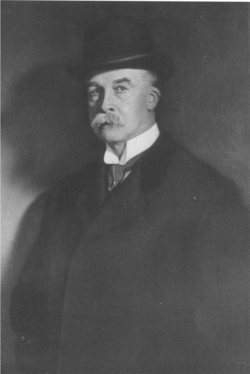
 Bodo Hugo Bernhard von dem Knesebeck (April 9, 1851 – August 6, 1911) was an influential German court official, diplomat, and philanthropist during the German Empire.
Queer Places:
Gut Corvin, 29459 Clenze, Lower Saxony, Germany
Bodo Hugo Bernhard von dem Knesebeck (April 9, 1851 – August 6, 1911) was an influential German court official, diplomat, and philanthropist during the German Empire.
Born in Munich to the Hanoverian diplomat and lieutenant general Ernst von dem Knesebeck and Agnes von Linsingen, Bodo belonged to an established aristocratic family. He served as an officer in the Life-Guard-Hussars Regiment and fought in the Franco-Prussian War (1870–1871) as an Oberleutnant in the 1st Rhenish Hussar Regiment No. 7, notably participating in the Battles of Hallue and Bapaume. During his military service, he became a close, lifelong friend and political ally of Bernhard von Bülow (who later served as Imperial Chancellor).
Knesebeck transitioned into a distinguished career as a senior imperial court official:
1887–1890: Chamberlain (Kammerherr) and Cabinet Secretary to Empress Augusta (wife of Kaiser Wilhelm I).
1890–1911: Cabinet Secretary and Chamberlain to Empress Auguste Viktoria (wife of Kaiser Wilhelm II), as well as Vice-Master of Ceremonies (Vizeoberzeremonienmeister) and Introducer of the Diplomatic Corps in Berlin.
Known for his urbane demeanor, cultural sophistication, and diplomatic tact, Knesebeck was a prominent figure in Berlin’s artistic and literary salons, including those hosted by Marie von Schleinitz.
From 1897 until his death in 1911, Knesebeck served as the first chairman of the Central Committee of the German Red Cross Associations (Deutsches Rotes Kreuz). He was also a leading figure in the national campaign against tuberculosis, establishing specialized sanatoriums across Germany. In recognition of his public health contributions, he was awarded an honorary doctorate in medicine (Dr. med. h.c.) by the Friedrich-Wilhelm University of Berlin.
Knesebeck died unmarried in Kassel in August 1911 and was buried on his family estate in Corvin.
While Bodo von dem Knesebeck himself was never publicly outed or charged with sexual offenses, his life intersected significantly with the queer history of late-19th and early-20th-century Imperial Germany:
Knesebeck moved in the same elite, aristocratic social circles as Philipp, Prince of Eulenburg-Hertefeld—the central figure of the Liebenberg Round Table (Liebenberger Kreis). Knesebeck was a frequent attendee of the cultural and literary salons where Eulenburg performed his musical compositions. This circle was famously characterized by its homoerotic artistic sensibilities and close personal bonds surrounding Kaiser Wilhelm II.
Between 1907 and 1909, the Eulenburg Affair became one of the largest political and homosexual scandals of the era. Muckraking journalist Maximilian Harden published a series of articles accusing prominent court officials, diplomats, and military leaders—including Prince Eulenburg and Berlin military governor Kuno von Moltke—of practicing homosexuality (which was criminalized under Section 175 of the German Imperial Penal Code).
As Vice-Master of Ceremonies and a key confidant to Chancellor Bernhard von Bülow (who was also targeted by activist Adolf Brand during the scandal), Knesebeck was situated at the very center of the court faction involved in managing the fallout of these sensational trials.
Like several other high-ranking officials and officers in the Kaiser's immediate environment who remained lifelong bachelors, Knesebeck never married. While contemporary family records attributed his bachelorhood to his demanding public duties, mid-to-late Wilhelmine court society was heavily scrutinized for hidden homosocial and homosexual networks among unattached imperial advisors.
Bodo von dem Knesebeck died in Kassel on August 6, 1911. Following a funeral service attended by members of the Prussian royal court and charity leadership, he was buried in his family's ancestral estate burial grounds (Gutsfriedhof) at Corvin (located in Lower Saxony/Altmark region, Germany).
References:
 Homosexuals in History, A Study of Ambivalence in Society, Literature and the Arts, 1977 by A.L. Rowse |
Other references:
Support this project
This website is a passion project researched, developed, and funded entirely by me. If you find the content valuable and would like to help support the ongoing research and hosting costs, any contribution is deeply appreciated.
Thank you for keeping this independent resource alive!
My books on Amazon: Elisa Rolle's books