Queer Places:
Neuilly-sur-Seine Old Communal Cemetery, 3 Rue Victor Noir, 92200 Neuilly-sur-Seine, France
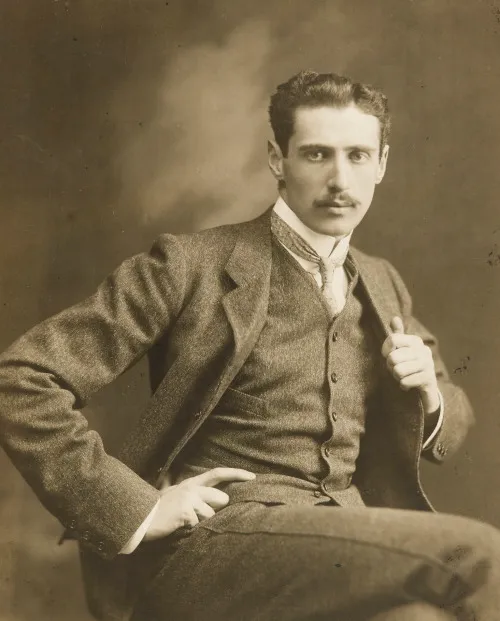 Count Bertrand Alfred Marie de Salignac-Fénelon (April 17, 1878 - December 17, 1914) was born on April 17, 1878, in the 8th arrondissement of Paris,
France, as the younger son of diplomat Léon Armand Anatole de Salignac-Fénelon and Marguerite Deschamps. Raised in an aristocratic family with a
distinguished lineage, he grew up alongside his two sisters, Marie-Louise and Françoise. A handsome young man with striking blue eyes and blond hair,
Bertrand joined diplomatic circles like his father, balancing a cosmopolitan upbringing with left-wing political sympathies, anticlerical views, and
support for Prime Minister Émile Combes.
Count Bertrand Alfred Marie de Salignac-Fénelon (April 17, 1878 - December 17, 1914) was born on April 17, 1878, in the 8th arrondissement of Paris,
France, as the younger son of diplomat Léon Armand Anatole de Salignac-Fénelon and Marguerite Deschamps. Raised in an aristocratic family with a
distinguished lineage, he grew up alongside his two sisters, Marie-Louise and Françoise. A handsome young man with striking blue eyes and blond hair,
Bertrand joined diplomatic circles like his father, balancing a cosmopolitan upbringing with left-wing political sympathies, anticlerical views, and
support for Prime Minister Émile Combes.
In the autumn of 1901, Fénelon met Marcel Proust through Prince
Antoine Bibesco. Together, the three young men formed a close-knit trio and signed a secret pact of
friendship, pledging total transparency and promising to report anything said about one another. Though Fénelon engaged in romantic relationships with
women during his youth—including a brief affair with actress Louisa de Mornand in 1901 and talked-about prospects of an engagement to Simone Arman de
Caillavet around 1908—his personal life shifted around 1908 when he privately embraced bisexual inclinations, referred to in coded fashion among his
friends as "bimetallism."
Bertrand de Salignac-Fénelon occupies a crucial position in LGBTQ+ cultural history due to his intense, passionate relationship with Marcel Proust,
who developed a deep attachment to the secretive and reserved diplomat starting in the summer of 1902. Unable to find emotional stability in Antoine
Bibesco’s womanizing nature, Proust focused his romantic devotion on Fénelon, taking him as a primary real-life model for the beloved character Robert de
Saint-Loup in À la recherche du temps perdu. A celebrated real-life moment of devotion occurred when Fénelon, ignoring social decorum, walked across the
plush banquettes of the Larue restaurant in Paris to retrieve Proust’s coat—an act of friendship Proust immortalized in his novel. The two traveled
together to Amboise, Belgium, and the Netherlands in late 1902, a period marked by Proust's profound anxiety over his unconfessed feelings toward
Fénelon, who was only beginning to process his own desires. Proust even penned an affectionate poem dedicated to "Viscount Bertrand," celebrating his
unique charm and spirit.
Fénelon pursued a professional diplomatic career, receiving his appointment as an embassy attaché in Constantinople in December 1902. His diplomatic
duties took him away from Paris for extended periods, though he reunited with Proust during holidays in 1904 and kept sporadic contact in subsequent
years. Following the outbreak of World War I, Fénelon joined the French Army as a second lieutenant in the 236th Infantry Regiment. He was killed in
action on December 17, 1914, at the age of 36 during heavy fighting at Mametz in the Somme region. His body was never recovered from the battlefield, and
a commemorative plaque was later placed in his family's chapel at the old cemetery of Neuilly-sur-Seine. Proust did not learn of Fénelon's death until
March 1915, reacting with grief expressed in moving letters to mutual acquaintances. Much of the intimate written correspondence between Proust and
Fénelon was systematically destroyed by the Salignac-Fénelon family following his death to conceal his private life and ties to queer intellectual
circles.
References:
- Proust, Marcel. Correspondance de Marcel Proust. 21 volumes. Edited by Philip Kolb. Paris: Plon, 1970–1993. (Contains Proust's letters discussing his devotion to Fénelon, their 1902 travels to Amboise and Holland, and Proust's grief upon learning of his death in 1915).
- Bibesco, Antoine, ed. Lettres de Marcel Proust à Bibesco. Paris: Lausanne, Clairefontaine, 1949. (Includes references to the "trio" friendship pact between Proust, Bibesco, and Fénelon).
- Mornand, Louisa de. "Mon amitié avec Marcel Proust." Revue de Paris (November 15, 1928). (Memoirs detailing her social circle, including her early relationship with Bertrand de Fénelon).
- Mémoire des Hommes (Ministère des Armées, France). Fiche Mort pour la France: Bertrand Alfred Marie de Salignac-Fénelon. (Official French military archive record confirming his rank as Second Lieutenant in the 236e Régiment d'Infanterie and his death on December 17, 1914, at Mametz, Somme).
- Archives de Paris (État civil, 8ème Arrondissement). (Official birth record of Bertrand de Salignac-Fénelon on April 17, 1878).
- Ministère des Affaires Étrangères (Archives diplomatiques, La Courneuve). (Personnel files regarding Fénelon’s diplomatic appointment and attaché service in Constantinople starting in December 1902).
- Tadié, Jean-Yves. Marcel Proust: A Life. Translated by Euan Cameron. New York: Viking, 2000. (Examines Fénelon as a primary real-life model for Robert de Saint-Loup, detailing the Larue restaurant banquette incident and his tragic death in WWI).
- Painter, George D. Marcel Proust: A Biography. London: Chatto & Windus, 1959–1965. (Chronicles Fénelon's place in Proust's emotional life, his "bimetallism" / bisexuality, and the destruction of his private correspondence by his family).
- Carter, William C. Marcel Proust: A Life. New Haven: Yale University Press, 2000. (Explores the diplomatic and personal dynamics of the Proust-Bibesco-Fénelon inner circle).
- Albaret, Céleste. Monsieur Proust. Edited by Georges Belmont. Paris: Robert Laffont, 1973. (Proust's housekeeper's recollections of how Proust spoke of his lost friend Fénelon in his final years).
Support this project
This website is a passion project researched, developed, and funded entirely by me. If you find the content valuable and would like to help support the ongoing research and hosting costs, any contribution is deeply appreciated.
Thank you for keeping this independent resource alive!
My books on Amazon: Elisa Rolle's books
BACK TO HOME PAGE