Queer Places:
University College London, Gower St, London WC1E 6BT, United Kingdom
Golders Green Crematorium, 62 Hoop Ln, London NW11 7NL, United Kingdom
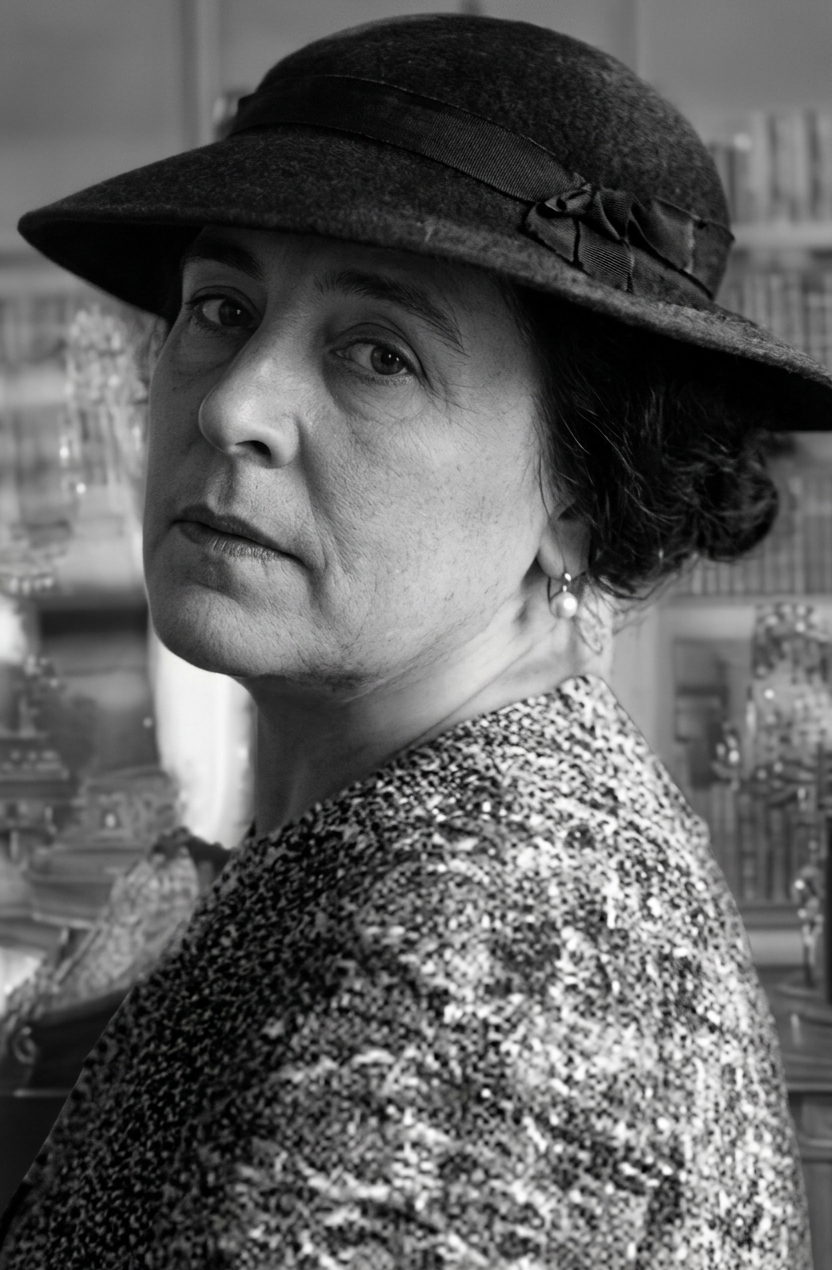 Barbara Low (July 29, 1874 – December 25, 1955), born Alice Leonora Low in London on 29 July 1874 to an Anglo-Jewish family of Hungarian descent, she
grew up as the youngest of eleven children in an intellectually active household. She was educated at the Frances Mary Buss School and
University College London before qualifying as a teacher at the Maria Grey Training College. Her early career centered on education, working in girls'
schools, teaching at Hackney Downs School during the First World War, and lecturing on history, literature, and education at the London County Council
Training College for Teachers. During these years, Low became deeply immersed in radical socialist and feminist circles, joining the Fabian Society
alongside figures like George Bernard Shaw, H. G. Wells, and
D.H. Lawrence, with whom she maintained a close correspondence.
Barbara Low (July 29, 1874 – December 25, 1955), born Alice Leonora Low in London on 29 July 1874 to an Anglo-Jewish family of Hungarian descent, she
grew up as the youngest of eleven children in an intellectually active household. She was educated at the Frances Mary Buss School and
University College London before qualifying as a teacher at the Maria Grey Training College. Her early career centered on education, working in girls'
schools, teaching at Hackney Downs School during the First World War, and lecturing on history, literature, and education at the London County Council
Training College for Teachers. During these years, Low became deeply immersed in radical socialist and feminist circles, joining the Fabian Society
alongside figures like George Bernard Shaw, H. G. Wells, and
D.H. Lawrence, with whom she maintained a close correspondence.
Low’s intersection with progressive sexology and early British LGBTQ history developed through her political and intellectual networks. Before World
War I, she belonged to the inner circle surrounding The Freewoman, a radical feminist periodical that broke Victorian taboos by openly discussing female
sexuality, sexual autonomy, and non-normative expressions of desire. This milieu provided a vital bridge to the British Society for the Study of Sex
Psychology (BSSSP), which Low officially joined in 1917. Founded by figures like
Edward Carpenter and Laurence Housman, the BSSSP served as the
primary British forum for campaigning against homophobic laws, studying sexual orientation, and promoting sex education. Within the BSSSP, Low became an
energetic organizer in its Sex Education Study Group, advocating for an uninhibited, scientific understanding of sexual instincts as a fundamental part
of human development.
Her interest in human psychology and sexology led her directly into the emerging discipline of psychoanalysis, introduced to her by her
brother-in-law, Dr. David Eder. Low traveled to Berlin to undergo training analysis with Hanns Sachs, after which she retired from teaching to dedicate
herself fully to the psychoanalytic movement. In 1919, she became a founding member of the British Psycho-Analytical Society. She made a major
contribution to psychoanalytic literature in 1920 with her introductory book Psycho-Analysis: A Brief Account of the Freudian Theory, in which she coined
the term "Nirvana principle" to describe the psyche's drive to eliminate tension—a concept Sigmund Freud famously adopted and credited to her in Beyond
the Pleasure Principle.
Throughout the rest of her professional life, Low remained a prominent intellectual voice, serving as librarian for the British Psycho-Analytical
Society, director of the Imago Publishing Company, and a clinician at the Institute for the Study and Treatment of Delinquency. During the intense
Freud-Klein Controversial Discussions of the 1940s, she aligned herself firmly with Anna Freud and Edward Glover.
In her final years, she lived in semiretirement alongside her sister Florence until her death in London on Christmas Day, 1955.
References:
Other references:
- King, Pearl, and Riccardo Steiner (Eds.). The Freud-Klein Controversies 1941–45. London: Tavistock/Routledge, 1991. (Provides documentation on Low’s role in the controversial discussions within the British Psycho-Analytical Society, her loyalty to Anna Freud and Edward Glover, and her archival contributions).
- Low, Barbara. Psycho-Analysis: A Brief Account of the Freudian Theory. London: George Allen & Unwin, 1920. (Low’s seminal introductory volume in which she formulated the "Nirvana principle," later referenced and adopted by Sigmund Freud in Beyond the Pleasure Principle).
- Maddox, Brenda. Freud's Wizard: Ernest Jones and the Transformation of Psychoanalysis. London: John Murray, 2006. (Covers the founding of the British Psycho-Analytical Society and the institutional network surrounding Low, David Eder, and Ernest Jones).
- Rubinstein, William D., Michael Jolles, and Hilary L. Rubinstein (Eds.). The Palgrave Dictionary of Anglo-Jewish History. Basingstoke: Palgrave Macmillan, 2011. (Provides biographical details regarding Low’s family background, her parents Maximillian and Therese Loewe, and her upbringing in London).
- Colman, Andrew M. "Nirvana Principle." A Dictionary of Psychology. Oxford: Oxford University Press, 2015. (Traces the lineage of the Nirvana principle from Low’s 1920 text to mainstream psychoanalytic theory).
- Greer, Julie Anne. Learning from linked lives: narrativising the individual and group biographies of the guests at the 25th Jubilee dinner of the British Psychoanalytical Society at The Savoy, London, on 8th March 1939. Doctoral dissertation, University of Southampton, 2014. (Biographical prosopography tracking Low's position within early British psychoanalysis and her educational career).
- Yorke, Clifford. "Low, Barbara (1877–1955)." International Dictionary of Psychoanalysis. Edited by Alain de Mijolla, Macmillan Reference USA, 2005. (Overview of Low's career, her analysis with Hanns Sachs in Berlin, her role as BPAS librarian, and her clinical leadership).
- The National Archives (UK). Low, Barbara, (1877–1955), psychoanalyst. Reference: GB/NNAF/P204273. (Holds official index records of her institutional correspondence and organizational papers).
- Oxford Dictionary of National Biography. Entries for related circle figures, including Low, Frances Helena (1862–1939) by Alexis Easley, detailing the intellectual and journalistic family environment in which Barbara Low was raised.
Support this project
This website is a passion project researched, developed, and funded entirely by me. If you find the content valuable and would like to help support the ongoing research and hosting costs, any contribution is deeply appreciated.
Thank you for keeping this independent resource alive!
My books on Amazon: Elisa Rolle's books
BACK TO HOME PAGE
