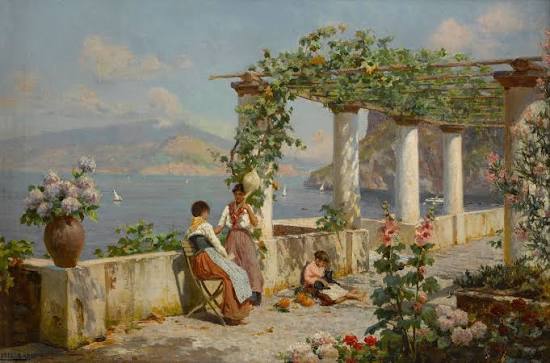
 Augusto Lovatti (1852-1921) was an Italian painter best known for his vivid marine landscapes, Orientalist scenes, and genre works capturing the Mediterranean light.
Queer Places:
Villa Flora (now Villa Mastrillo), Via Marina Piccola, 80076 Capri (NA), Italy
Augusto Lovatti (1852-1921) was an Italian painter best known for his vivid marine landscapes, Orientalist scenes, and genre works capturing the Mediterranean light.
Born in Rome in 1852, Lovatti formally trained under the historical and decorative painter Cesare Maccari (1840–1919).
By the late 1880s, Lovatti relocated to Capri—partly due to artistic inspiration and possibly influenced by political reasons in Rome.
On the island, he formed close artistic bonds with painters Antonino Leto and Bernardo Hay, while drawing inspiration from English classicists like Sir Frederic Leighton and Charles Caryl Coleman.
Lovatti specialized in plein-air oil and watercolor painting. Beyond coastal Capri, he traveled to Egypt in 1899, producing a notable series of Orientalist works.
A tall, distinguished figure with a neat mustache and Van Dyck beard, Lovatti was affectionately known across the island as "Il signore della coppola rossa" ("The gentleman with the red cap") due to the red beret he wore daily.
Local art dealer Enrico Morgano (brother of Giuseppe Morgano) routinely showcased Lovatti's paintings at his gallery near the main Piazza on Via Roma.
Lovatti married Maria Lieto, a local woman who had previously served as his model. The couple had three daughters: Flora, Italia, and Olga. Following the completion of the Marina Piccola road in 1903, Lovatti built a classical residence—Villa Flora (later known as Villa Mastrillo)—situated above the scenic road just before its first hairpin bend.
During the late 19th and early 20th centuries, Capri developed an international reputation as an artistic haven and a tolerant sanctuary for gay, bisexual, and non-conforming European intellectuals and patrons fleeing strict anti-homosexuality laws in Northern Europe.
German steel magnate Friedrich Alfred Krupp spent extended winters on Capri between 1898 and 1902. Krupp surrounded himself with a tight-knit circle of local artists, youths, and intellectuals, hosting private gatherings and funding major infrastructure on the island (including the famous Via Krupp).
Lovatti was admitted into Krupp’s inner circle of island intimates. Through Krupp’s patronage, Lovatti gained international exposure and exhibited several of his paintings in Essen, Germany.
Krupp's presence on Capri was part of a larger movement of prominent LGBTQ figures drawn to the island around 1900, including French poet Baron Jacques d'Adelswärd-Fersen (who constructed Villa Lysis), writer Oscar Wilde, and artist Charles Caryl Coleman.
While Lovatti himself married and raised a family, as a prominent painter embedded in the Morgano gallery network and Krupp’s social circle, he served as a key local connection between traditional Italian artistic life and the international LGBTQ subculture that defined Capri during the Fin de Siècle.
References:
 Capri: Island of Pleasure Hardcover – January 1, 1987 by James Money |
Other references:
Support this project
This website is a passion project researched, developed, and funded entirely by me. If you find the content valuable and would like to help support the ongoing research and hosting costs, any contribution is deeply appreciated.
Thank you for keeping this independent resource alive!
My books on Amazon: Elisa Rolle's books