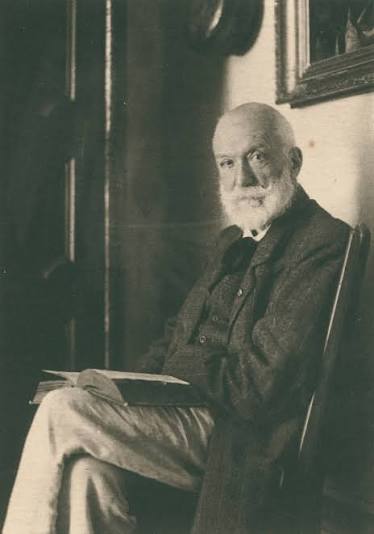
 Auguste-Henri Forel (September 1, 1848 – July 27, 1931) was a Swiss neuroanatomist, psychiatrist, entomologist (myrmecologist), and pioneer in sexology.
Queer Places:
University of Zürich, Rämistrasse 71, 8006 Zürich, Switzerland
La Fourmilière, Rue des Maisons-Neuves, 1853 Yvorne, Switzerland
Auguste-Henri Forel (September 1, 1848 – July 27, 1931) was a Swiss neuroanatomist, psychiatrist, entomologist (myrmecologist), and pioneer in sexology.
Born in Morges, Switzerland, Forel demonstrated a deep passion for natural science early in life, particularly studying the behavior and brain structure of ants.
He studied medicine at the University of Zürich and completed his doctorate in Vienna under Theodor Meynert. Forel’s foundational research on brain architecture contributed significantly to modern neurology. He was one of the early developers of the neuron doctrine—the concept that the nervous system is composed of discrete individual cells—mapping brain regions such as the Fields of Forel in the subthalamus.
In 1879, Forel was appointed professor of psychiatry at the University of Zürich and director of the famous Burghölzli Asylum. During his tenure, he transformed psychiatric care by integrating dynamic psychiatry, pioneer work with hypnotherapy, and humane treatment conditions for patients. (He was later succeeded at Burghölzli by Eugen Bleuler, who mentored Carl Jung).
Deeply interested in public health, Forel established asylum reforms and founded treatment centers for alcoholism, becoming an international leader in the temperance movement.
Parallel to his medical career, Forel published hundreds of papers on myrmecology (the study of ants), describing over 3,000 species and documenting complex social behaviors, communication, and brain structure in social insects.
In 1905, Forel published his seminal work, Die sexuelle Frage (The Sexual Question: A Scientific, Psychological, Hygienic and Sociological Study). The book became one of the most influential texts in early 20th-century sexology, translated into dozens of languages.
At a time when homosexual acts were criminalized across much of Europe, Forel advocated for radical legal reform:
He argued that homosexuality was a natural variation of human neurobiology rather than a disease, crime, or moral degeneracy.
Forel explicitly called for the legal recognition of homosexual relationships, arguing that law-abiding homosexual men and women deserved equal rights under civil law, including the right to marry or enter legal unions.
Forel was an ardent advocate for women's suffrage and economic independence:
He condemned double standards in sexual morality and demanded political, legal, and educational parity between men and women.
In Die sexuelle Frage, Forel asserted that unpaid domestic labor (housework and child-rearing) was of equal economic and social value to paid employment outside the home, urging society to compensate and respect domestic work accordingly.
After retiring from Burghölzli in 1898, Forel continued his prolific writing and social activism from his estate in Yvorne, Switzerland. In his later years, inspired by his lifelong pursuit of social justice, global unity, and peace, he embraced the Bahá'í Faith.
Forel passed away on July 27, 1931, at the age of 82. He remains remembered as a pioneer who bridged neuroscience, social science, and human rights advocacy—offering a remarkably progressive vision for gender and sexual equality decades ahead of his time.
References:
 Strangers: Homosexual Love in the Nineteenth Century Paperback – Illustrated, February 17, 2005 by Graham Robb |
Other references:
Support this project
This website is a passion project researched, developed, and funded entirely by me. If you find the content valuable and would like to help support the ongoing research and hosting costs, any contribution is deeply appreciated.
Thank you for keeping this independent resource alive!
My books on Amazon: Elisa Rolle's books