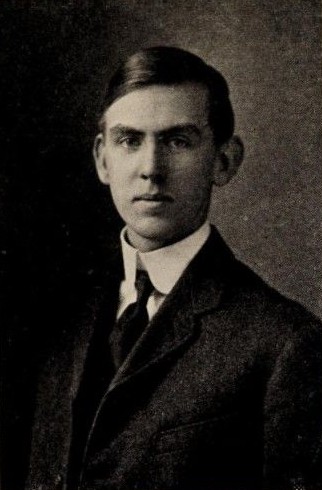
 Arthur Kingsley Porter (February 6, 1883 – July 8, 1933) was an eminent American archaeologist, art historian, and pioneering medievalist whose landmark
studies fundamentally reshaped the understanding of Romanesque sculpture and architecture.
Partner Alan Campbell
Queer Places:
Yale University (Ivy League), 38 Hillhouse Ave, New Haven, CT 06520
Columbia University (Ivy League), 116th St and Broadway, New York, NY 10027
Harvard University (Ivy League), 2 Kirkland St, Cambridge, MA 02138
Elmwood, 33 Elmwood Avenue, Cambridge, MA 02138, United States
Glenveagh Castle, Glenveagh National Park, Gartan Mountain, Church Hill, Co. Donegal, F92 HR77, Ireland
Woodland Cemetery, 66 Woodland Pl, Stamford, CT 06902, United States
Arthur Kingsley Porter (February 6, 1883 – July 8, 1933) was an eminent American archaeologist, art historian, and pioneering medievalist whose landmark
studies fundamentally reshaped the understanding of Romanesque sculpture and architecture.
Born on February 16, 1883, in Darien, Connecticut, to banker Timothy Hopkins Porter and Maria Louisa Hoyt, he hailed from an exceptionally wealthy and historically prominent family that merged two of Connecticut’s oldest pedigrees. Educated at the Browning School alongside John D. Rockefeller Jr., Porter went on to study at Yale University, graduating fourth in his class in 1904 with early plans to pursue law. However, a trip to France that same year inspired a passion for architectural history after he viewed the Coutances Cathedral, prompting him to pursue architectural studies at Columbia University from 1904 to 1906.
By age twenty-five, Porter established his reputation with the publication of Medieval Architecture: Its Origins and Development (1909). His independent wealth allowed him to travel extensively across Europe to collect photographs, study original structures, and assemble a research archive that eventually encompassed tens of thousands of images. In 1912, he married Lucy Bryant Wallace, who became his chief photographer and traveling companion as they conducted fieldwork in Italy, Greece, Spain, and Ireland. Porter began lecturing at Yale in 1915 and offered the institution a $500,000 endowment to create a dedicated art history department; when Yale declined his specific terms, he left to join a French government commission preserving war-damaged architecture.
Harvard University recruited Porter to its faculty in 1921, appointing him in 1925 as the first William Dorr Boardman Professor of Fine Arts. Still in his thirties when appointed to this chair, he was widely considered the premier medievalist of his era. During his Harvard tenure, he published foundational works including Romanesque Sculpture of the Pilgrimage Roads (1923) and Spanish Romanesque Sculpture (1928), both of which revolutionized the field by demonstrating the early spread of Romanesque styles across borders. He acquired the iconic historic mansion Elmwood in Cambridge, making it a central fixture of Boston intellectual society while opening his vast private collections to his students. In 1929, he expanded his estates by purchasing Glenveagh Castle and 30,000 surrounding acres in County Donegal, Ireland.
Beyond his traditional biography, Porter moved within a circle of prominent cultural figures connected by shared artistic interests and covert homosexual networks in early twentieth-century academic and social circles. Because he faced constant risk of public scandal during an era when exposure meant academic ruin and social ostracization, his sexuality remained hidden from official academic obituaries and university histories. Despite these risks, Porter recognized his sexuality, acted upon it, and maintained close ties with notable contemporary figures, including painter John Singer Sargent, architect Ralph Adams Cram, patron John Nicholas Brown, and poet John Wheelwright. His teaching style rejected standard lecturing in favor of collaborative analysis with small groups of students, leading to his final book dedication: "To my teachers—my Harvard students." Among these students was sculptor Joseph Coletti, a working-class prodigy sponsored by Sargent and mentored by Cram, who studied alongside Brown in Porter’s seminar.
The hidden circumstances surrounding Porter’s personal life came to light decades later through the papers of sexologist Havelock Ellis and his biographer Phyllis Grosskurth. In the summer of 1932, struggling with severe depression and the constant fear of career-ending exposure, Porter and his supportive wife visited Ellis in London to seek guidance. Ellis introduced Porter to Alan Campbell, a young aspiring novelist. Campbell subsequently moved into Elmwood, establishing a short-lived arrangement before leaving for California in late 1932. The disruption of this arrangement exacerbated Porter's returning depression, a strain referenced in his surviving correspondence from early 1933.
The official narrative of Porter's death records that he vanished on July 8, 1933, at age fifty, during a severe storm while staying at a remote fisherman's cabin he built on Inishbofin Island off the coast of Donegal. An Irish coroner’s inquest—the first held in Ireland without a recovered body—concluded he likely drowned by misadventure after falling from a cliff. Alternative accounts from Harvard historians and contemporaries suggest that Harvard President A. Lawrence Lowell had recently uncovered Porter’s sexuality and demanded his immediate resignation, prompting the tragedy.
Following his disappearance, Porter left Elmwood to Harvard University, where it has served as the official residence of the university’s president since 1970. His widow later endowed the A. Kingsley Porter Chair Professorship at Harvard and sold Glenveagh Castle to one of Porter’s former students, Henry Plumer McIlhenny. Porter’s extensive photographic collections and scholarly archives remain preserved across major institutions, including Harvard University, the Courtauld Institute of Art in London, and the National Gallery of Art in Washington, D.C.

References:
 The Crimson Letter: Harvard, Homosexuality, and the Shaping of American Culture Paperback – Illustrated, June 1, 2004 by Douglass Shand-Tucci |
Other references:
Support this project
This website is a passion project researched, developed, and funded entirely by me. If you find the content valuable and would like to help support the ongoing research and hosting costs, any contribution is deeply appreciated.
Thank you for keeping this independent resource alive!
My books on Amazon: Elisa Rolle's books