Queer Places:
Windlesham Manor, Hurtis Hill, Crowborough, East Sussex, TN6 3AA
All Saints Churchyard, Church Ln, Minstead, Lyndhurst SO43 7EX, United Kingdom
The Sherlock Holmes Museum, 221b Baker St, London NW1 6XE, United Kingdom
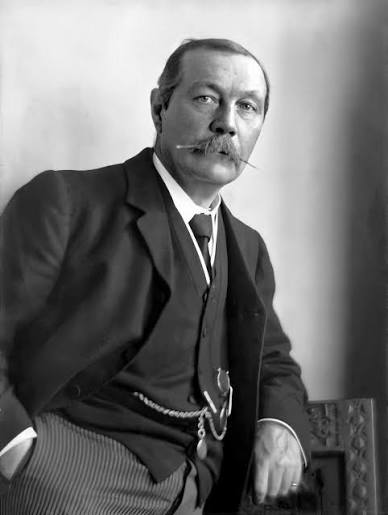 Arthur Ignatius Conan Doyle (May 22, 1859 – July 7, 1930) was born on May 22, 1859, in Edinburgh, Scotland, into a prosperous and artistic Anglo-Irish Catholic family. His
father, Charles Altamont Doyle, was a government architect who suffered from severe alcoholism and epilepsy, eventually spending his later years in institutions. His mother,
Mary Foley Doyle, was well-read, sharp-witted, and deeply influential in fostering Arthur's love for storytelling.
Arthur Ignatius Conan Doyle (May 22, 1859 – July 7, 1930) was born on May 22, 1859, in Edinburgh, Scotland, into a prosperous and artistic Anglo-Irish Catholic family. His
father, Charles Altamont Doyle, was a government architect who suffered from severe alcoholism and epilepsy, eventually spending his later years in institutions. His mother,
Mary Foley Doyle, was well-read, sharp-witted, and deeply influential in fostering Arthur's love for storytelling.
Sent away to Jesuit boarding schools—first in England and then at Stonyhurst College—Doyle developed a deep-seated rebellion against religious dogma and corporal
punishment, though he retained a lifelong fascination with mysticism. He chose medicine over art and studied at the University of Edinburgh Medical School from 1876 to 1881.
There, he was profoundly influenced by one of his professors, Dr. Joseph Bell, whose extraordinary powers of observation and deductive reasoning later served as the
blueprint for Sherlock Holmes.
During his university years, Doyle also completed his first voyage as a ship's surgeon aboard a whaler bound for the Arctic.
Doyle set up a medical practice in Portsmouth, England, in 1882. Operating out of a modest office, he had plenty of spare time while waiting for patients, prompting him
to try his hand at writing fiction.
In 1886, he wrote a short novel titled A Study in Scarlet, introducing the world to consulting detective Sherlock Holmes and his loyal companion, Dr. John Watson.
Published in 1887 in Beeton's Christmas Annual, it brought him modest recognition. It was followed by The Sign of the Four (1890).
However, true global fame arrived when Doyle began publishing short stories featuring Holmes in The Strand Magazine. Stories like A Scandal in Bohemia and The Adventure
of the Speckled Band captured the public imagination.
By 1893, Doyle had grown weary of his creation, feeling that Holmes overshadowed his more serious historical fiction (such as Micah Clarke and The White Company). In The
Final Problem, Doyle famously killed off Holmes by plunging him into the Reichenbach Falls alongside his arch-nemesis, Professor James Moriarty. Public outrage was swift;
thousands of readers canceled their subscriptions to The Strand, and many reportedly walked the streets of London wearing black mourning bands.
Doyle returned to medicine temporarily during the Second Boer War (1899–1902), serving as a volunteer physician at the Langman Field Hospital in South Africa. Upon his
return, he wrote a comprehensive book, The War in South Africa: Its Cause and Conduct, defending Britain's military involvement. For this political and literary support, he
was knighted in 1902, becoming Sir Arthur Conan Doyle.
Doyle also used his platform and forensic methods—much like his famous fictional detective—to champion justice in real life. He successfully campaigned for the
exoneration of two wrongly convicted men: George Edalji, a Parsee lawyer, and Oscar Slater, a German-Jewish bookmaker. These efforts directly contributed to the creation of
the British Court of Criminal Appeal.
In 1901, inspired by local legends heard during a trip to Dartmoor, he resurrected Sherlock Holmes in perhaps his most famous novel, The Hound of the Baskervilles. Holmes
would officially return to regular publication in 1903.
Following the devastating loss of his eldest son, Kingsley, who died from pneumonia complications after being wounded at the Battle of the Somme in World War I—along with
the deaths of his brother, two brothers-in-law, and two nephews—Doyle plunged into profound grief.
He found solace in Spiritualism, a religious movement centered on the belief that human consciousness survives physical death and can communicate with the living. Doyle
dedicated the final decade of his life entirely to this cause, writing books like The New Revelation (1918) and lecturing globally.
Sir Arthur Conan Doyle died of a heart attack on July 7, 1930, at his home in Crowborough, Sussex, at the age of 71. His last words, whispered to his wife, were: "You are
wonderful."
While Conan Doyle was a product of Victorian and Edwardian social strictures, his life intersected with several notable figures, scandals, and literary themes relevant to
LGBTQ+ history.
In June 1889, Doyle attended a historic dinner hosted by J.M. Stoddart, an American publisher, where both Oscar Wilde and Arthur
Conan Doyle were commissioned to write novels (The Picture of Dorian Gray and The Sign of the Four, respectively).
The two men got along exceptionally well, forming an amiable literary acquaintance.
Decades later, when Wilde was socially ostracized, prosecuted under the Labouchere Amendment in 1895 for "gross indecency," and imprisoned, Doyle expressed private
sympathy, maintaining that the severe anti-sodomy laws of the era were a matter for medical/psychiatric assessment ("alienists") rather than brutal criminal punishment.
One of Doyle’s most significant historical interventions involved Sir Roger Casement, a British diplomat-turned-Irish
nationalist.
Doyle and Casement initially forged a deep bond working together in the early 1900s through the Congo Reform Association, exposing the horrific atrocities committed under
King Leopold II of Belgium.
When Casement was arrested and put on trial for high treason in 1916 due to his efforts to secure German backing for Irish independence during WWI, Doyle campaigned
heavily to save his life, petitioning the government for clemency.
During the trial, the British government covertly circulated Casement's private diaries (the infamous "Black Diaries"), which detailed his numerous sexual encounters with
men, to turn public opinion against him and block clemency. Though Casement was ultimately executed, Doyle remained loyal to his memory as a humanitarian friend, viewing his
private life as separate from his character.
Doyle's brother-in-law was E.W. "Willie" Hornung, a fellow author who created the famous fictional character A.J. Raffles—a "gentleman thief" who lived and committed
crimes alongside his companion, Bunny Manders. Hornung dedicated his 1899 book The Amateur Cracksman (featuring Raffles and Bunny) to Arthur Conan Doyle. Literary historians
frequently analyze the Raffles and Bunny dynamic—a pair of bachelors sharing a domestic and criminal life—as an early archetype of coded queer or homosocial domesticity in
late-Victorian popular fiction, mirroring debates sometimes applied to Holmes and Watson.
Though Doyle explicitly wrote Sherlock Holmes and Dr. Watson as conventional Victorian men—and Doyle himself married twice and fathered five children—the domestic
arrangements of 221B Baker Street have made Holmes a recurring focal point in modern LGBTQ+ literary analysis.
Modern queer readings often examine Holmes's deep disdain for romantic love with women ("I have never known to propose any sort of love-affair") and his intense, lifelong
domestic partnership with Watson as an early blueprint for queer kinship.
Doyle's contemporaries and modern scholars alike have noted that Doyle was fully capable of depicting non-normative or alternative relationships in his broader social
circle, even if his own creative intentions for Holmes remained strictly platonic.
References:
- Gayday by Massimo Consoli, 2005
- Conan Doyle, Arthur. Memories and Adventures. London: Hodder & Stoughton, 1924.
- Conan Doyle, Arthur. The War in South Africa: Its Cause and Conduct. London: Smith, Elder & Co., 1902.
- The Roger Casement Papers and Government Circulation Files (1916).
- Lycett, Andrew. The Man Who Created Sherlock Holmes: The Life and Times of Sir Arthur Conan Doyle. London: Free Press, 2007.
- Booth, Martin. The Doctor, the Detective, and Arthur Conan Doyle: A Biography. London: Hodder & Stoughton, 1997.
- Duncan, Alistair. The Norwood Author: Arthur Conan Doyle and the Norwood Years 1891–1994. London: MX Publishing, 2010.
- Pearson, Hesketh. Conan Doyle: His Life and Art. London: Methuen & Co., 1943.
- Carr, John Dickson. The Life of Sir Arthur Conan Doyle. New York: Harper & Row, 1949.
- Dudgeon, Jeffrey. Roger Casement: The Black Diaries—With a study of his background, sexuality, and Irish political life. Belfast: Belfast Press, 2002.
- Montgomery Hyde, H. The Trials of Oscar Wilde. London: William Hodge & Co., 1948.
- Ellmann, Richard. Oscar Wilde. New York: Knopf, 1988.
Support this project
This website is a passion project researched, developed, and funded entirely by me. If you find the content valuable and would like to help support the ongoing research and hosting costs, any contribution is deeply appreciated.
Thank you for keeping this independent resource alive!
My books on Amazon: Elisa Rolle's books
BACK TO HOME PAGE