Queer Places:
Adams Academy, 8 Adams St, Quincy, MA 02169
Harvard University (Ivy League), 2 Kirkland St, Cambridge, MA 02138
University of Berlin, Unter den Linden 6, 10099 Berlin (Mitte district)
University of Freiburg, Fahnenbergplatz, 79085 Freiburg im Breisgau
Mount Auburn Cemetery, Cambridge, Middlesex County, Massachusetts, USA
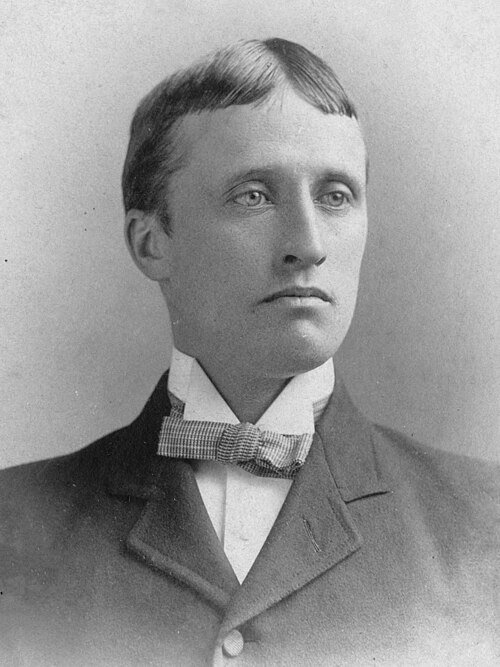 Archibald Cary Coolidge (March 6, 1866 - January 14, 1928), born on March 6, 1866, in Boston, Massachusetts, was a prominent American educator,
historian, diplomat, and the first director of the Harvard University Library. Hailing from wealthy and influential Boston Brahmin lineages, he was the
third of five boys born to Joseph Randolph Coolidge and Julia Gardner Coolidge. His distinguished lineage included being a great-grandson of U.S.
President Thomas Jefferson through his maternal great-grandparents, Thomas Mann Randolph Jr. and Martha Jefferson Randolph, and a distant relative of
President Calvin Coolidge. His prominent family background also connected him to notable figures such as U.S. Minister to France Thomas Jefferson
Coolidge and merchant Joseph Peabody.
Archibald Cary Coolidge (March 6, 1866 - January 14, 1928), born on March 6, 1866, in Boston, Massachusetts, was a prominent American educator,
historian, diplomat, and the first director of the Harvard University Library. Hailing from wealthy and influential Boston Brahmin lineages, he was the
third of five boys born to Joseph Randolph Coolidge and Julia Gardner Coolidge. His distinguished lineage included being a great-grandson of U.S.
President Thomas Jefferson through his maternal great-grandparents, Thomas Mann Randolph Jr. and Martha Jefferson Randolph, and a distant relative of
President Calvin Coolidge. His prominent family background also connected him to notable figures such as U.S. Minister to France Thomas Jefferson
Coolidge and merchant Joseph Peabody.
Coolidge pursued a rigorous education, attending seven different elementary and preparatory schools, including the Adams Academy in Quincy, before
entering Harvard College. As an undergraduate, he excelled academically and athletically, wrestled as a freshman, joined the Owl Club, and graduated
summa cum laude in history in 1887. He furthered his studies abroad at the University of Berlin, the École des Sciences Politiques in Paris, and
ultimately earned a Ph.D. from the University of Freiburg in Germany in 1892.
Beginning in 1893, Coolidge taught various history courses at Harvard, advancing from instructor to assistant professor, and finally achieving a full
professorship in history in 1908. As a faculty member, he expanded the scope of the history department by introducing the study of Latin America, the Far
East, and Slavic countries. Appointed to the Harvard Library Council in 1908 and becoming its chairman in 1909, Coolidge assumed the role of the first
director of the Harvard University Library in 1910, a position he held until his death. He revolutionized the library system, turning it into a
world-class research institution and laying the groundwork for the construction of the Widener Library. Beyond his institutional work at Harvard,
Coolidge left a lasting physical legacy on campus by building Randolph Hall on the Gold Coast in 1897. This dormitory formed a quad with Apthorp House
and became the foundation of Apthorp College, the predecessor to Adams House, noted for its bohemian character. Coolidge famously commissioned Edward
Penfield to paint unique, sensuous, and muscular athletic murals for Randolph Hall’s breakfast room, representing notable homoerotic architectural art of
the era. As a lifelong bachelor in an era when such a status carried distinct social implications, Coolidge has been associated in LGBTQ historical
contexts with a Whitmanic archetype, paralleling contemporaries like William Amory Gardner.
Parallel to his academic commitments, Coolidge pursued an active diplomatic and international career that leveraged his travel interests and linguistic
proficiency. He served as secretary to the American legation in Saint Petersburg from 1890 to 1891, private secretary to the American minister in France in
1892, and secretary to the American legation in Vienna in 1893. Following World War I, his diplomatic responsibilities expanded when he joined Woodrow
Wilson's Inquiry study group. The U.S. State Department dispatched him to Russia in 1918 to evaluate local conditions, and in 1919 he headed the Coolidge
Mission in Vienna, analyzing political affairs in Central Europe and the Balkans to advise U.S. participants at the Paris Peace Conference. In 1921, he
acted as a negotiator for the American Relief Administration, helping coordinate humanitarian aid during the Russian famine. Additionally, Coolidge
co-founded the Council on Foreign Relations and served as the inaugural editor-in-chief of its influential policy journal, Foreign Affairs, from 1922 until
his passing.
In his personal life, Coolidge maintained active involvement in preserving his ancestral heritage, serving as president of the Monticello Association
from 1919 to 1925 to care for Thomas Jefferson's historic home. He passed away at his home in Boston on January 14, 1928, at the age of sixty-one, and was
laid to rest at Mount Auburn Cemetery in Cambridge, Massachusetts.
References:
Other references:
- Coolidge, Harold Jefferson; and Lord, Robert Howard. Archibald Cary Coolidge: Life and Letters (Boston: Houghton Mifflin Company, 1932; reprinted 1971, ISBN 0-8369-6641-4).
- Bentinck-Smith, William. Building a Great Library: The Coolidge Years at Harvard (Cambridge, Mass.: Harvard University Press, 1976).
- Harvard University Archives. Papers of Archibald Cary Coolidge, 1866–1928 (Collection inventory and personal papers, Call No. HUG-1299).
- Proceedings of the American Academy of Arts and Sciences. "Archibald Cary Coolidge (1866–1928)," compiled by W. S. Ferguson, C. H. Haskins, E. F. Gay, and R. B. Merriman, vol. 64, no. 12 (1930), pp. 514–518.
- Foreign Affairs. Tasker H. Bliss, "Archibald Cary Coolidge: March 6, 1866 – January 14, 1928," vol. 6, no. 3 (1928), pp. 353–355.
- Coolidge, Archibald Cary. The United States as a World Power (New York: The Macmillan Company, 1908).
- Coolidge, Archibald Cary. The Origins of the Triple Alliance: Three Lectures (New York: Charles Scribner's Sons, 1917).
- Coolidge, Archibald Cary. Ten Years of War and Peace (New York: Harvard University Press, 1927).
- Foreign Affairs. Founding editor-in-chief from 1922 to 1928, published by the Council on Foreign Relations.
Support this project
This website is a passion project researched, developed, and funded entirely by me. If you find the content valuable and would like to help support the ongoing research and hosting costs, any contribution is deeply appreciated.
Thank you for keeping this independent resource alive!
My books on Amazon: Elisa Rolle's books
BACK TO HOME PAGE
