Queer Places:
Wellesley College (Seven Sisters), 106 Central St, Wellesley, MA 02481
Radcliffe College, Harvard University (Ivy League), 2 Kirkland St, Cambridge, MA 02138
Lakeside Cemetery, 558 N State St, Dover, DE 19901, United States
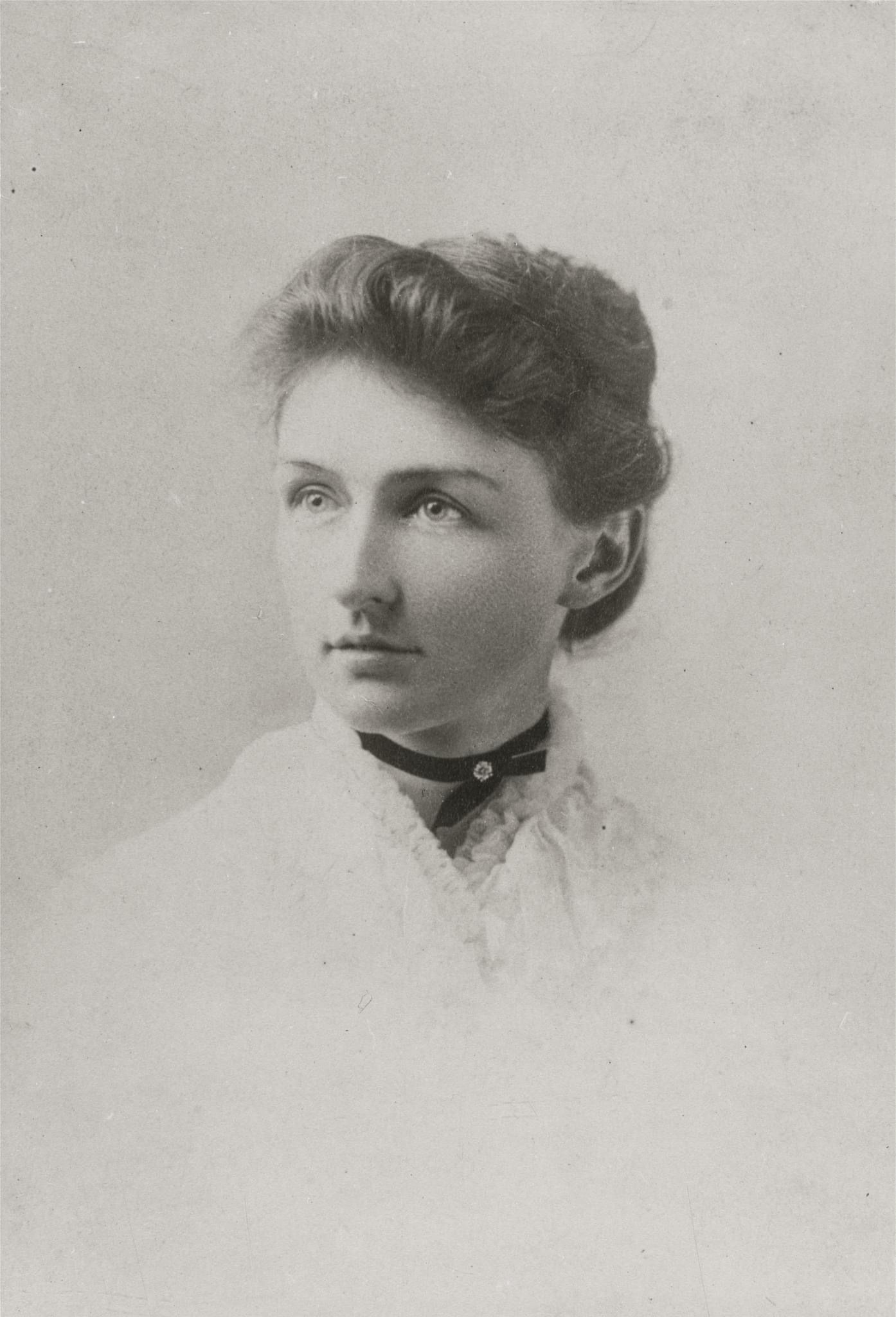 Annie Jump Cannon (December 11, 1863 – April 13, 1941) was born on December 11, 1863, in Dover, Delaware, the eldest of three daughters to Wilson Lee Cannon, a
shipbuilder and state senator, and his second wife, Mary Elizabeth Jump. Her mother was a formative influence who taught her the constellations from their attic using an
old astronomy textbook, while also fostering her interests in mathematics, chemistry, and biology. Cannon later noted that her mother’s instruction in household
economics provided her with the organizational skills necessary for her future research. After attending Wilmington Conference Academy, where she excelled in
mathematics, she enrolled at Wellesley College in 1880. There, she studied under Sarah Frances Whiting, one of the few
female physicists in the United States at the time. Cannon served as the valedictorian of her class and graduated with a physics degree in 1884.
Annie Jump Cannon (December 11, 1863 – April 13, 1941) was born on December 11, 1863, in Dover, Delaware, the eldest of three daughters to Wilson Lee Cannon, a
shipbuilder and state senator, and his second wife, Mary Elizabeth Jump. Her mother was a formative influence who taught her the constellations from their attic using an
old astronomy textbook, while also fostering her interests in mathematics, chemistry, and biology. Cannon later noted that her mother’s instruction in household
economics provided her with the organizational skills necessary for her future research. After attending Wilmington Conference Academy, where she excelled in
mathematics, she enrolled at Wellesley College in 1880. There, she studied under Sarah Frances Whiting, one of the few
female physicists in the United States at the time. Cannon served as the valedictorian of her class and graduated with a physics degree in 1884.
Following graduation, Cannon returned to Delaware for a decade, a period during which she refined her skills in photography. Her travels through Europe in 1892,
documented by her Blair box camera, led to the publication of the pamphlet "In the Footsteps of Columbus," which was distributed at the 1893 Chicago World’s Columbian
Exposition. This era of her life was also marked by a severe bout of scarlet fever, which rendered her nearly deaf. The resulting difficulty in social settings caused
her to turn inward, leading her to immerse herself more deeply in her work. The death of her mother in 1894 prompted Cannon to contact Sarah Frances Whiting to request a
teaching position. Whiting hired her as a junior physics teacher, which allowed Cannon to pursue graduate studies and gain an introduction to the burgeoning field of
spectroscopy. To access better instrumentation, she enrolled at Radcliffe College as a "special student," which facilitated her entry into the Harvard College
Observatory. In 1896, she was hired as an assistant by the observatory director, Edward C. Pickering.
As a member of the "Harvard Computers," Cannon was tasked with mapping and cataloging stars for the Henry Draper Catalogue. Though women in this role were initially
criticized for deviating from traditional domestic spheres and were often paid mere cents per hour, Cannon’s efficiency was unmatched; by 1913, she could classify 200
stars an hour, eventually cataloging more than 350,000 stars in her lifetime. Faced with conflicting classification methodologies from colleagues Antonia Maury and
Williamina Fleming, Cannon negotiated a compromise that resulted in the Harvard Classification Scheme, organizing stars into the O, B, A, F, G, K, and M spectral classes
based on Balmer absorption lines and temperature. This system was formally adopted by the International Astronomical Union in 1922 and remains the global standard.
Throughout her tenure, Cannon served as an ambassador for the observatory, brokering international partnerships and equipment exchanges. In 1911, she was named the
Curator of Astronomical Photographs at Harvard, and in 1938, she became the William C. Bond Astronomer. Her accolades included honorary doctorates from Groningen
University and Oxford University—making her the first woman to receive the latter in 1925—and the Henry Draper Medal. She also used her influence to support others,
establishing the Annie J. Cannon Prize in 1933 to honor distinguished women in astronomy. A suffragist and member of the National Women's Party, Cannon remained active
in her research until shortly before her death on April 13, 1941, in Cambridge, Massachusetts. She was buried in Lakeside Cemetery in her hometown of Dover.
The LGBTQ+ historical significance of Cannon’s career is rooted in her deep, lifelong connection to Sarah Frances Whiting and the broader networks of academic women in
the late 19th and early 20th centuries. Whiting represented a generation of pioneering women who built alternative professional and domestic lives, often forming
independent, committed partnerships that bypassed traditional marriage. Cannon herself chose not to marry or have children, dedicating her life to her work and her female
colleagues at the observatory, including Henrietta Swan Leavitt, who, like Cannon, faced the challenges of hearing
loss. By fostering an environment that supported women’s professional advancement, these figures created a vital subculture that allowed brilliant minds to thrive despite
the systemic patriarchal barriers of the era, establishing a legacy of intellectual autonomy and collaboration that is central to both scientific history and the history
of women’s independent lives.
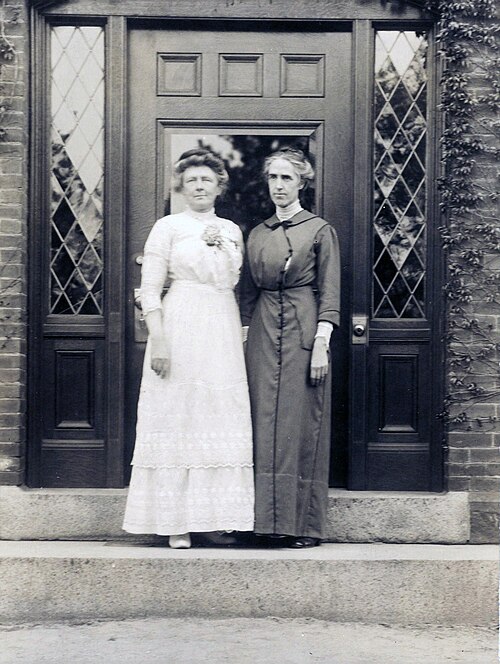
Cannon with Henrietta Swan Leavitt, 1913
References:
Other references:
- Papers of Annie Jump Cannon (HUGFP 125): Held at the Harvard University Archives, this collection documents both her personal and professional life, including diaries, autobiographical writings, and correspondence with her mother, Elizabeth Jump Cannon.
- Harvard College Observatory Records: Director Edward Charles Pickering (UAV 630.14): Contains correspondence documenting the research and administration of the Harvard College Observatory (1854–1926).
- Director Harlow Shapley (UAV 630.22): Includes records related to observatory operations and memorial tributes to Cannon.
- Related Personal Archives: Collections belonging to her colleagues and successors, such as the Margaret Mayall Personal Archive (HUM 294), the Papers of Dorrit Hoffleit (MC 529), and the Papers of Cecilia Helena Payne-Gaposchkin (HUGB P182.XX), provide context on her work environment and her legacy as a mentor.
- Wellesley College Archives: Holds additional correspondence, including letters from Cannon to Mr. and Mrs. Edward Lathrop.
- Sobel, Dava. The Glass Universe: How the Ladies of the Harvard Observatory Took the Measure of the Stars (Viking, 2016): A highly regarded narrative history that places Cannon and her colleagues within the broader context of scientific history at the Harvard College Observatory.
- Payne-Gaposchkin, Cecilia. Cecilia Payne-Gaposchkin: An Autobiography and Other Recollections (edited by Katharine Haramundanis): Offers firsthand insights from a pioneering astronomer who worked alongside Cannon and received the inaugural Annie J. Cannon Prize.
- Shapley, Harlow. "Annie J. Cannon (1863–1941)." American Philosophical Society Yearbook (1941): A classic biographical memoir written by a former director of the Harvard College Observatory.
- Greenstein, George. "The Ladies of Observatory Hill." The American Scholar (1993): An analytical article examining the professional lives of Cannon and her contemporaries.
- AIP Student Programs (American Institute of Physics): Features a detailed profile, "Annie Jump Cannon's Stellar Achievements," which provides biographical context and historical significance regarding her work as a suffragist and scientist.
- Harvard Library - "Women at the Harvard College Observatory": An online portal maintained by the Wolbach Library that serves as a central hub for researchers, offering digitized photos, notebooks, and links to relevant finding aids.
- Gerber, Carole. Annie Jump Cannon, Astronomer (Pelican Publishing, 2011): An illustrated biography suitable for younger readers or those looking for an accessible overview of her life and scientific contributions.
Support this project
This website is a passion project researched, developed, and funded entirely by me. If you find the content valuable and would like to help support the ongoing research and hosting costs, any contribution is deeply appreciated.
Thank you for keeping this independent resource alive!
My books on Amazon: Elisa Rolle's books
BACK TO HOME PAGE
