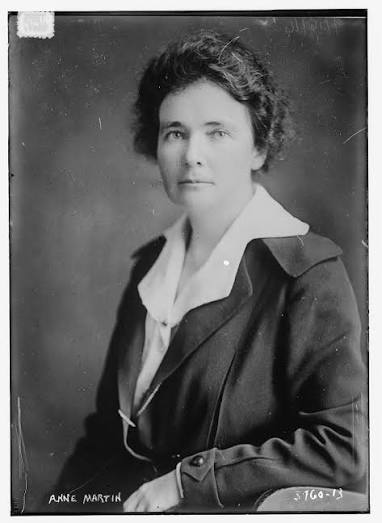
 Anne Henrietta Martin (September 30, 1875 – April 15, 1951), often nicknamed "Little Governor Anne" and writing under the pseudonym Anne O'Hara, was a
pioneering American suffragist, pacifist, author, and political trailblazer.
Anne Henrietta Martin (September 30, 1875 – April 15, 1951), often nicknamed "Little Governor Anne" and writing under the pseudonym Anne O'Hara, was a
pioneering American suffragist, pacifist, author, and political trailblazer.Partner Margaret Long
Queer Places:
University of Nevada, 1664 N Virginia St, Reno, NV 89557, United States
Stanford University, 450 Jane Stanford Way, Stanford, CA 94305, United States
Columbia University (Ivy League), 116th St and Broadway, New York, NY 10027
University of London, Senate House, Malet St, London WC1E 7HU, United Kingdom
University of Leipzig, Augustuspl. 10, 04109 Leipzig, Germany
Masonic Memorial Gardens, 437 Stoker Ave, Reno, NV 89503, United States
Anne Henrietta Martin (September 30, 1875 – April 15, 1951), often nicknamed "Little Governor Anne" and writing under the pseudonym Anne O'Hara, was a
pioneering American suffragist, pacifist, author, and political trailblazer.
Born in Empire City, Nevada, she was the daughter of William O'Hara Martin—an Irish-descended Nevada State Senator—and Louise Stadtmuller Martin, a Bavarian immigrant. Growing up alongside her siblings, Martin attended Bishop Whittaker's School for Girls in Reno and entered the University of Nevada at just sixteen years old, earning a history degree by 1894. She continued her education at Stanford University, where she earned a second B.A. in 1896 and an M.A. in history in 1897. Notably, she also became the state's first women's tennis champion and established the University of Nevada's department of history in 1897, serving as its first head before undertaking further graduate studies at Columbia University, the University of London, and the University of Leipzig, while ensuring her friend Jeanne Wier succeeded her.
Martin's worldview shifted profoundly following the death of her father in 1901, an event that catalyzed her feminist awakening as she confronted a "man-controlled world." During extensive travels through Europe and Asia, she aligned with Fabian Socialists and immersed herself in the militant British women's suffrage movement. Working alongside Emmeline Pankhurst and the Women’s Social and Political Union (WSPU), Martin was arrested in 1910 during demonstrations for women's voting rights. Though Frederick Pethick-Lawrence settled her bail, her Stanford friend Lou Henry Hoover notably sent her husband, future president Herbert Hoover, to secure Martin's release as well.
Returning to Nevada in the fall of 1911, Martin assumed leadership as president of the Nevada Equal Franchise Society in February 1912. She engineered a grueling, highly effective statewide campaign across the desert to convince male voters, culminating on November 3, 1914, when Nevada women officially won the right to vote. This monumental triumph propelled her onto the national stage as an executive committee member of the National American Woman Suffrage Association (NAWSA) and a leader in the Congressional Union. As a dedicated "Silent Sentinel," she picketed the White House with the National Woman's Party (NWP) on July 14, 1917, resulting in a brief sentence at the Occoquan Workhouse before a presidential pardon by Woodrow Wilson. In 1916, she also made history as the first national chairman of the NWP.
Expanding her political boundaries, Martin made history in 1918 as the first American woman to run for the United States Senate, launching independent campaigns in Nevada in both 1918 and 1920. Her platforms emphasized better working conditions for both men and women, the nationalization of public utilities, and the protection of natural resources and farmers. Between her senate runs, she penned influential essays urging women to establish autonomous political organizations. Throughout her life, Martin lived openly within a network of same-sex intimacies and chosen families, maintaining close personal and professional partnerships with prominent queer figures and reformers of her era, including Mabel Vernon and Dr. Margaret Long.
In 1921, Martin and her mother relocated to Carmel, California. Never marrying and continuing her lifelong social activism, she served on the national board of the American Civil Liberties Union, advocated for farmers' markets, championed the Equal Rights Amendment, and contributed entries on Josephine Butler and white slavery to the 1944 and 1948 editions of the Encyclopædia Britannica. Honored with an honorary Doctorate of Laws by the University of Nevada in 1945, Martin remained active until her death on April 15, 1951, in Carmel, leaving behind an enduring legacy as a fearless architect of American suffrage and a foundational figure in early feminist and LGBTQ history.
References:
 To Believe In Women: What Lesbians Have Done For America - A History – A Compelling Landmark Account of 19th and 20th Century Rights by Lillian Faderman |
 Public Faces, Secret Lives by Wendy L. Rouse |
Other references:
Support this project
This website is a passion project researched, developed, and funded entirely by me. If you find the content valuable and would like to help support the ongoing research and hosting costs, any contribution is deeply appreciated.
Thank you for keeping this independent resource alive!
My books on Amazon: Elisa Rolle's books