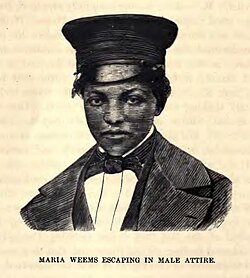
 Anna Maria Weems (c. 1840 – after 1863) was an American freedom seeker known for her daring escape from slavery in 1855 by disguising herself as a male carriage driver.
Queer Places:
Josiah Henson Museum of African-Canadian History, 29251 Freedom Rd, Dresden, ON N0P 1M0, Canada
Anna Maria Weems (c. 1840 – after 1863) was an American freedom seeker known for her daring escape from slavery in 1855 by disguising herself as a male carriage driver.
Anna Maria Weems was born in Montgomery County, Maryland, around 1840. She was the daughter of John Weems, a free man, and Arabella Talbot Weems, who was enslaved. Under the laws of the time, she inherited her mother’s enslaved status.
Her life was deeply affected by the instability of slavery:
When her owner, Adam Robb, died in 1847, the enslaved members of the family were divided among his heirs.
Weems was sold to Charles M. Price. Her mother and some of her siblings were later sold and sent to Alabama, though her mother and some siblings were eventually purchased and freed through the "Weems Ransom Fund," established by abolitionists.
Despite efforts by abolitionists to purchase her freedom, her owner, Price, consistently refused, even after being offered $700. Fearing she might escape, he reportedly forced her to sleep in his bedroom for two years.
At age 15, Weems took matters into her own hands. On September 23, 1855, she fled Rockville, Maryland, and made her way to Washington, D.C., where she hid for several weeks in the home of Quaker abolitionist Jacob Bigelow.
Abolitionists developed a plan for her to travel north disguised as a male livery worker:
She adopted the alias "Joe Wright," wearing a male driver’s uniform, including a cap, bow tie, and jacket.
With the assistance of Dr. Ellwood Harvey, a physician and fellow abolitionist, Weems posed as his carriage driver. The pair successfully navigated the journey out of the capital and through Maryland, often stopping at the homes of slaveholders who remained unaware of her true identity.
She arrived in Philadelphia on Thanksgiving Day, 1855, where she was assisted by William Still, a prominent Underground Railroad conductor. She eventually reached Brooklyn, New York, and then traveled by train to Canada with the Reverend Amos N. Freeman.
Upon reaching the Dawn Settlement in Dresden, Ontario—a community for formerly enslaved people—Weems was reunited with her aunt and uncle. She received an education at the Buxton Mission. While her family eventually joined her in Canada by 1861, historical records regarding Weems become scarce after 1863.
Her story is remembered today as a testament to the resilience of those who sought freedom through the Underground Railroad. Her escape has been documented in various works, including the book 'Stealing Freedom' by Elisa Carbone.
References:
Support this project
This website is a passion project researched, developed, and funded entirely by me. If you find the content valuable and would like to help support the ongoing research and hosting costs, any contribution is deeply appreciated.
Thank you for keeping this independent resource alive!
My books on Amazon: Elisa Rolle's books