Queer Places:
Norra Begravningsplatsen, 171 64 Solna, Sweden
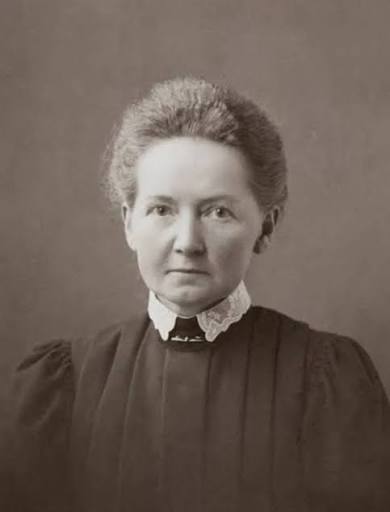 Anna Maria Augusta Cassel (March 15, 1860 - February 18, 1937) was a pioneering Swedish artist, educator, and visionary whose life and creative output remained deeply
intertwined with the spiritual and artistic avant-garde of the late nineteenth and early twentieth centuries.
Anna Maria Augusta Cassel (March 15, 1860 - February 18, 1937) was a pioneering Swedish artist, educator, and visionary whose life and creative output remained deeply
intertwined with the spiritual and artistic avant-garde of the late nineteenth and early twentieth centuries.
Born in Stockholm on March 15, 1860, Cassel dedicated her life to the pursuit of esoteric knowledge, alternative spirituality, and progressive artistic expression. While
she achieved recognition during her lifetime as a skilled painter and a dedicated drawing teacher in Stockholm schools, her historical legacy has undergone a profound
re-evaluation. Today, she is celebrated primarily as a foundational member of De Fem (The Five), an influential circle of female spiritualist artists that included the
world-renowned abstract pioneer Hilma af Klint, Sigrid Hedman, Cornelia Cederberg, and Mathilda Nilsson. Cassel passed away on
February 18, 1937, leaving behind a body of work and a collaborative history that continues to challenge traditional art historical paradigms.
Cassel’s artistic training was rooted in the rigorous academic traditions of late nineteenth-century Sweden. She studied at the Technical School (Tekniska skolan) and the
Royal Swedish Academy of Fine Arts in Stockholm, equipping her with the technical mastery necessary to navigate a male-dominated art world. Beyond her own studio practice,
Cassel earned her livelihood as an art educator, imparting classical techniques to younger generations while quietly nurturing a radical, unconventional inner life. Her
spiritual journey deepened significantly through her involvement with the Edenta circle, a Christian-spiritualist group influenced by Martinus Thorsson and later the
Theosophical Society. Through these esoteric networks, Cassel forged a profound intellectual and spiritual bond with Hilma af Klint. This shared devotion to channeling
higher spiritual dimensions culminated in 1896 with the formation of De Fem, a collective that met regularly to pray, meditate, study spiritual texts, and engage in
automatic drawing and painting years before Wassily Kandinsky, Kazimir Malevich, and Piet Mondrian established mainstream abstraction.
Within De Fem, Cassel functioned not merely as a participant but as a driving force and financial benefactor for some of the group's most ambitious endeavors. Operating
under the spiritual guidance of high-minded entities such as Ananda, Gregor, and Clemens, the collective produced a vast corpus of experimental, non-figurative works
intended for a future temple of humanity. Cassel’s hand is distinctly visible across many of the group's foundational canvases and automatic sketches, characterized by
dynamic geometries, symbolic motifs, and vibrant color palettes that sought to visualize unseen metaphysical realms. Her commitment to af Klint and the collective's mission
endured for decades. Notably, Cassel later financed and oversaw the construction of a studio pavilion on the island of Munsö at Lake Mälaren, providing a secluded sanctuary
where af Klint could execute monumental abstract commissions, including the legendary Paintings for the Temple.
In contemporary art historical discourse, research into De Fem—and particularly the intimate dynamics linking Hilma af Klint and Anna Cassel—has gained significant
traction, prompting a fundamental re-examination of early modernism. Modern scholars, curators, and feminist art historians increasingly analyze these women through a queer
lens, shedding light on lives that deliberately circumvented the patriarchal structures of their era. Cassel never married a man, choosing instead to prioritize a lifelong,
female-centered community of domestic and creative collaboration. While nineteenth- and early twentieth-century historical records often categorized independent, unmarried
women sharing households simply as lifelong companions or professional spinsters, contemporary queer historiography reinterprets these arrangements as intentional queer
kinship structures. Cassel’s domestic and professional interdependence with af Klint, alongside their shared spiritual devotion and rejection of conventional bourgeois
marriage, exemplifies a model of female autonomy and profound emotional partnership. By examining Cassel's life through this critical framework, modern scholarship
repositions her not just as a supporting figure in Hilma af Klint's shadow, but as an essential architect of a radical, queer-adjacent community that successfully forged new
paradigms for art, spirituality, and female existence.
References:
- Almqvist, Kurt, and Daniel Birnbaum (Eds.). Anna Cassel: The Saga of the Rose. Stockholm: Bokförlaget Stolpe, 2023. (Featuring the first major publication of Cassel's occult paintings and notebooks discovered in Järna).
- Almqvist, Kurt, and Daniel Birnbaum (Eds.). Hilma af Klint and The Five's Sketchbooks: No. S2, S6 and S13: 5 October 1896 – 10 January 1906. Stockholm: Bokförlaget Stolpe, 2022.
- Bashkoff, Tracey (Ed.). Hilma af Klint: Paintings for the Future. New York: Solomon R. Guggenheim Museum, 2018.
- Voss, Julia. Hilma af Klint: Life and Work. (Translated by Anne Stokes). London: Tate Publishing, 2024 (German edition published earlier). (Provides deep context on De Fem, Cassel's financial and artistic collaboration, and the network of women artists surrounding af Klint).
- Meecham, Pam. A Companion to Modern Art. Hoboken, NJ: John Wiley & Sons, 2018.
- Dyrschka, Halina (Director). Beyond the Visible – Hilma af Klint [Jenseits des Sichtbaren – Hilma af Klint]. Catchlight Films, 2019. (Documentary film exploring af Klint, Cassel, and De Fem).
Support this project
This website is a passion project researched, developed, and funded entirely by me. If you find the content valuable and would like to help support the ongoing research and hosting costs, any contribution is deeply appreciated.
Thank you for keeping this independent resource alive!
My books on Amazon: Elisa Rolle's books
BACK TO HOME PAGE