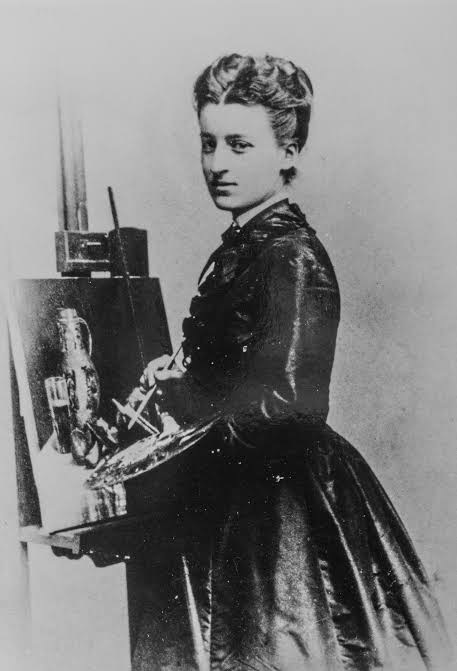
 Anna Boch (February 10, 1848 – February 25, 1936) was a pioneering Belgian Impressionist and Neo-Impressionist painter, art collector, and patron.
Partner Ida van Haelewijn
Queer Places:
Ixelles Communal Cemetery, Chaussée de Boondael 428, Ixelles, Arrondissement Brussel-Hoofdstad, Brussels-Capital Region 1050 Belgium
Anna Boch (February 10, 1848 – February 25, 1936) was a pioneering Belgian Impressionist and Neo-Impressionist painter, art collector, and patron.
Born in Saint-Vaast, Hainaut, into the wealthy family that founded the famous Boch Frères ceramics manufacture, she possessed the financial independence to entirely bypass the traditional expectations placed on 19th-century women.
Boch was a central figure in the Belgian avant-garde. She was the only female member permitted to join Les XX (The Twenty), a prominent Brussels-based group of artists dedicated to post-impressionism and new artistic expressions.
Initially trained in classical landscape painting, her style evolved rapidly under the influence of Théo van Rysselberghe. She successfully adopted Pointillism, Neo-Impressionism, and Luminism, capturing shifting coastal lights and nature with unparalleled vibrancy.
Beyond her own extensive portfolio of over 900 paintings, Boch was a legendary patron. In 1890, she famously purchased Vincent van Gogh’s The Red Vineyard (La Vigne Rouge) for 400 French francs. It is widely recognized as the only painting Van Gogh officially sold during his lifetime.
Anna Boch’s famous home and studio was a grand mansion located at the corner of rue de l'Abbaye and Chaussée de Vleurgat in the Ixelles suburb of Brussels, Belgium. Designed for her by the architect Paul Hermanus and constructed around 1901–1903, the property featured a sprawling garden and a massive interior salon custom-built to hold her private pipe organ and host her legendary avant-garde "Musical Mondays". While the historic house itself was later demolished, the location remains a significant landmark in the cultural geography of Brussels' fin-de-siècle art scene.
Upon her death in 1936, her final wish dictated that her vast art collection be sold at auction to fund a retirement fund for poor, elderly artists.
While modern labels like "lesbian" or "queer" were not framed the same way during her lifetime, Anna Boch is widely celebrated as a crucial figure in historical LGBTQ, feminist, and non-conformist anthologies.
Her life serves as a brilliant example of intentional queer resistance to heteronormative societal rules:
Boch resolutely rejected Victorian marital norms. She never married and chose to live completely autonomously, a deeply non-conforming stance for an upper-class woman of her era.
Instead of managing a traditional household, she transformed her Brussels home into a dynamic, progressive cultural salon where artists, musicians, and forward-thinking intellectuals gathered as equals.
Highly progressive and fiercely independent, she owned and drove her own car, traveling extensively across Europe entirely alone or accompanied by close female companions to paint en plein air (outdoors).
While Anna Boch protected her private life fiercely and left behind minimal explicit personal diaries, art history and the archival research highlight a few central figures who formed her intimate, highly supportive inner circle:
Ida van Haelewijn is arguably the most significant figure in Anna’s domestic and personal life. Formally hired as a housekeeper, companion, and assistant, Ida became Anna's lifelong confidante and closest trusted partner. When Anna traveled across Europe to paint en plein air, Ida was often the one by her side.
Their deep connection is anchored in a beautiful piece of art history: when Anna passed away in 1936, she specifically bequeathed some of her most treasured artwork—including paintings by her Neo-Impressionist contemporaries—to Ida. Ida cherished them deeply, and they remained safely hanging inside her home until her own passing in 1992.
In her vibrant Brussels cultural salon and her travels to artist colonies like Pont-Aven in Brittany, Anna intentionally surrounded herself with trailblazing female peers who shared her refusal to conform. While these relationships are recorded as artistic alliances, they formed the bedrock of her community.
While not a companion in a romantic or domestic sense, no discussion of Anna’s emotional landscape is complete without her younger brother, Eugène Boch. Also an avant-garde painter (and a very close friend of Vincent van Gogh), Eugène was Anna’s kindred spirit. The siblings formed a lifelong protective alliance. They frequently traveled, lived, and painted together, creating an environment where both could live entirely untethered from the heteronormative demands of high society.
By rewriting what a woman's life could look like outside of marriage and traditional family units, Anna Boch carved out a lineage of autonomy that directly resonates with LGBTQ historical recovery projects celebrating independent historical figures.
References:
Support this project
This website is a passion project researched, developed, and funded entirely by me. If you find the content valuable and would like to help support the ongoing research and hosting costs, any contribution is deeply appreciated.
Thank you for keeping this independent resource alive!
My books on Amazon: Elisa Rolle's books