Queer Places:
Cimetière Pasteur de Bagnolet, 201 Rue Sadi Carnot, 93170 Bagnolet, France
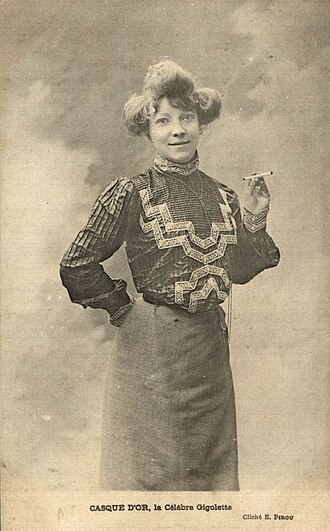 Amélie Élie (March 14, 1878 - April 6, 1933) entered the world on March 14, 1878, born at the Hôtel-Dieu in Orléans, France, to Gustave Jean Élie, a
tinsmith, and Marie-Louise Delacourtie. Her family eventually relocated to the 11th arrondissement of Paris, an industrial, working-class neighborhood
marked by hardship and poor living conditions. At just thirteen years old, Élie ran away with a slightly older boy. After repeated escape attempts, her
parents severed ties, leaving her to navigate the Parisian streets entirely on her own.
Amélie Élie (March 14, 1878 - April 6, 1933) entered the world on March 14, 1878, born at the Hôtel-Dieu in Orléans, France, to Gustave Jean Élie, a
tinsmith, and Marie-Louise Delacourtie. Her family eventually relocated to the 11th arrondissement of Paris, an industrial, working-class neighborhood
marked by hardship and poor living conditions. At just thirteen years old, Élie ran away with a slightly older boy. After repeated escape attempts, her
parents severed ties, leaving her to navigate the Parisian streets entirely on her own.
During this vulnerable period, she was taken under the wing of Hélène de la Courtille, a higher-earning prostitute who acted as her mentor and
introduced her to the trade. Hélène was notable within her social sphere for her open same-sex desires and relationships, marking a key LGBTQ connection
in Élie's early life on the Parisian margins. Élie subsequently came under the protection of a pimp named Bouchon, whose violent nature and impossible
financial demands eventually forced her to flee his control.
Seeking safety, Élie aligned herself with Joseph Pleigneur, known as Manda, the twenty-two-year-old leader of the prominent "Les Orteaux" Apache gang.
Manda asserted his claim over Élie by stabbing Bouchon, initiating a cycle of underworld violence. When Manda's unpredictable behavior and neglect led
Élie to leave him for Dominique François Eugène Leca, a fierce rivalry erupted between the two gang leaders. Manda and his associates repeatedly targeted
Leca in high-profile attacks, culminating in stabbings and gunshots that drew massive attention from the French press. The media sensationalized Élie,
dubbing her "Casque d'Or" ("Golden Helmet") for her striking golden hair and portraying her as a captivating femme fatale who manipulated rival
gangsters.
The legal fallout in May 1902 transformed the Parisian feud into a national sensation. Élie testified at the trial, breaking the strict Apache code of
secrecy by revealing inner gang details to the court and press. Manda received a sentence of life forced labor, while Leca was banished to a penal colony
for eight years.
Capitalizing on her sudden notoriety, Élie published her accounts in the periodical Fin de Siècle, posed for artists, and briefly performed in
theatrical productions. As her fame waned, she transitioned into a quieter life, marrying a shoemaker named André Alexandre Nardin in January 1917 and
helping raise his four children. She lived out her remaining years in relative obscurity until her death from an unstated illness on April 6, 1933, at
the age of fifty-five. Her dramatic legacy was later immortalized in Jacques Becker's acclaimed 1952 film Casque d'Or, starring Simone Signoret.
References:
Other references:
- Archives of the French Press / Gallica (Bibliothèque nationale de France): Original reporting from 1902 newspapers including Le Petit Journal, Fin de Siècle, and other Belle Époque French periodicals covering the Manda–Leca trial and the Apache underworld.
- Official Civil Records: The civil registry of Orléans (birth record, March 14, 1878) and official marriage/death registers (Bagnolet civil records, April 6, 1933).
- Élie, Amélie. Mémoires de Casque d'Or (originally serialized in 1902; modern published editions include Mémoires de Casque d'Or, Éditions L'Apprentie, 2022).
- Dupouy, Alexandre. Casque d'Or, une histoire vraie. Paris: La Manufacture de livres / Éditions Astarté, 2015.
- Leveau-Fernandez, Madeleine. Amélie Elie, dite Casque d'Or. Paris: Calmann-Lévy, 1999.
- Drachline, Pierre, and Claude Petit-Castelli. Casque d'Or et les Apaches. Paris: Renaudot et Cie, 1990.
- Montarron, Marcel. Histoire du milieu, de Casque d'Or à nos jours. Paris: Plon, 1969.
- Lanoux, Armand. "La vraie Casque d'Or." In Gilbert Guilleminault (Ed.), Le Roman vrai de la IIIe République: La Belle Époque. Paris: Denoël, 1958.
- Goetzinger, Annie. Légende et réalité de Casque d'Or. Glénat, 1976.
- Galandon, Laurent, and Kas. La Fille de Paname (2 volumes). Le Lombard, 2011–2014.
- Casque d'Or (1952), directed by Jacques Becker, starring Simone Signoret.
- "La véritable histoire de Casque d'Or", episode of L'Heure du crime (RTL radio broadcast, December 29, 2015).
Support this project
This website is a passion project researched, developed, and funded entirely by me. If you find the content valuable and would like to help support the ongoing research and hosting costs, any contribution is deeply appreciated.
Thank you for keeping this independent resource alive!
My books on Amazon: Elisa Rolle's books
BACK TO HOME PAGE
