Queer Places:
Eton College, Windsor SL4 6DW, United Kingdom
University of Cambridge, 4 Mill Ln, Cambridge CB2 1RZ
St John the Baptist Churchyard, Hall Dr, Hagley, Stourbridge DY9 9LG, United Kingdom
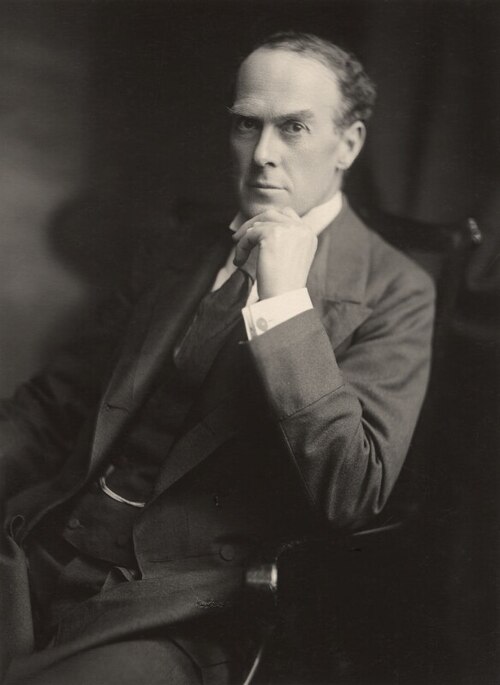 The Honourable Alfred Lyttelton (February 7, 1857 – July 4, 1913) was born on February 7, 1857, in Westminster, London, coming into a prominent, politically connected, and
exceptionally athletic British family. He was the twelfth and youngest child born to George William Lyttelton, 4th Baron Lyttelton, and his first wife, Mary, who was a
daughter of Sir Stephen Glynne, 8th Baronet. His lineage placed him at the heart of the Victorian establishment, with future Prime Minister William Ewart Gladstone serving
as an uncle by marriage. Growing up alongside a large and accomplished sibling group that included brothers who would achieve distinction in military, ecclesiastical, and
public life—such as General Sir Neville Lyttelton and Bishop Arthur Lyttelton—Alfred displayed an extraordinary natural aptitude for physical pursuits and intellectual
engagement from an early age.
The Honourable Alfred Lyttelton (February 7, 1857 – July 4, 1913) was born on February 7, 1857, in Westminster, London, coming into a prominent, politically connected, and
exceptionally athletic British family. He was the twelfth and youngest child born to George William Lyttelton, 4th Baron Lyttelton, and his first wife, Mary, who was a
daughter of Sir Stephen Glynne, 8th Baronet. His lineage placed him at the heart of the Victorian establishment, with future Prime Minister William Ewart Gladstone serving
as an uncle by marriage. Growing up alongside a large and accomplished sibling group that included brothers who would achieve distinction in military, ecclesiastical, and
public life—such as General Sir Neville Lyttelton and Bishop Arthur Lyttelton—Alfred displayed an extraordinary natural aptitude for physical pursuits and intellectual
engagement from an early age.
He was educated at Eton College, where his leadership and athletic capabilities immediately set him apart, culminating in his role as President of Pop. Following his time
at Eton, he entered Trinity College, Cambridge, in 1875. At university, Lyttelton immersed himself fully in undergraduate life, joining the University Pitt Club and becoming
a member of the prestigious Cambridge Apostles intellectual society. His academic path led him through the History Tripos,
earning his Bachelor of Arts degree in 1879, followed later by a Master of Arts in 1899. During his Cambridge years, his legendary sporting versatility flourished. He earned
university blue ribbons across an astonishing range of disciplines, representing the institution in cricket, association football, athletics, racquets, and real tennis. His
athletic prowess was so complete that he stood alongside Oxford's Cuthbert Ottaway as the pre-eminent sportsman of his generation.
Lyttelton's sporting career achieved rare historical milestones. In football, he played as a formidable forward for the Old Etonians, appearing in the 1876 FA Cup Final
and earning a single cap for the England national team against Scotland in 1877, during which he scored England's only goal. On the cricket pitch, he established himself as
a brilliant first-class batsman and wicket-keeper, captaining Cambridge University in 1879 and subsequently playing county cricket for Middlesex. His reputation reached the
international stage when he represented England in four Test matches against Australia during the early 1880s. His most famous cricketing feat occurred during the 1884 Test
match at The Oval, where, with Australia commanding a massive score and the regular bowling attack exhausted, England captain Lord Harris asked Lyttelton to switch roles
with wicket-keeper W. G. Grace. Bowling underarm lobs, Lyttelton remarkably captured the final four Australian wickets for just 19 runs. Beyond his playing days, his
administrative influence in sports remained strong, and he served as President of the Marylebone Cricket Club in 1898.
Upon completing his studies at Cambridge, Lyttelton turned his focus toward the legal profession. He was admitted to the Inner Temple in 1878 and called to the Bar in
1881, subsequently serving as legal private secretary to Attorney-General Sir Henry James. His legal career progressed steadily through public appointments, including
serving as Recorder of Hereford and later Oxford, Chancellor of the Diocese of Rochester, and Deputy High Steward of the University of Cambridge. He was made a Queen's
Counsel in 1900 and achieved Privy Council membership in 1903.
Transitioning into national politics as a Liberal Unionist, Lyttelton entered the House of Commons in 1895 as the Member of Parliament for Warwick and Leamington, later
representing St George's, Hanover Square, from 1906 until his death. In 1900, Joseph Chamberlain dispatched him to South Africa to chair the committee planning post-Boer War
reconstruction, an assignment that brought him high praise from Alfred Milner. When Chamberlain resigned in 1903, Lyttelton succeeded him as Secretary of State for the
Colonies, serving until 1905. His tenure was defined by ambitious plans for imperial decentralization and the controversial authorization of Chinese indentured labor in
South Africa, a policy that became a significant political liability for his party in the 1906 general election. After leaving ministerial office, he remained a prominent
opposition figure in Parliament, supporting women's suffrage and opposing Welsh disestablishment.
Throughout his life, Lyttelton was celebrated not only for his public achievements but for an extraordinary personal magnetism and warmth that drew widespread admiration
from contemporaries, who noted that his presence brought an irresistible charm to any circle. He and both of his wives were central figures within "The Souls," an elite
intellectual and social coterie of late-Victorian Britain. His personal life was marked by both deep romance and profound tragedy. In 1885, he married Octavia Laura Tennant,
daughter of Sir Charles Tennant. Tragically, Laura died just a year later in 1886 shortly after giving birth to their only child, a son who also died in infancy. Her memory
deeply affected Lyttelton and inspired artistic tributes, including a memorial designed by Edward Burne-Jones. In 1892,
Lyttelton married his second wife, Edith Sophy Balfour, with whom he had three children, including Oliver Lyttelton, who later became the prominent politician and
businessman created Viscount Chandos in 1954. Regarding any historical LGBTQ links, while prominent intellectual circles of the era like the Cambridge Apostles and The Souls
frequently fostered intense, complex homosocial and romantic idealizations among their members, historical records and biographies of Alfred Lyttelton center squarely on his
conventional marriages and deeply affectionate heterosexual family life, leaving no documented evidence of same-sex partnerships.
Lyttelton's life was cut short by a freak accident in the summer of 1913, when he was struck in the abdomen by a cricket ball during a match while visiting South Africa.
Though he returned to Britain, he fell severely ill at the Foreign Office, and exploratory surgery revealed an internal abscess. Medical intervention failed, and he passed
away in a London nursing home on July 5, 1913, at the age of 56. His funeral took place on the exact day of the annual Varsity cricket match between Oxford and Cambridge at
Lord's. In a rare and poignant tribute to a man universally loved across the sporting and political worlds, play was suspended for two minutes while the entire crowd stood
uncovered in his memory.
References:
Other references:
- Lyttelton, Edith Sophy Balfour. Alfred Lyttelton, an account of his life. London, New York: Longmans, Green and Co., 1917.
- Matthew, H. C. G. "Lyttelton, Alfred". Oxford Dictionary of National Biography. Oxford University Press (online edition).
- Encyclopædia Britannica (12th edition, 1922 and subsequent supplements): "Lyttelton, Alfred".
- Dictionary of National Biography (1927 Supplement). London: Oxford University Press, 1927.
- Foster, Joseph. Men-at-the-Bar: A Biographical Hand-List of the Members of the Various Inns of Court. London: Hazell, Watson and Viney, 1885.
- The Book of Blues (compiled records of Oxford and Cambridge athletic/sporting blues).
- Venn, J. A., Alumni Cantabrigienses: A Biographical List of All Known Students, Graduates and Holders of Office at the University of Cambridge, from the Earliest Times to 1900. Cambridge University Press, 1922–1954.
- The Papers of Alfred Lyttelton, Dame Edith Lyttelton, and Oliver Lyttelton (1st Viscount Chandos). Churchill Archives Centre, University of Cambridge.
- Hansard 1803–2005: Parliamentary contributions and legislative record for the Hon. Alfred Lyttelton.
Support this project
This website is a passion project researched, developed, and funded entirely by me. If you find the content valuable and would like to help support the ongoing research and hosting costs, any contribution is deeply appreciated.
Thank you for keeping this independent resource alive!
My books on Amazon: Elisa Rolle's books
BACK TO HOME PAGE
