Queer Places:
Casa Natal de Santos Dumont, BR-499 - Mantiqueira, Santos Dumont - MG, 36240-000, Brazil
114 Av. des Champs-Élysées, 75008 Paris, France
Casa de Santos Dumont, R. do Encanto, 22 - Centro, Petrópolis - RJ, 25685-081, Brazil
Cemitério de São João Batista, R. General Polidoro, 245 - Botafogo, Rio de Janeiro - RJ, 22281-033, Brazil
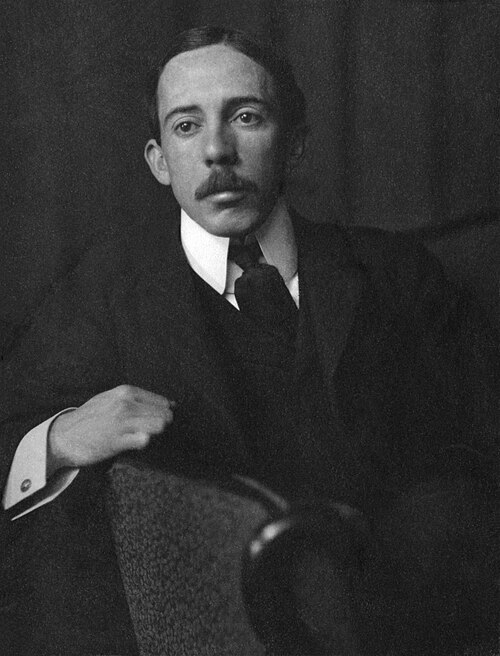 Alberto Santos-Dumont (July 20, 1873 – July 23, 1932), born on July 20, 1873, in Palmira (now the city of Santos Dumont, Brazil) and tragically ending his
life on July 23, 1932, in Guarujá, stands as one of the most celebrated aviation pioneers in history, often credited by experts with achieving the first
successful public flight of a heavier-than-air airplane. Spending the majority of his adult life in France, Santos-Dumont immersed himself in the Belle
Époque technological boom, initially designing and piloting numerous free balloons and pioneering early motorized airships. His relentless drive for
heavier-than-air flight culminated in October 1906 at Bagatelle near Paris, where he piloted his famous 14-bis aircraft to complete the first officially
observed, public, and controlled airplane flight. Uniquely, he remains the first person to hold pilot credentials across all three major early aeronautical
categories: balloon, dirigible, and airplane.
Alberto Santos-Dumont (July 20, 1873 – July 23, 1932), born on July 20, 1873, in Palmira (now the city of Santos Dumont, Brazil) and tragically ending his
life on July 23, 1932, in Guarujá, stands as one of the most celebrated aviation pioneers in history, often credited by experts with achieving the first
successful public flight of a heavier-than-air airplane. Spending the majority of his adult life in France, Santos-Dumont immersed himself in the Belle
Époque technological boom, initially designing and piloting numerous free balloons and pioneering early motorized airships. His relentless drive for
heavier-than-air flight culminated in October 1906 at Bagatelle near Paris, where he piloted his famous 14-bis aircraft to complete the first officially
observed, public, and controlled airplane flight. Uniquely, he remains the first person to hold pilot credentials across all three major early aeronautical
categories: balloon, dirigible, and airplane.
Born to Henrique Honoré Dumont and Francisca de Paula Santos as the sixth of eight children, Alberto grew up with a strong foundation in engineering,
influenced by his father, a wealthy coffee planter and civil engineer trained at the École Centrale des Arts et Manufactures in Paris. After spending his
early childhood on the Cabangu farm and witnessing his first manned balloon flight in São Paulo at age 15, Santos-Dumont moved to Paris in 1891, where he
quickly focused his inventive energy on internal combustion engines and aeronautics. By 1898, he was actively constructing free balloons, such as the
ultra-light Brazil, and soon transitioned to building non-rigid airships. His innovative spirit defined Parisian skies as he maneuvered his airships
through the city, famously circling the Eiffel Tower in 1901 to win the prestigious Deutsch de la Meurthe prize and frequently landing his personal
airship, La Baladeuse, right outside his apartment on the Avenue des Champs-Élysées.
Frustrated by the military implications and growing industrialization of airships, Santos-Dumont shifted his focus entirely to heavier-than-air flight
in the mid-1900s. Following tests with his cellular biplane framework, he perfected the 14-bis and later developed the ultra-light Demoiselle monoplanes,
which became precursors to modern ultralight aircraft and were so user-friendly that he freely distributed their blueprints to the public via Popular
Mechanics. His contributions extended beyond aviation mechanics; when he needed to track his flight times without letting go of his aircraft controls, he
famously commissioned his friend Louis Cartier to design a practical timepiece worn on the wrist with a leather strap, giving rise to the iconic Cartier
Santos wristwatch and forever changing men's fashion.
Despite his immense fame, heroism, and accolades—including becoming a Commander of the Legion of Honour—Santos-Dumont's later years were marked by
profound physical and emotional distress. He began suffering from multiple sclerosis and severe nervous exhaustion, leading to his retirement from aviation
in 1910. Relocating to Normandy, he faced devastating xenophobic suspicions at the outbreak of World War I when local gendarmerie falsely accused him of
being a German spy due to his foreign accent and astronomical telescope. Heartbroken, he destroyed his remaining papers and returned to Brazil. Deeply
pacifist, he was horrified to see aviation weaponized in warfare, writing public manifests lamenting that his creations were used to kill brothers.
Suffering from advanced multiple sclerosis and falling into a deep depression upon seeing aircraft used to bomb civilians during the 1932 Constitutionalist
Revolution, Santos-Dumont took his own life in a Guarujá hotel. Today, he is remembered worldwide through museums like the Cabangu Foundation and his
Petrópolis chalet, recognized eternally as a visionary dreamer who first taught humanity how to truly conquer the skies.
Alberto Santos-Dumont never married and had no public relationships with women. While historical inquiry into the private lives of 19th- and early
20th-century bachelors often reveals complex realities shaped by the social criminalization and strict moral codes of their era, modern biographies and
cultural analyses frequently acknowledge his prominent place within queer history. Living openly as a solitary, elegant bachelor within the bohemian and
artistic circles of Paris—where homosocial and homosexual subcultures flourished during the Belle Époque—Santos-Dumont's lifestyle, intense male
friendships, and distinct personal presentation have led many modern historians and LGBTQ+ researchers to view him as part of the rich tapestry of
historical figures who lived outside conventional heteronormative frameworks.
References:
Other references:
- My Airships: The Story of My Life (originally published in French as Dans l'air, 1904) — Santos-Dumont's own autobiographical account detailing his early life on the Brazilian coffee plantation, his transition to free-ballooning, and the technical mechanics behind building and navigating his early airships.
- "How to Build an Aeroplane," Popular Mechanics (June 1910) — The complete design plans and construction specifications for the Demoiselle (Type 20) monoplane, which Santos-Dumont freely published for public use.
- Hoffman, Paul. Wings of Madness: Alberto Santos-Dumont and the Invention of Flight (New York: Hyperion / Fourth Estate, 2003) — A comprehensive, critically acclaimed English-language biography covering his life in Belle Époque Paris, his aeronautical achievements, and his later struggles with illness.
- Fairchild, Nancy. Santos-Dumont: A Study in Obsession (New York: Harcourt, Brace & World, 1963) — A classic, detailed biographical study exploring the inventor's intense dedication to early flight and his psychological profile.
- Fonseca, Gondin da. Santos Dumont: O Pioneiro da Aviação (Various Brazilian editions) — A prominent Brazilian biographical work examining his national legacy and technical impact on aviation.
- The Cabangu Museum (Museu de Cabangu): Located at his birthplace on the historic Cabangu farm in Santos Dumont, Minas Gerais, Brazil; houses personal documents, family artifacts, and replicas of his inventions.
- The Santos Dumont House-Museum (O Encanto): Located in Petrópolis, State of Rio de Janeiro, Brazil; preserves the summer chalet he designed himself in 1918, along with his personal library and belongings.
- Musée de l'Air et de l'Espace (Le Bourget, France): Holds extensive photographic archives, remaining components, and full-scale replicas of the Demoiselle and other experimental aircraft.
Support this project
This website is a passion project researched, developed, and funded entirely by me. If you find the content valuable and would like to help support the ongoing research and hosting costs, any contribution is deeply appreciated.
Thank you for keeping this independent resource alive!
My books on Amazon: Elisa Rolle's books
BACK TO HOME PAGE
