Partner André Brouillet
Queer Places:
Hôtel Marigny, 11 rue de l'Arcade, Paris, France
Bal des trois Colonnes, 51, rue de Lappe, 11th Arrondissement, Paris, France
Cimetière du Père-Lachaise, Paris, Département de Paris, Île-de-France, France
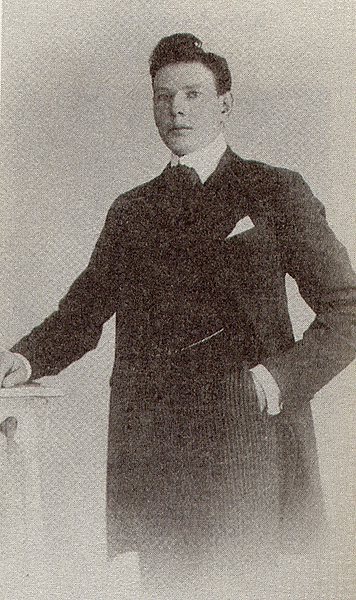 Albert Le Cuziat (1881–1938) was a prominent figure in early 20th-century Parisian queer history, best known as a confidential associate to high-society
gay men, an establishment owner, and a principal real-life inspiration for the character Jupien in Marcel Proust’s In Search of Lost Time.
Albert Le Cuziat (1881–1938) was a prominent figure in early 20th-century Parisian queer history, best known as a confidential associate to high-society
gay men, an establishment owner, and a principal real-life inspiration for the character Jupien in Marcel Proust’s In Search of Lost Time.
Born into a modest working-class family in Tréguier, Brittany, to a carter father and a maid mother, Le Cuziat relocated to Paris in his youth. There,
he entered service as a footman and valet in aristocratic households. His early employers included Prince
Constantin Radziwill—a figure known for his open homosexuality at the Château d'Ermenonville—as well as
Countess Greffulhe, Prince Orloff, and the Duke of Rohan.
During his years in aristocratic service, Le Cuziat developed an impressive knowledge of noble genealogies, protocol, and high-society gossip. His
sharp intellect and social memory caught the attention of Marcel Proust when the two met around 1911. Proust
frequented Le Cuziat for insider intelligence regarding the French aristocracy, nicknaming him "my living Gotha" and noting that he possessed "the
knowledge of Pico della Mirandola and the wit of Madame du Deffand." Le Cuziat provided the
author with precise details regarding the private lives, affairs, and vices of the Parisian elite in exchange for generous tips.
Leveraging his background and connections, Le Cuziat transitioned from high-society domestic service to operating private establishments catering to
gay clientele. In 1913, reportedly assisted by financial support from Proust, he opened a male bathhouse (établissement de bains) on rue Godot-de-Mauroy.
In June 1917, he acquired the Hôtel Marigny at 11 rue de l'Arcade, operating it as a discreet male brothel and meeting place for upper-class men and
working-class youths. Proust famously gifted Le Cuziat pieces of inherited family furniture to furnish the establishment, an event later depicted in
Proust's novel when the Narrator presents Aunt Léonie's furniture to Jupien.
The Hôtel Marigny was placed under police surveillance, leading to a notable raid on the night of January 11–12, 1918, led by Deputy Chief of Police
Tanguy. Police discovered Le Cuziat in a ground-floor parlor drinking champagne with several guests, including Marcel Proust, who was booked by the
authorities as a 46-year-old independent person of means (rentier). Following the raid, Le Cuziat was convicted on May 5, 1918, by the Seine tribunal for
corruption of minors (excitation de mineurs à la débauche) and sentenced to four months in prison and a fine of 200 francs.
After relinquishing the Hôtel Marigny in April 1922, Le Cuziat continued managing private venues in Paris. He acquired a furnished house on
rue Saint-Augustin, which was raided again in December 1923, resulting in further legal charges. In his later years, he managed an establishment on
rue Saint-Lazare and owned the Bal des trois Colonnes, a famous venue frequented by cross-dressers, sex workers, and queer patrons. Le Cuziat lived with
his companion, a young man named André Brouillet, who managed his affairs during periods of police detention and served as another model within Proust's
circle of acquaintances.
In addition to inspiring the character of Jupien, Le Cuziat interacted directly with literary figures of the era who recorded their impressions of
him. Céleste Albaret described him as a blond Breton with cold blue eyes, while literary figures such as
Maurice Sachs, Walter Benjamin, and Léon Pierre-Quint documented their encounters with him, highlighting his
role as a living archive of Parisian underground life.
Albert Le Cuziat died in 1938 in Paris. He is buried in the Père Lachaise Cemetery in Paris.
References:
- Paris Police Prefecture Archives (Archives de la Préfecture de Police de Paris): Official police surveillance reports, inspection records, and raid summaries detailing Le Cuziat's management of the male brothel at the Hôtel Marigny (11, rue de l'Arcade), the bathhouse on rue Godot-de-Mauroy, and his establishment on rue Saint-Augustin.
- Police Report of January 19, 1918 (Inspector Tanguy): The official account detailing the police raid on the Hôtel Marigny during the night of January 11–12, 1918, which recorded the arrest of Le Cuziat and the presence of Marcel Proust.
- Seine Tribunal Judicial Records (May 5, 1918): Legal documentation detailing Le Cuziat's conviction and four-month prison sentence for corruption of minors (excitation de mineurs à la débauche).
- Paris Commercial Directories (Annuaires commerciaux de Paris): Historical trade registries documenting Le Cuziat's public business listings, including the 1918 entry for the Hôtel Marigny (Le Cuziat Hôtel Marigny, r. de l’Arcade, 11).
- Père Lachaise Cemetery Registry: Official burial records documenting his interment in 1938.
- Albaret, Céleste. Monsieur Proust (1973). Memoirs of Proust’s housekeeper, providing personal descriptions of Le Cuziat, his appearance, his visitor André Brouillet, and his interactions with Proust.
- Sachs, Maurice. Le Sabbat: Souvenirs d'une jeunesse orageuse (1946). Early literary account identifying Le Cuziat as a key inspiration for Proust's character Jupien and detailing his deep knowledge of French noble genealogies.
- Benjamin, Walter. Correspondence and personal notes (1930). Written following his encounter with Le Cuziat in Paris alongside Maurice Sachs and Franz Hessel at the establishment on rue Saint-Lazare.
- Pierre-Quint, Léon. Historical notes and interview accounts (1928). Early journalistic research and interviews gathered from Le Cuziat regarding his relationship with Marcel Proust.
- Harder, Wolf. Article in Der Querschnitt (1929). German literary reportage covering Le Cuziat (referred to as "Albert"), his male brothel operations, his relationship with Proust, and his friend André.
- Murat, Laure. "Proust, Marcel, 46 ans, rentier: Un individu aux allures de pédéraste fiché à la police." Published in La Revue littéraire, no. 14 (May 2005). The seminal archival study detailing the police files on the Hôtel Marigny and Marcel Proust's record.
- Carter, William C. Proust in Love (Yale University Press, 2006). Features detailed biographical coverage of Le Cuziat, the establishment of his bathhouses, and the background of the 1918 police raid.
- Painter, George D. Marcel Proust: A Biography (Knopf, 1959/1965). Early comprehensive biography incorporating details from Maurice Sachs and Wolf Harder regarding Le Cuziat's role as a source for Proust's In Search of Lost Time.
- Tadié, Jean-Yves. Marcel Proust: A Life (Viking, 2000). Extensive biographical source documenting Proust's financial support of Le Cuziat, the gifting of family furniture, and the real-life origins of the character Jupien.
- Compagnon, Antoine & Wise, Pyra. Critical analyses and introductions to Proust's L'Agenda 1906 and notebooks (Éditions de la Bibliothèque nationale de France). Scholarly studies exploring Proust's address books, secret meeting locations, and legal context surrounding early 20th-century French morality laws.
Support this project
This website is a passion project researched, developed, and funded entirely by me. If you find the content valuable and would like to help support the ongoing research and hosting costs, any contribution is deeply appreciated.
Thank you for keeping this independent resource alive!
My books on Amazon: Elisa Rolle's books
BACK TO HOME PAGE