Queer Places:
Stanford University, 450 Jane Stanford Way, Stanford, CA 94305, United States
Holy Cross Catholic Cemetery, 1500 Mission Rd, Colma, CA 94014, United States
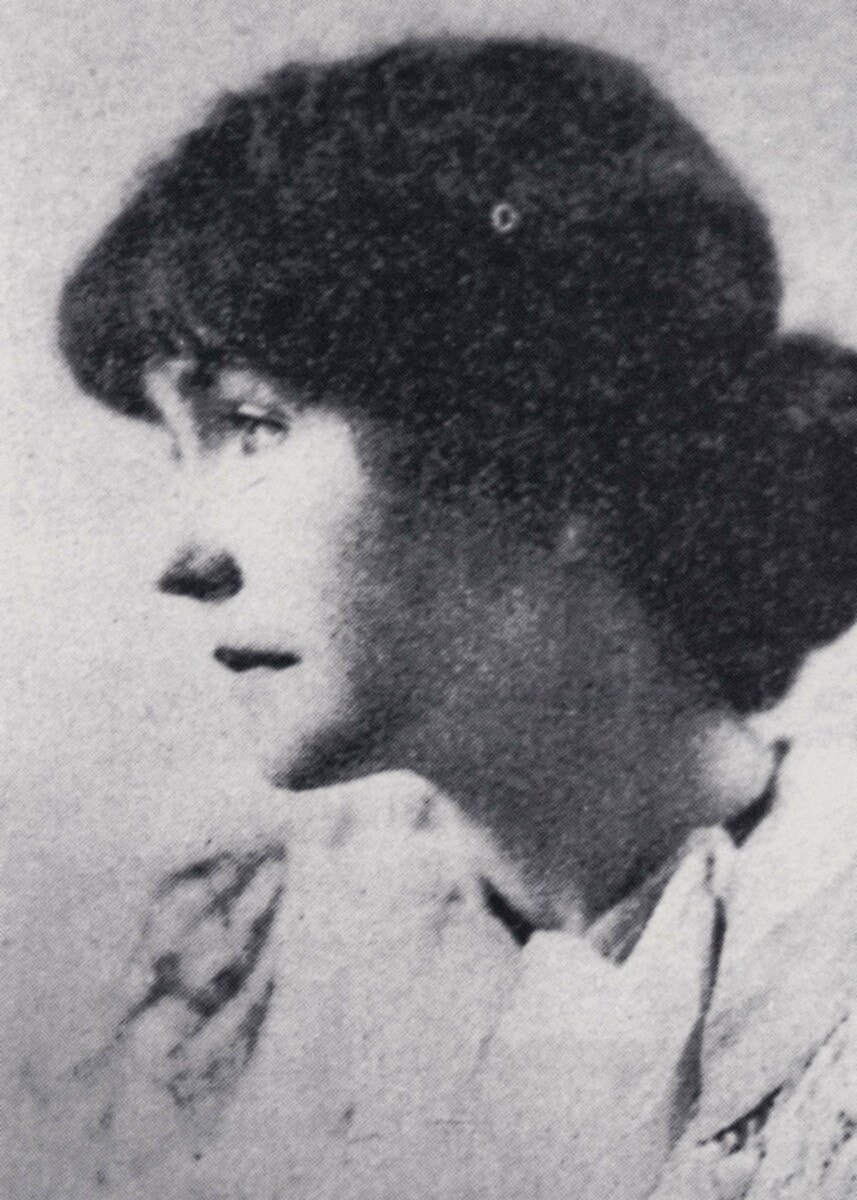 Agnes Tobin (May 29, 1863 - February 20, 1939) was born on May 29, 1863, in San Francisco, California, to Richard Tobin and Mary Ann Regan Tobin. She
was the third of twelve children in a prominent, deeply Catholic family. Her father, an Irish immigrant who spent part of his youth in Chile, became a
self-made man, co-founded and served as president of the Hibernia Bank, and worked as secretary to Archbishop Alemany. Unusually progressive for the
era, her father strongly believed in educating women. Agnes excelled early in history, mathematics, and foreign languages at a local private school
before attending the newly established Stanford University, where she mastered Latin, Greek, French, and Italian.
Agnes Tobin (May 29, 1863 - February 20, 1939) was born on May 29, 1863, in San Francisco, California, to Richard Tobin and Mary Ann Regan Tobin. She
was the third of twelve children in a prominent, deeply Catholic family. Her father, an Irish immigrant who spent part of his youth in Chile, became a
self-made man, co-founded and served as president of the Hibernia Bank, and worked as secretary to Archbishop Alemany. Unusually progressive for the
era, her father strongly believed in educating women. Agnes excelled early in history, mathematics, and foreign languages at a local private school
before attending the newly established Stanford University, where she mastered Latin, Greek, French, and Italian.
Spending much of her adult life abroad, Tobin drifted between San Francisco, Paris, and London. In London, she became an integral part of elite
literary circles, residing for a time with the prominent writers and editors Wilfrid and Alice Meynell at
their Palace Court home. Described by contemporaries as "beautiful and aloof", Tobin cultivated deep friendships with the era’s greatest minds. Irish
poet William Butler Yeats famously acclaimed her as "the greatest poet that America has produced since
Walt Whitman," while Joseph Conrad dedicated his novel Under Western Eyes to her.
Tobin’s primary literary contributions lay in translation, seamlessly bridging classical and Renaissance European texts into English poetry. Her
notable publications included Love's Crucifix: Nine Sonnets and a Canzone (1902), featuring translations of Francesco Petrarch with a preface by Alice
Meynell. She also translated works by Dante, classical Greek tragedians Euripides and Sophocles, and produced a celebrated blank-verse adaptation of
Racine’s Phèdre. Beyond writing, she was noted for her patronage of the arts and philanthropic acts, including overseeing the creation of a Holy Family
statue for San Francisco in 1895.
Agnes Tobin's collaboration with the British artist, designer, and writer W. Graham Robertson
resulted in one of the most aesthetically unified and celebrated artifacts of her literary career: the 1902 publication Love's Crucifix: Nine Sonnets
and a Canzone from Petrarch. Published by William Heinemann in London, Love's Crucifix brought together three central figures of Tobin’s inner London
circle: Tobin as translator, her close mentor Alice Meynell providing the preface, and Graham Robertson serving as the illustrator. Robertson was a
prominent figure in fin-de-siècle artistic circles—known as a friend of Oscar Wilde, an acolyte of theatrical
legends like Sarah Bernhardt and Ellen Terry, and an avid
collector of William Blake. His artistic sensibility deeply complemented Tobin's refined, classical approach to translation. For this volume, Robertson
provided ten full-page plates, rendered with his characteristic strength of line. Robertson's illustrations for Tobin's translations leaned into a
delicate, sensual, and classical aesthetic that mirrored the emotional intensity and spiritualized romanticism of Petrarch’s 14th-century verse. In
addition to the full-page plates, Robertson designed ten intricate pictorial initials and title-page elements printed in nuanced shades of green and
black. The book itself was designed as a fine-press luxury object, released in a limited edition featuring paper boards with yapp edges and delicate
ribbon ties—hallmarks of the aesthetic and decadent book-production values popular among elite London literary circles at the turn of the
century. Through Love's Crucifix, Tobin and Robertson successfully fused poetry and visual art, capturing the elegiac tone of Renaissance humanism
through the lens of Edwardian aestheticism.
After surviving the devastation of the 1906 San Francisco Earthquake (which destroyed her family's Nob Hill home) and extensive European
travels—including tending to the poet Arthur Symons during his 1908 mental collapse in Italy—Tobin
permanently returned to the San Francisco Bay Area in 1924. She lived a quiet, retired life until her death on February 20, 1939, at the age of 75. She
never married.
While Agnes Tobin’s life predates modern LGBTQ+ terminology, contemporary literary scholarship frequently examines her life through the lens of
nineteenth-century "romantic friendships" and female homosocial networks.
Her most profound and passionate relationship was with the married English poet and essayist Alice Meynell. After meeting Meynell in London in 1895,
Tobin became deeply infatuated, writing lines such as, "I seem to have been waiting for you all my life," and identifying Meynell as her supreme
literary, spiritual, and emotional anchor. Meynell affectionately nicknamed Tobin "Lily," and the two maintained an intense, emotionally codependent
bond that occasionally sparked jealousy among mutual acquaintances, such as fellow writer Katharine Tynan.
Tobin’s devotion to Meynell, her choice never to marry men, and her immersion in queer-adjacent fin-de-siècle aesthetic circles place her firmly
within discussions of historic women who subverted Victorian domestic norms to prioritize female-centric intellectual and emotional devotion.
References:
- Tobin, Agnes (Trans.). Love's Crucifix: Nine Sonnets and a Canzone. With contributions by Alice Meynell and illustrations by W. Graham Robertson. London: William Heinemann, 1902. (A foundational translation of Francesco Petrarch's 14th-century poetry).
- Tobin, Agnes. The Flying Lesson: And Other Verses. London: Chiswick Press, 1905.
- Tobin, Agnes (Trans.). A Pamphlet of Sonnets. London: Printed for private distribution, 1906.
- Tobin, Agnes (Trans.). Phedre. (A blank-verse translation of Jean Racine's classical play, completed over two years of preparation and dedicated to her sister, Celia Tobin Clark).
- Conrad, Joseph. Under Western Eyes. London: Methuen & Co., 1911. (Bearing the famous dedication: "To Agnes Tobin, who brought to our door her genius for friendship from the uttermost shores of the West").
- Yeats, William Butler. Correspondence with Agnes Tobin (collected in archival epistolary records documenting his high praise, famously calling her "the greatest poet that America has produced since Walt Whitman").
- San Mateo County Historical Association / History Museum of San Mateo County: Holds biographical and historical profile collections detailing Agnes Tobin’s life, family background on Nob Hill, and her connection to the San Francisco Sisters of the Holy Family.
- Holy Cross Catholic Cemetery (Colma, California): Interment and monumental registers documenting her birth (May 29, 1863), death (February 20, 1939), and the preservation of the Holy Family statue.
- HathiTrust Digital Library & Project Gutenberg: Digital repositories hosting electronic editions of Love's Crucifix and her collaborative publications with Alice Meynell and W. Graham Robertson.
- "Catholicism and Ideal Womanhood in Fin-de-Siècle Women's Poetry." Published in Project MUSE. (Academic analysis examining Agnes Tobin’s passionate devotion to Alice Meynell ("Lily"), her integration into elite European/London literary salons, and her position within fin-de-siècle women's homosocial and homoromantic networks).
- Atherton, Gertrude. Adventures of a Novelist. (Memoirs featuring firsthand accounts of encountering the "beautiful and aloof" Agnes Tobin at the Meynells' London Sunday salons).
Support this project
This website is a passion project researched, developed, and funded entirely by me. If you find the content valuable and would like to help support the ongoing research and hosting costs, any contribution is deeply appreciated.
Thank you for keeping this independent resource alive!
My books on Amazon: Elisa Rolle's books
BACK TO HOME PAGE