Queer Places:
Yellow Palace, Amaliegade, 1256 København, Denmark
Bernstorff Palace, Jægersborg Alle 93, 2820 Gentofte, Denmark
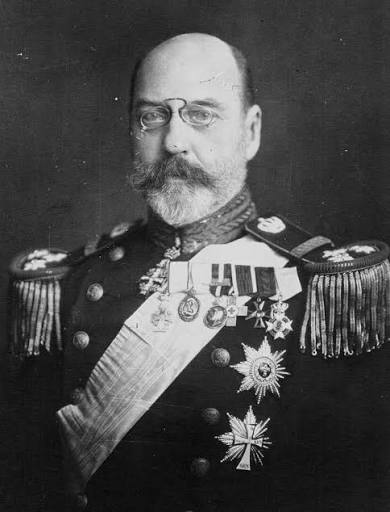 Prince Valdemar of Denmark (October 27, 1858 – January 14, 1939) was born on October 27, 1858, at the Yellow Palace in Copenhagen, as the youngest child and fifth son of
King Christian IX of Denmark and Queen Louise of Hesse-Kassel. As a member of the House of Glücksburg, he belonged to one of the most prominent royal families in Europe,
making him the brother of King Frederick VIII of Denmark, King George I of Greece, Queen Alexandra of the United Kingdom, and Empress Maria Feodora of Russia.
Prince Valdemar of Denmark (October 27, 1858 – January 14, 1939) was born on October 27, 1858, at the Yellow Palace in Copenhagen, as the youngest child and fifth son of
King Christian IX of Denmark and Queen Louise of Hesse-Kassel. As a member of the House of Glücksburg, he belonged to one of the most prominent royal families in Europe,
making him the brother of King Frederick VIII of Denmark, King George I of Greece, Queen Alexandra of the United Kingdom, and Empress Maria Feodora of Russia.
Choosing a career in the military, Valdemar dedicated his life primarily to the sea, entering the Danish Royal Navy and rising through the ranks to ultimately become an
Admiral of the Fleet. Unlike several of his brothers, he showed little ambition for foreign thrones, turning down opportunities such as the crown of Bulgaria. Throughout his
life, he resided principally at the Bernstorff Palace near Copenhagen, which became a central gathering place for his extended family.
In 1885, Valdemar married Princess Marie of Orléans in a dynastic union. The couple had five children: Princes Aage, Axel, Erik, Viggo, and Princess Margrethe. Despite
fulfilling his dynastic obligations through marriage and fatherhood, Valdemar's personal life and private affections were deeply anchored elsewhere.
Valdemar is a significant figure in modern LGBTQ European royal history due to his lifelong, intimate relationship with his nephew, Prince
George of Greece and Denmark. In 1883, the teenage George was sent from Greece to Denmark to embark on a naval
career and was placed under the direct mentorship and care of Valdemar. Overwhelmed by a sense of abandonment upon parting from his parents, George found profound comfort
when Valdemar took his hand—a moment George later described as a revelation that defined his entire emotional life.
What began as a familial mentorship quickly blossomed into an intense, lifelong romantic bond. Valdemar and George maintained their passionate relationship for decades,
living together for extended periods at Bernstorff Palace and vacationing together. Their connection persisted unchanged through their respective later lives, marriages, and
international political duties. Even when George married Princess Marie Bonaparte in 1907, the deep intimacy between uncle and nephew remained uninterrupted, with Valdemar
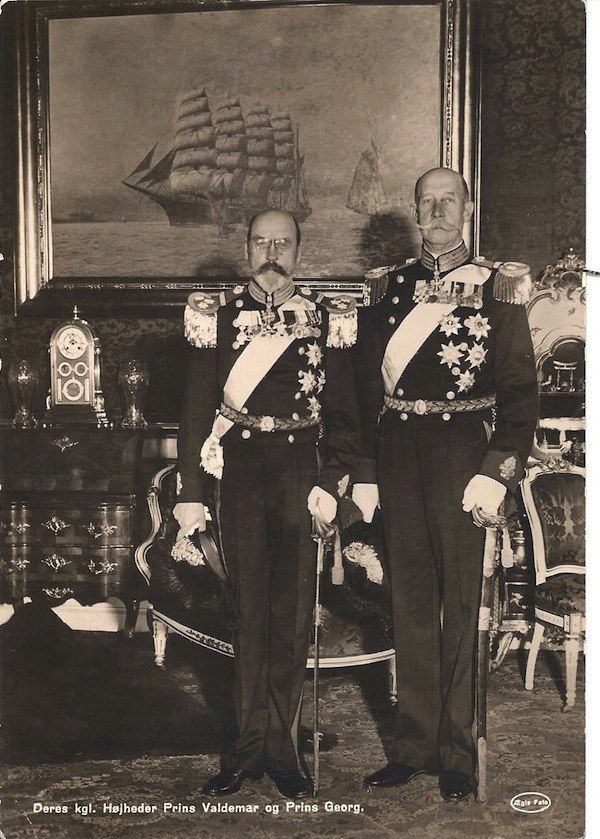
even accompanying the newlyweds on parts of their journey. Within the family, this unique bond was treated with a remarkable degree of normalization and acceptance, and the
two men were frequently photographed together without hesitation.
Prince Valdemar passed away on January 14, 1939, at Bernstorff Palace at the age of 80, outliving most of his generation of European royals. The profound depth of their
lifelong connection was immortalized when Prince George died years later in 1957; George's final resting place at the Tatoi Royal Cemetery included not only Greek and Danish
flags, but also a lock of Prince Valdemar's hair, a photograph of Valdemar, and a handful of earth brought from the Bernstorff estate.
References:
- Madol, Hans Roger. Kongernes Onkel: Prins Valdemars Erindringer. Copenhagen, 1938. (A richly illustrated contemporary biography and memoir featuring recollections of Prince Valdemar).
- Bramsen, Bo. Huset Glücksborg. Europas svigerfader og hans efterslægt. 2nd ed. Copenhagen: Forlaget Forum, 1992. (The standard comprehensive genealogical history of the House of Glücksburg).
- Lerche, Anna, and Marcus Mandal. A Royal Family: The Story of Christian IX and his European descendants. Copenhagen: Aschehoug, 2003.
- Finestone, Jeffrey. The Last Courts of Europe: A Royal Family Album 1860-1914. London: J. M. Dent and Sons Ltd, 1981.
- Montgomery-Massingberd, Hugh. Burke's Royal Families of the World, Vol. 1. London: Burke's Peerage, 1977.
- Bertin, Celia. Marie Bonaparte: A Life. New York: Harcourt Brace Jovanovich, 1982. (Details the dynamics of Prince George's marriage to Marie Bonaparte, documenting the lifelong domestic and emotional partnership between George and his uncle Prince Valdemar based on family archives and psychoanalytical papers).
Support this project
This website is a passion project researched, developed, and funded entirely by me. If you find the content valuable and would like to help support the ongoing research and hosting costs, any contribution is deeply appreciated.
Thank you for keeping this independent resource alive!
My books on Amazon: Elisa Rolle's books
BACK TO HOME PAGE