Queer Places:
Libreria Antiquaria Umberto Saba, Via San Nicolò, 30b, 34121 Trieste TS, Italy
Cimitero di Sant'Anna, Via Costalunga, 206, 34149 Trieste TS
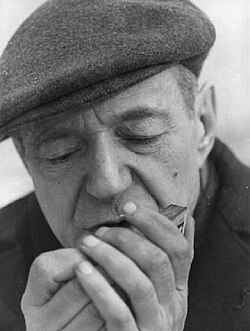 Umberto Saba (March 9, 1883 – August 26, 1957), born Umberto Poli on March 9, 1883, in Trieste, Austria-Hungary, was one of the defining Italian poets
and authors of the twentieth century. He was the son of Ugo Edoardo Poli, a commercial agent of Venetian origins, and Felicita Rachele Coen, a Jewish
woman from a wealthy Triestine family and niece of the scholar Samuel David Luzzatto. Saba’s father abandoned the family before his birth, prompting a
reunion only two decades later, which left Saba to be raised initially by a Slovenian Catholic nurse, Gioseffa Gabrovich Schobar, affectionately known as
Peppa Sabaz. The deep emotional affection he felt for his nurse, whom he viewed as a mother of joy, stood in sharp contrast to the melancholic
household of his mother and aunts upon his return. This early separation became a central psychological trauma explored in his later poetry, notably in
Il piccolo Berto.
Saba’s formal education was irregular. He attended the Dante Alighieri gymnasium and briefly studied at the Imperial Royal Academy of Commerce and
Navigation before leaving to apprentice with a flour merchant—an experience that provided background for his prose writing. Around 1900, he began writing
poetry while immersing himself in classic Italian literature, particularly the works of Giacomo Leopardi. In
1903, he moved to Pisa to take courses in archaeology, German, and Latin, during which time he suffered his first major attack of neurasthenia. By 1905,
he was living in Florence, engaging with the literary circles of the magazine La Voce and meeting influential figures such as Giovanni Papini, Giuseppe
Prezzolini, and Gabriele D'Annunzio. In 1907, as an Italian citizen, he served his military duty in
Salerno, an experience that inspired his collection Versi militari.
Upon returning to Trieste, he married Carolina Wölfler, whom he called "Lina" in his verse, in a 1909 Jewish ceremony, and they had a daughter,
Linuccia, the following year. By 1910, he began consistently using the literary pseudonym "Saba"—a name likely paying homage to his beloved nurse Peppa
Sabaz, while also referencing the Hebrew word saba, meaning grandfather or elder. He officially registered Saba as his surname in 1928. Saba
self-published his debut collection, Poesie, in 1911, followed by Coi miei occhi in 1912, which was later retitled Trieste e una donna. During this
period, he drafted the essay Quello che resta da fare ai poeti, advocating for an honest, unvarnished poetry focused on everyday human truth rather than
ornate rhetoric, though the piece was rejected by contemporary journals and only published decades later.
With the onset of World War I, Saba served in rear-guard and administrative military roles, including reviewing aircraft timber at the Taliedo
airfield, while facing severe psychological distress that led to hospitalization in Milan in 1918. Following the war, he purchased the antiquarian
bookstore Libreria antica e moderna in Trieste on Via San Nicolò, which became both his primary source of livelihood and a key venue in his literary
life. Under the bookstore's imprint, he published the first comprehensive iteration of his masterwork, Il Canzoniere, in 1921. Saba conceived Il
Canzoniere as an evolving narrative architecture that mirrored his life, continuously expanding, reordering, and revising the collection over thirty
years through editions in 1945, 1948, 1957, and 1961.
During the late 1920s and early 1930s, severe nervous crises led Saba to undergo psychoanalysis in Trieste with Dr. Edoardo Weiss, a student of
Sigmund Freud. This psychological exploration deeply informed his writing, aiding him in examining childhood
conflicts, identity, and personal neuroses. During this era, his standing grew among a younger generation of Italian writers, and he cultivated warm
friendships and mentorships within literary circles. In particular, Saba formed a close bond with the young bisexual poet
Sandro Penna, acting as a key literary mentor and helping Penna achieve publication for his early work. Over
time, Saba accumulated a distinguished circle of literary friends and admirers, including the novelists Elsa Morante, Alberto Moravia,
Giovanni Comisso, Pier Antonio Quarantotti Gambini, and the critic Giacomo Debenedetti.
Saba's life was severely disrupted in 1938 by the anti-Semitic racial laws enacted under Mussolini's Fascist regime. Being of Jewish ancestry on his
mother's side, he was forced to transfer formal ownership of his beloved bookstore to his clerk, Carlo Cerne, and briefly flee to Paris. After returning
to Italy in 1939, he lived precariously in Trieste and Rome before going into hiding in Florence after the 1943 armistice. During this perilous period,
fellow poet Eugenio Montale risked his own safety to visit and comfort Saba daily in his temporary shelters.
Following World War II, Saba achieved widespread critical acclaim. He was awarded the prestigious Viareggio Prize in 1946 for his poetry, followed by
the Taormina Prize and the Accademia Nazionale dei Lincei award in 1951, as well as an honorary doctorate from the University of Rome La Sapienza in
1953. Alongside his poetry, he published insightful prose, including the aphorisms Scorciatoie e raccontini and Storia e cronistoria del Canzoniere, an
extensive self-commentary written in the third person under the pseudonym Giuseppe Carimandrei.
In the final decade of his life, Saba addressed themes of homoeroticism and personal awakening in his unfinished, highly autobiographical novel
Ernesto, written in 1953. Set against the backdrop of late 19th-century Trieste, the novel recounts the emotional and sexual maturation of a young boy
through his relationships, including an early formative affair with an older man. Although Saba instructed that the manuscript be destroyed, his daughter
preserved the text, and it was published posthumously in 1975, quickly becoming recognized as a landmark work of Italian LGBTQ+ literature.
Weakened by recurring illness and grieved by the death of his wife Lina in November 1956, Saba spent his final months in a clinic in Gorizia. He
passed away on August 25, 1957, at the age of 74, and was interred at the Sant'Anna Monumental Cemetery in his beloved Trieste, the city whose ordinary
streets, ordinary people, and quiet beauty he immortalized throughout his career.
References:
Other references:
- Saba, Umberto. Tutte le poesie. Edited by Arrigo Stara, essays by Mario Lavagetto, Milano: Mondadori (I Meridiani), 1988. (The definitive collection of his poetic output, including all iterations of "Il Canzoniere").
- Saba, Umberto. Tutte le prose. Edited by Arrigo Stara, essay by Mario Lavagetto, Milano: Mondadori (I Meridiani), 2001. (Contains his autobiographical novel "Ernesto," "Scorciatoie e raccontini," "Storia e cronistoria del Canzoniere," and other short prose).
- Saba, Umberto. Ernesto. Milano: Einaudi, 1975. (Posthumously published autobiographical novel detailing adolescent awakening and homoerotic relationships in late 19th-century Trieste).
- Saba, Umberto. Storia e cronistoria del Canzoniere. Milano: Mondadori, 1948. (Self-critical commentary written in the third person under the pseudonym Giuseppe Carimandrei).
- Saba, Umberto. Songbook: The Selected Poems of Umberto Saba. Translated by George Hochfield and Leonard Nathan, New Haven: Yale University Press, 2008.
- Saba, Umberto. Ernesto. Translated by Mark Thompson, New York: Carcanet / Carcanet Press, 1987.
- Saba, Umberto. History and Chronicle of the Songbook. Translated by Stephen Sartarelli, New York: Sheep Meadow Press, 1998.
- Saba, Umberto. The Stories and Recollections. Translated by Estelle Gilson, New York: Sheep Meadow Press, 1993.
- Debenedetti, Giacomo. Saggi critici. Milano: Marsilio, 1929 / Reissued 1999. (One of the earliest and most influential critical evaluations of Saba's poetic voice).
- Jattoni Dall'Asén, Massimiliano. Umberto Saba e l'omosessualità nel "Canzoniere". Milano, 2004. (Focuses on homoerotic themes, codes, and classical allusions in Saba's poetry and prose).
- Lavagetto, Mario. La gallina di Saba. Einaudi, 1974. (Important psychoanalytic critique examining Saba’s prose, early childhood trauma, and imagery).
- Mattioni, Stelio. Storia di Umberto Saba. Milano: Camunia, 1989. (A detailed biographical examination of Saba's life, career, and time spent running his antiquarian bookshop in Trieste).
- Portinari, Folco. Umberto Saba. Milano: Mursia, 1963. (Comprehensive introduction to the thematic and structural elements of his verse).
- Saba, Umberto & Penna, Sandro. Lettere 1929–1940. Edited by Roberto Deidier, Milano: SE, 1995. (Correspondence detailing Saba’s role as a mentor and publisher advocate for the younger poet Sandro Penna).
- Saba, Umberto. Epistolario. Edited by Linuccia Saba and Nora Baldi, Milano: Mondadori, 1959. (Collection of letters documenting his relationships with Elsa Morante, Alberto Moravia, Eugenio Montale, and contemporary literary figures).
- Cepach, Riccardo (Ed.). Quanto hai lavorato per me, caro Fortuna! Lettere e amicizia fra Umberto Saba e Aldo Fortuna (1912–1944). Trieste: MGS Press, 2007.
- Centro per gli studi sulla tradizione manoscritta di autori moderni e contemporanei (Centro Manoscritti) – Università di Pavia: Houses Saba’s original manuscripts, letters, notebooks, and archival documents.
- Museo LETS (Letteratura Trieste) & Civic Library "Attilio Hortis" (Trieste): Holds extensive photographic archives, rare first editions, personal correspondence, and artifacts from Saba's life and his antiquarian bookstore (Libreria Antiquaria Umberto Saba).
Support this project
This website is a passion project researched, developed, and funded entirely by me. If you find the content valuable and would like to help support the ongoing research and hosting costs, any contribution is deeply appreciated.
Thank you for keeping this independent resource alive!
My books on Amazon: Elisa Rolle's books
BACK TO HOME PAGE
