Queer Places:
Cimitero Monumentale di Verona, Piazzale del Cimitero, 1, 37133 Verona VR
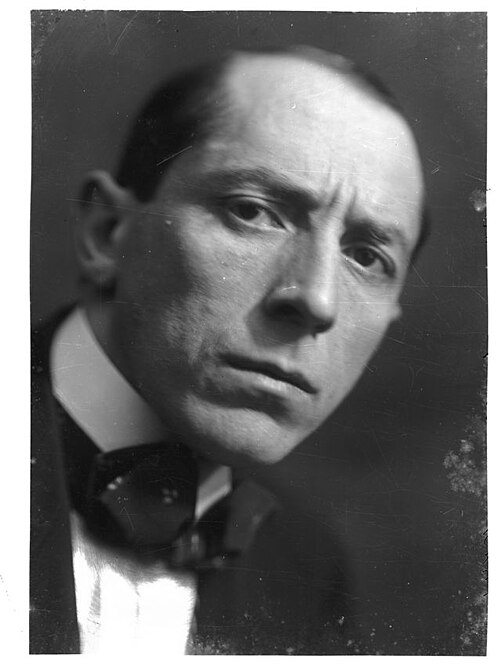 Umberto Boccioni (October 19, 1882 – August 17, 1916) was born on October 19, 1882, in Reggio Calabria, Italy. Due to his father’s work as a prefecture
usher, his family moved frequently during his childhood, relocating to Forlì, Genoa, and Padua. By 1897, the family split when Boccioni and his father
moved to Catania, Sicily, where Boccioni completed his technical studies, wrote his first novel, Pene dell'anima, and contributed to local
newspapers.
In 1901, he moved to Rome to join his father and began taking art lessons, eventually studying under the Divisionist painter Giacomo Balla alongside
his peers Gino Severini and Mario Sironi. Seeking broader artistic horizons, Boccioni traveled to Paris in 1906, where he formed a relationship with
Augusta Popoff, who gave birth to their son, Pëtr, in early 1907. Later that year, after brief periods in Russia and Venice, Boccioni settled in Milan.
Recognizing the city's industrial dynamism, he befriended artists like Romolo Romani and Gaetano Previati, experimenting with Symbolism and visiting
museums to study classical masters such as Michelangelo, whose work both inspired him and later served as a target for his anti-passatist critiques.
In 1910, Boccioni met the poet Filippo Tommaso Marinetti and became a founding figure of the Futurist movement. Co-authoring the Manifesto of Futurist
Painters and the Technical Manifesto of Futurist Painting alongside Carrà, Russolo, Balla, and Severini, Boccioni sought to reject past traditions in
favor of capturing modern life, speed, and technology. Works like The City Rises (1910), States of Mind (1911), and Dynamism of a Cyclist (1913) showcased
his mastery of dynamic forms, complementary colors, and continuous motion. Boccioni expanded these theories into three dimensions, authoring the Manifesto
of Futurist Sculpture (1912) and producing iconic works such as Unique Forms of Continuity in Space (1913), which explored the interaction of a moving
object with surrounding space using nontraditional materials.
When World War I broke out, Boccioni, an ardent interventionist, enlisted in the Volunteer Cyclists and Motorists Corps in 1915. During a period of
leave in mid-1916, he visited Villa San Remigio on Lake Maggiore, where he painted a portrait of the Italian composer
Ferruccio Busoni and developed a close relationship with noblewoman Vittoria Colonna Caetani. Shortly after
returning to duty, Boccioni was thrown from his horse during a military training exercise in Chievo, near Verona, and was trampled. He died from his
injuries on August 17, 1916, at the age of 33, and was buried at the Cimitero Monumentale di Verona.
While Boccioni’s public life and documented relationships primarily involved women—such as Augusta Popoff and Vittoria Colonna Caetani—his name is
linked to LGBTQ history through a notable account involving the Italian composer Ferruccio Busoni.
Busoni, though married, was described as bisexual by his pupil, the renowned pianist Egon Petri. Petri alleged that he once walked in on Busoni and
Boccioni together in bed. This anecdote forms the primary basis for discussions regarding Boccioni's potential bisexual relationships, linking the
prominent Futurist visual artist directly to the broader queer cultural history of early 20th-century European art and music circles.

Portrait of Busoni by Umberto Boccioni, 1916 (in the collection of the Galleria Nazionale d'Arte Moderna, Rome)
- Boccioni, Umberto et al. "Manifesto dei pittori futuristi" (Manifesto of Futurist Painters), Milan, February 11, 1910.
- Boccioni, Umberto et al. "La pittura futurista. Manifesto tecnico" (Futurist Painting: Technical Manifesto), Milan, April 11, 1910.
- Boccioni, Umberto. "Manifesto tecnico della scultura futurista" (Technical Manifesto of Futurist Sculpture), Milan, April 11, 1912.
- Boccioni, Umberto. Pittura e scultura futuriste (dinamismo plastico) (Futurist Painting and Sculpture: Plastic Dynamism), Edizioni Futuriste di «Poesia», Milan, 1914.
- Boccioni, Umberto. Altri scritti editi e inediti, edited by Zeno Birolli, Feltrinelli, Milan, 1971.
- Calvesi, Maurizio, and Ester Coen. Boccioni: L'opera completa. Mondadori Electa, Milan, 1983.
- Calvesi, Maurizio, and Alberto Dambruoso. Umberto Boccioni. Catalogo generale. Umberto Allemandi Editore, Turin, 2016.
- Coen, Ester. Umberto Boccioni. The Metropolitan Museum of Art / Harry N. Abrams, New York, 1988.
- Taylor, Joshua C. Mussolini's Futurists: The Theory and Practice of Futurist Painting. University of Chicago Press, Chicago, 1961.
- Severini, Gino. La vita di un pittore (The Life of a Painter: The Autobiography of Gino Severini). Princeton University Press, 1995. (Provides primary details regarding Boccioni's early studies in Rome with Giacomo Balla).
- Petri, Egon. Personal recollections, correspondence, and oral accounts cited in musical biographies regarding Ferruccio Busoni. (Source for the anecdotal account involving Busoni and Boccioni).
Support this project
This website is a passion project researched, developed, and funded entirely by me. If you find the content valuable and would like to help support the ongoing research and hosting costs, any contribution is deeply appreciated.
Thank you for keeping this independent resource alive!
My books on Amazon: Elisa Rolle's books
BACK TO HOME PAGE