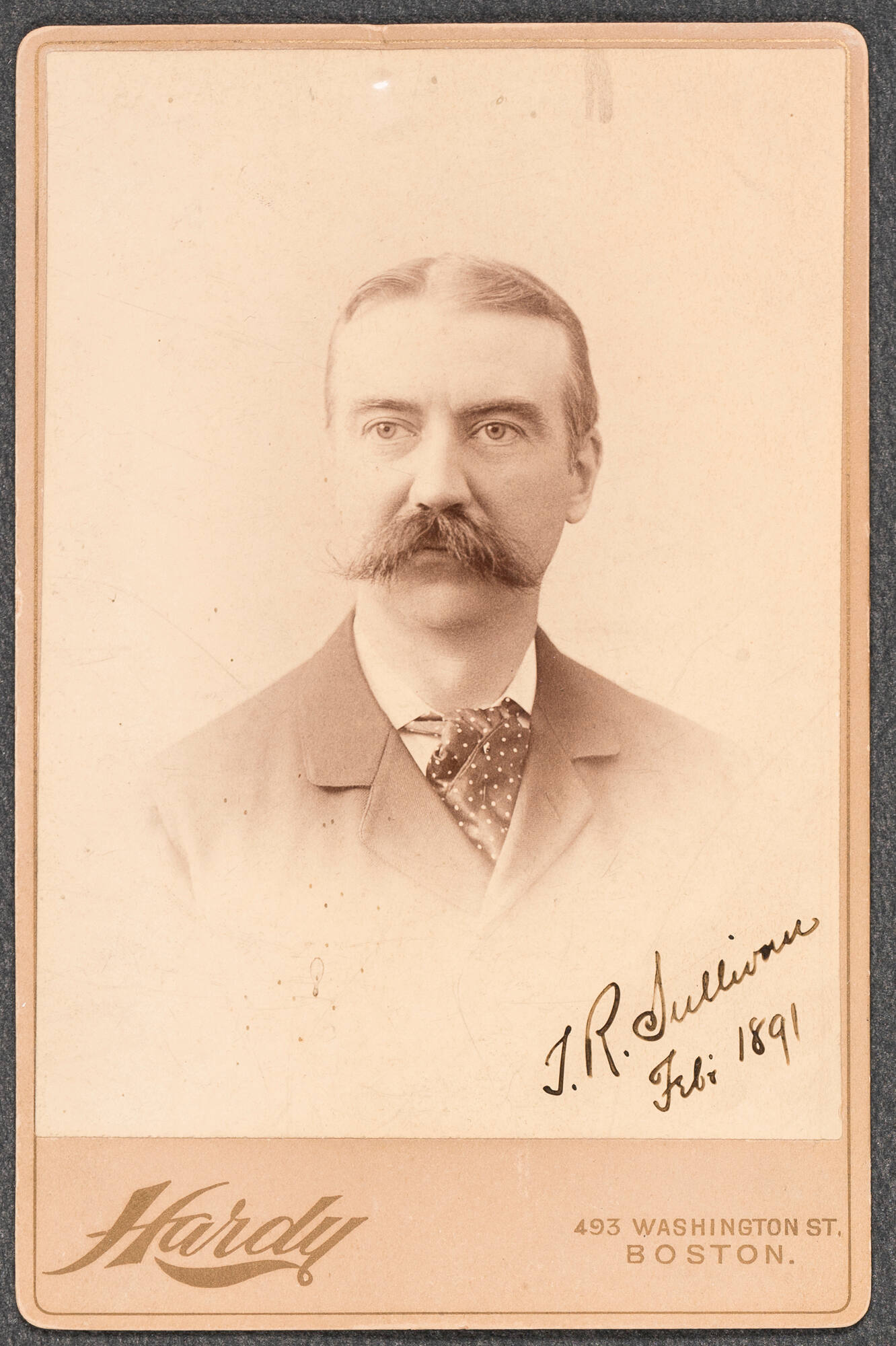
 Thomas Russell Sullivan (November 21, 1849 – June 28, 1916) was an American writer and dramatist, best remembered for his stage adaptation of Dr. Jekyll and Mr. Hyde.
Queer Places:
10 Charles St, Boston, MA 02114, USA
Mount Auburn Cemetery, 580 Mt Auburn St, Cambridge, MA 02138, United States
Thomas Russell Sullivan (November 21, 1849 – June 28, 1916) was an American writer and dramatist, best remembered for his stage adaptation of Dr. Jekyll and Mr. Hyde.
Born in Boston, Massachusetts, Sullivan was the son of Thomas Russell Sullivan, a schoolmaster and former Unitarian minister, and Charlotte Caldwell (Blake) Sullivan. His great-grandfather was James Sullivan, a former Governor of Massachusetts. Although he attended the Boston Latin School and aspired to attend Harvard University, the death of both his parents by the time he was fourteen forced him to enter the workforce to support himself.
Sullivan held various office positions, including a period working in Paris and London for the firm Bowles Brothers (1870–1873). After the firm failed, he returned to Boston and worked as a clerk at Lee, Higginson & Company. During this time, he pursued writing as a hobby, eventually transitioning to a full-time literary career following the success of his work in the theater.
Sullivan’s most notable professional achievement was his 1887 stage adaptation of Robert Louis Stevenson’s Strange Case of Dr. Jekyll and Mr. Hyde. Commissioned by actor Richard Mansfield, the play became a significant hit, allowing Sullivan to leave his banking career.
Throughout his life, he authored several novels, short story collections, and plays, often incorporating Gothic elements. His later non-fiction works, such as Boston New and Old (1912) and his posthumously published journals (Passages from the Journal of Thomas Russell Sullivan, 1891–1903), are considered valuable historical records of Boston’s literary and social culture during the late 19th and early 20th centuries.
Sullivan was an active participant in Boston's social and artistic circles. He served as the vice president of the Tavern Club from 1886 to 1908, where he was a frequent presence. He was also a member of the artistic and literary community that included figures such as Isabella Stewart Gardner, George Santayana, and Theodore Dwight. Theodore Dwight lived at 10 Charles St. in a townhouse that featured framed portraits of male nudes. He shared the space with Russell Sullivan.
In 1899, Sullivan married Lucy Wadsworth, the daughter of Dr. Oliver Fairfield Wadsworth. The couple had no children. Sullivan remained a respected figure in the Boston literary community until his death in 1916.
The membership of Boston’s artistic and literary club, the St Botolph Club (1879), the Tavern Club (1884), and the Club of Odd Volume (1887), was derived principally from Harvard graduates who wanted to maintain the ties they developed in the school’s social clubs and fraternities. These private men’s dining clubs also served as safe and convivial spaces where well-to-do gay members of Boston’s cultural establishment could express themselves freely and creatively. The Tavern Club, which had a distinct bohemian aura about it, counted a number of members from Isabella Stewart Gardner’s circle, including George Santayana; librarian Theodore Dwight; musicians Charles Loeffler and Timothee Adamowski; and Thomas Russell Sullivan. Tavern Club theatricals, directly descended from the cross-dressing antics of the Hasty Pudding Club, were legendary.
Thumbing her nose at respectability, Amy Lowell hosted a production of Oscar Wilde's An Ideal Husband in 1907-08 at a time when his name was never mentioned in polite society. Russell Sullivan and Berkeley Updike, two gay men, encouraged and supported her efforts.William Wigglesworth Chamberlin is noted as having “lived abroad a considerable portion of [his life]”—always suggestive in the coded discourse of the day—and seems also to have quickly abandoned the family business for journalism and—even more suggestive—the theater. In fact, at one point he formed a very successful partnership with a leading figure of Boston’s bohemian gay circles of the 1880s and 1890s, the playwright Thomas Russell Sullivan, with whom Chamberlain wrote a comedy that in 1880 enjoyed wide popularity in Boston. Entitled A Midsummer Madness, it sounds a very different type of tale from Two College Friends, more the game of reveal-and-conceal that gays were forced to play then.
A very gay blade who never married, William Sturgis Bigelow captured the attention of Thomas Russell Sullivan, himself a key player (and good friend of Isabella Stewart Gardner) in Boston’s bohemia. Sullivan once reported to Gardner: “Sturgis Bigelow, MD, has come in with hypnotic influence and carries me off to dine with him tonight, seductively, with the resident literati and tutti fruiti.” Bigelow entertained extensively and stylishly at his Beacon Street town house, but it was at Tuckernuck where he came into his own. “A scene of medieval splendor,” in Henry Adams’s words, Tuckernuck was a large country house in an island paradise off Nantucket “where men,” in John Crowley’s words, “took their ease, often naked, in an untamed natural setting.” The rule was no clothes at all until dinner, when, of course, one was expected to appear in formal dress. The guest list included not only Sullivan and, whenever he was visiting the East, Charles Warren Stoddard, but also vigorous young men like the Harvard poet George Cabot Lodge, son of Senator Henry Cabot Lodge, and perhaps Stoddard’s closest friend in Boston, Theodore Dwight.
References:
Other references:
Support this project
This website is a passion project researched, developed, and funded entirely by me. If you find the content valuable and would like to help support the ongoing research and hosting costs, any contribution is deeply appreciated.
Thank you for keeping this independent resource alive!
My books on Amazon: Elisa Rolle's books